Toast handles the order once someone takes it. That's the catch. When your staff is slammed and the phone keeps ringing, no POS in the world steps in to answer it. We're going to walk through how AI phone answering for Toast restaurants fills that gap and pushes orders straight into Toast, the same way your counter staff would.
TLDR:
It's 7:40 on a Friday and three callers are ringing through while your counter staff is heads-down building tickets. Toast is doing its job. It's routing orders to the kitchen, firing tickets to the KDS, and taking payment cleanly. What it can't do is pick up line two. Roughly 30% of restaurant calls go unanswered during peak hours, and research frequently attributed to BIA/Kelsey suggests roughly 85% of callers whose calls go unanswered do not call back, which turns each missed call into lost restaurant revenue that walks for good.
Toast's strengths in order entry, KDS routing, and payment processing only activate once a staff member is free to engage with the guest. During the dinner rush, that handoff rarely happens. The person who would take the call is already ringing up a walk-in or expediting a delivery bag, so the phone rings out. That gap shows exactly how POS integration impacts restaurant workflow when phone coverage breaks down.
The math stacks up fast. A single location fields around 150 missed calls a month, and each one is a $35 to $85 order that either lands with a third-party app taking third-party delivery commissions of 15% to 30%, or is lost entirely. HungerRush research estimates that those missed calls can add up to over $27,000 in lost revenue per year. For Toast restaurants, the POS is already wired to receive that order. The break happens upstream, at the phone.
| Metric | Estimated figure | Source / Context |
|---|---|---|
| Calls missed per restaurant per month | ~150 | Industry estimate |
| Missed calls during peak hours | ~30% | Industry estimate |
| Callers who do not call back after no answer | ~85% | Industry research, frequently attributed to BIA/Kelsey |
| Average phone order value | $48 | Industry estimate vs. $41 online |
| Third-party delivery base commission | 15-30% (30-40% all-in) | Industry estimate |
Toast operators regularly field high call volumes during peak meal periods, which creates the staffing pressure behind those missed calls.
The distinction that matters for a Toast restaurant is direction. Generic phone answering takes a message. Loman reads live from Toast and writes back into it, with no staff member bridging the gap.
Loman connects to the Toast menu in real time, which is the foundation of Toast POS and voice AI integration. If the spicy chicken sandwich was 86'd at 6:45 p.m., the AI already knows and never quotes it, so no one has to leave a table to fix the order. Price changes, daily specials, and modifier availability all update the moment Toast reflects them. A caller asking for "extra sauce on the side, no onions, add jalapenos" gets accurate confirmation because Loman reads Toast's modifier logic, not a static menu file.
Once the caller confirms, Loman pushes the ticket straight into Toast, which is the core of restaurant AI phone POS integration, and it lands on the KDS like any counter or kiosk order. The kitchen sees no difference. Payment happens in the call through the Toast integration, so the order arrives as a paid, closed ticket. No callback, no re-keying, no loose ends at pickup.
Take a modifier-heavy order: half pepperoni, half mushroom, thin crust, extra cheese, large. Each modifier maps to the correct Toast line item. When Loman detects an item is out, it offers the next closest option without dead air. AI upselling in restaurants works like this: prompts like "Would you like to add a two-liter for $3?" fire off the live Toast menu, lifting the average ticket with no staff involvement.
Follow one call the whole way through. The phone rings, Loman answers within seconds, and takes the full order with every modifier attached. It confirms a pickup time against Toast's current queue, takes payment on the call, and fires the ticket to the KDS. What the kitchen sees is a clean Toast ticket, indistinguishable from one a staffer punched in at the counter. Nobody re-keys anything. Nothing needs to be balanced out at shift end. The front-of-house never had to touch the phone.
Phone orders usually break down at the modifiers. A rushed staffer scrawls "no onions" on a paper ticket, the note gets missed, and the guest gets the wrong plate. Loman maps caller language directly to Toast modifier fields, a key principle covered in the restaurant phone automation guide for operators, so "light on the sauce, well done, add a side of ranch" arrives at the KDS exactly as the line expects it, using the same modifier logic the restaurant already configured in Toast. Every special request lands in the ticket the kitchen already reads.
Reservation-heavy restaurants should note that booking workflows connect through a separate reservation system like OpenTable, not Toast directly, since Toast handles the order side.
Crust Pizza owner Nick Haselidis reports that Loman paid for itself in 10 days, a result covered in depth in AI phone agent ROI for restaurants, with calmer phones and bigger tickets. Tony Boloney's reports capturing 75 to 100 extra orders per month per location. Both are operator-reported results, and both trace back to the same order-to-Toast path capturing revenue instead of only answering calls.
Every phone order a Toast restaurant answers directly averages $48 versus $41, a ~17% revenue premium over online ordering averages that compounds weekly. Answered calls also skip the 15-30% base commission (30-40% all-in) that third-party apps charge on deflected orders. Operators using Loman have reported up to 22% higher phone revenue.
Toast handles scheduling and tip reporting, but it can't cover a dedicated phone staffer at peak. Loman replaces that variable hourly labor with a flat $199/month for unlimited concurrent calls and no per-minute charges. Operators using Loman have reported up to 17% lower restaurant labor costs using AI phone agents. DeCheco's Pizzeria runs with one fewer front-of-house staffer while revenue keeps growing, an operator-reported result.
| Revenue lever | Without Loman | With Loman |
|---|---|---|
| Average phone order value | $48 (often lost or deflected) | $48 captured direct |
| Third-party commission | 15-30% base (30-40% all-in) | $0 on direct phone orders |
| Concurrent calls | Limited by staff | Unlimited |
| Phone labor cost | Variable hourly | Flat $199/month |
| Operator-reported revenue lift | Baseline | Up to 22% higher phone revenue |
Setup means connecting Loman to Toast, importing the menu, setting hours and a greeting, and configuring call-flow rules. The full picture of AI order taking for restaurants costs and workflow is covered there. No coding, no IT. Most restaurants go live in under 24 hours. Every call that rings out during tonight's dinner rush is revenue that never shows up in Toast's end-of-day report.
The gap Toast cannot fill is the one that costs real money: the phone ringing out during the dinner rush while every staffer is heads-down on the floor. Loman fills it by connecting directly to Toast, reading the live menu in real time, and pushing confirmed, paid tickets straight to the KDS the moment a caller confirms their order. Every modifier maps to the correct Toast line item. Every 86'd item gets caught before it is quoted. The kitchen sees a clean Toast ticket, indistinguishable from one punched in at the counter, with no one touching the phone to make it happen.
The operator results back that up. Crust Pizza owner Nick Haselidis reported that Loman paid for itself in 10 days, with calmer phones and bigger tickets. Tony Boloney's captures 75 to 100 extra orders per month per location, all traced back to the same direct-to-Toast order path. DeCheco's Pizzeria runs with one fewer front-of-house staff member while revenue keeps growing, an operator-reported result that reflects what happens when phone labor becomes a fixed, predictable cost instead of a variable one.
For any Toast restaurant where phone revenue matters, the math is straightforward. Loman handles unlimited concurrent calls at a flat $199/month, with no per-minute charges and no IT required. Most restaurants go live in under 24 hours. Every call that rings out tonight is a paid Toast ticket that never makes it to the KDS. Book a demo and see the integration live before the next rush.
Loman reads Toast's live menu in real time and pushes confirmed orders directly into Toast's POS and KDS as paid, closed tickets. No message-taking, no manual re-entry by staff. Every modifier, special request, and upsell lands in the same ticket the kitchen already sees, exactly as if a staffer punched it in at the counter.
Yes. Loman answers every inbound call concurrently, takes the full order with modifiers, processes payment during the call, and fires the ticket straight to Toast, all without a staff member touching the phone. Crust Pizza owner Nick Haselidis reported that Loman paid for itself in 10 days, with calmer phones and bigger tickets.
Phone orders average $48 versus $41 for online orders, a roughly 17% revenue premium. Missed calls either disappear entirely or get deflected to third-party delivery apps charging 15% to 30% in base commissions, costs that direct phone orders through Toast avoid entirely.
Slang AI is built around reservation management and guest communication. It does not publicly list full menu order-taking or direct POS ticket injection as part of its feature set. Loman handles both order taking and reservation management, with a direct Toast integration that closes the order and processes payment in the call, making it the better fit for any Toast restaurant where phone revenue is the priority.
Most Toast restaurants go live in under 24 hours. Setup involves connecting Loman to Toast, importing the menu, setting hours and a greeting, and configuring call-flow rules. No coding or IT required. White-glove setup is available for operators who want hands-on help.
The revenue gap in a Toast restaurant lives before the POS, not inside it. Your KDS, payment flow, and ticket routing all work the way they should, but none of it fires if the phone rings out during the rush. AI phone answering for Toast restaurants closes that gap: Loman answers every call, reads your live Toast menu, and delivers a clean paid ticket to the kitchen before the caller hangs up. Run a demo and see it live.
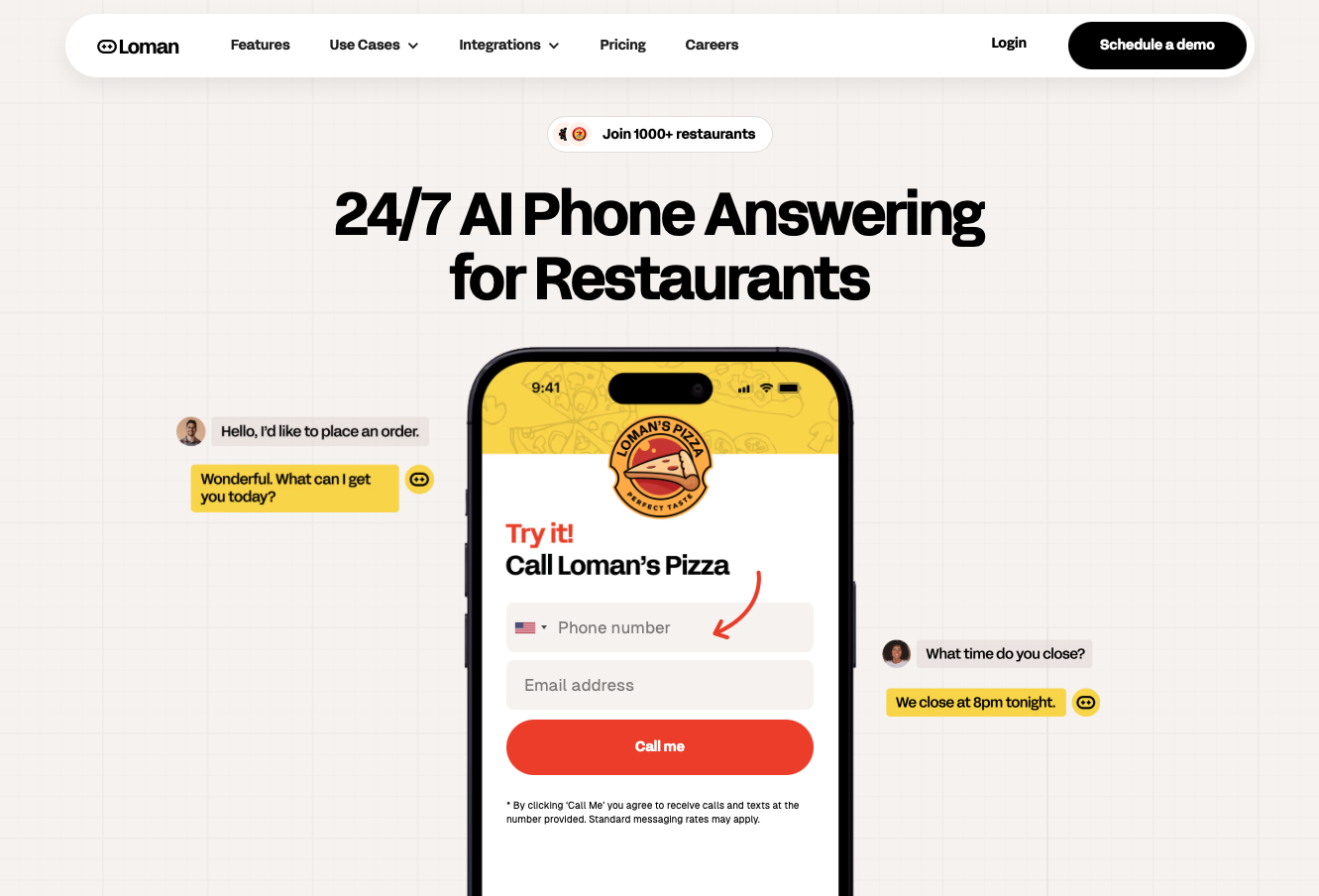
Enter your information in the form to receive a call from Loman and place an order like a customer would!

