The phone is ringing and your counter staff can see it, but their hands are full and the line is six deep. That call might be someone trying to place a $50 order or book a party for twelve, and by the time anyone gets to it, the caller is already dialing your competitor. The math on the ROI of AI phone agents for restaurants starts with 150 missed calls a month, 85 percent of whom never call back, and ends with how fast you can flip that lost revenue into profit.
TLDR:
It is 6:45 on a Friday and the phone is ringing while every staffer is buried in the dinner rush. Nobody can reach it. That moment repeats across the week, and the math adds up faster than most operators realize.
The average restaurant misses roughly 150 calls a month, about 1,800 a year. Between 60 and 70 percent of inbound calls carry order intent, so most of what goes unanswered is someone actively trying to spend money with you.
Here is the part that hurts. Research from BIA/Kelsey found 85 percent of callers will not call back after an unanswered ring. They move to the next restaurant on the list. Industry-wide, that pattern adds up to around $20 billion in lost sales every year.
When a guest calls instead of tapping through an app, they tend to spend more. Phone orders average $48 versus $41 online, a 17 percent premium that stacks up across hundreds of weekly tickets.
The gap comes down to intent. Someone who picks up the phone usually knows what they want, and they are easier to nudge toward a side, a drink, or a second entree mid-conversation. An app lets people quietly trim items before they check out.
That difference matters when you do the multiplication. Recapture 40 missed phone orders in a month at $48 each, and you are looking at real money an online channel would have undercounted by seven dollars a head. The orders you save are also your most valuable ones.
Labor is the line on your P&L you actually control, and it runs 25 to 36 percent of total revenue depending on your concept. That number is climbing. Minimum wages increased in multiple U.S. states entering 2026, adding additional pressure to restaurant labor costs, and industry turnover hovers near 73 percent, so every hour of phone duty costs more and gets harder to staff.
Now price out the phone itself. At $20 an hour including overhead, a staffer fielding calls three hours a day runs you $60 daily, roughly $1,800 a month. That is a register you are paying partly to answer the phone.
An AI phone agent flips that math. It turns a variable hourly expense into a flat software cost that does not call in sick, take breaks, or quit mid-rush.
A tired staffer at 7 p.m. forgets to ask about garlic knots. They are not being lazy. They have three tickets in hand and a line at the register, and the upsell is the first thing to drop when the rush hits.
An AI agent never has that problem. It suggests add-ons and combos on every call, with the same prompt at 7 p.m. that it used at 2 p.m. That consistency is where the lift comes from.
Restaurants running AI ordering typically see a 10 to 20 percent jump in average ticket size. On a $35 order, that is an extra $3.50 to $7.00 per transaction. Multiply that across every call in a week, and the suggestion nobody forgot starts funding the system itself.

Pulling your own numbers takes about fifteen minutes. Your call logs show how many calls go unanswered each month, and your POS gives you the average ticket to multiply against them. Add the phone hours your staff currently logs and the lift from consistent upselling, then subtract the software cost.
The model breaks into four inputs:
A 2025 Forbes article on AI restaurant hosts found restaurants pulling an extra $3,000 to $18,000 per month per location once they capture every call, upsell, and book reservations that used to slip away. For most operations, that puts the payback period under 30 days.
Break-even is the day your stacked-up recovered revenue passes your stacked-up software cost. After that, every captured order is profit.
How fast you get there depends on three numbers you already track: how many calls come in, how many you currently miss, and what the average ticket is worth. A high-volume shop dropping 200 calls a month clears the software fee in days, because recovered orders pile up quickly against a flat monthly cost. A quieter spot with lighter call traffic takes a little longer.
For most busy restaurants, that math lands somewhere inside the first 30 to 60 days. The higher your call volume, the sooner the line crosses.
Not every system clears its cost at the same speed. A few capabilities decide whether it pays back in weeks or drags.
| Capability | Why it moves ROI |
|---|---|
| Deep POS integration | Orders push straight in, so no staff re-key and no errors that cost reorders |
| Unlimited concurrent calls | Nobody hits a busy signal during the rush, where most missed orders happen |
| In-call payment | Closes the sale on the call instead of a callback that gets abandoned |
| Upsell engine | Drives the per-ticket lift covered earlier |
| After-hours capture | Catches orders when nobody is there to answer |
A year ago, most independent operators were watching from the sidelines while larger chains ran pilots. That window has closed. The question on most operators' floors now is how fast they can get a system running, not whether they should.
The data backs that shift. The restaurant voice AI market stood at roughly $10 billion and is projected to reach $49 billion by 2029 according to Mordor Intelligence. Operator sentiment has moved just as fast: nearly 94 percent of restaurant operators now say AI is necessary to stay competitive, and more than 71 percent report they plan to adopt it soon. The ones holding off are mostly weighing setup time and cost, not questioning whether it works.
The labor picture has sharpened that urgency. Minimum wages rose across more states again at the start of 2026, and turnover is still running near 73 percent industry-wide. Every hour of phone duty that costs $20 or more is an hour that gets harder to support when a flat-rate AI system can cover the same calls around the clock without overtime or no-shows.
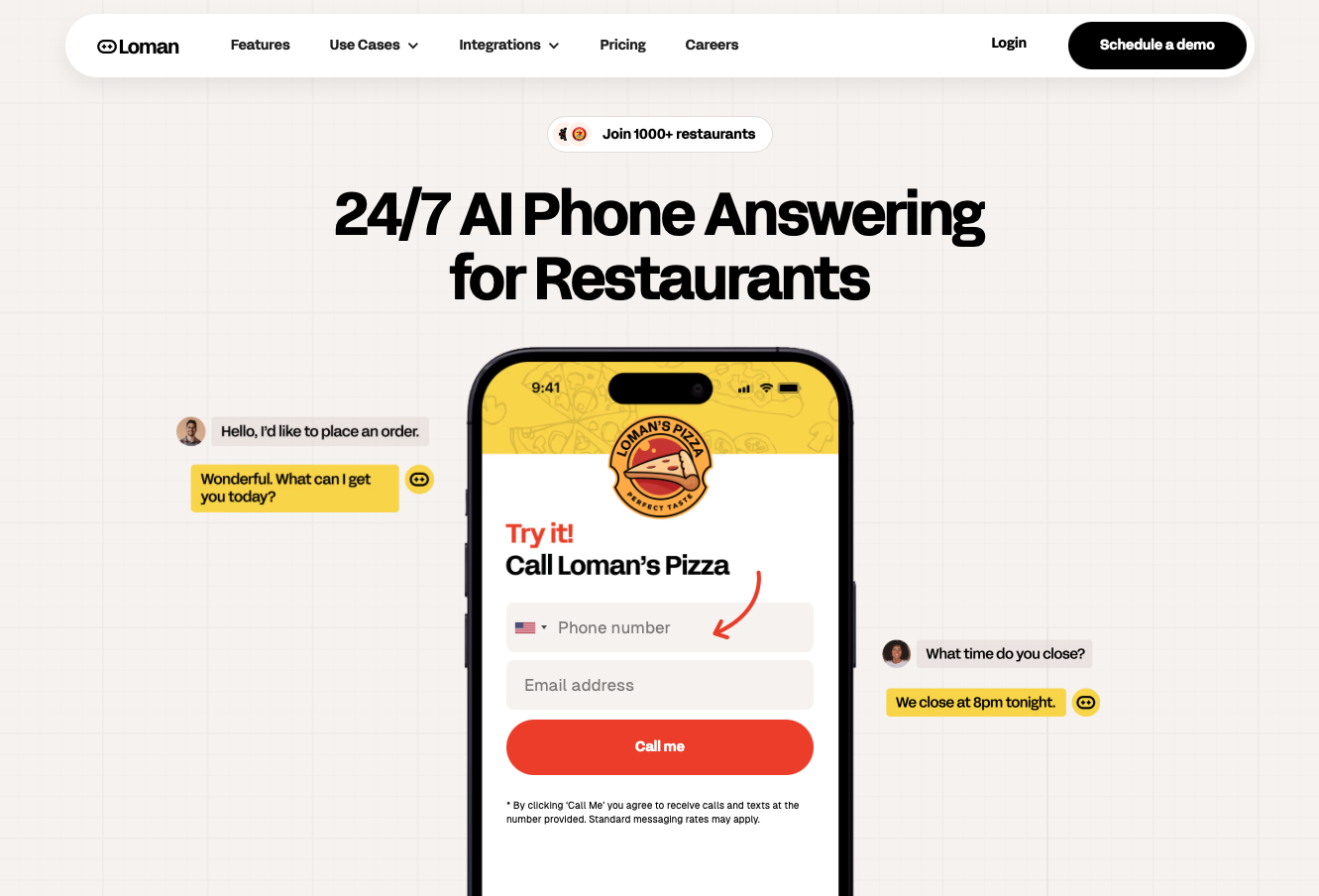
Every ROI driver above maps to something we built Loman to do. It answers 100 percent of calls with unlimited concurrent handling, so nobody hits a busy signal when your counter is slammed. It takes payment in-call, closing the sale instead of leaving an order to be abandoned on a callback.
Orders push straight into your POS through native integrations with Toast, SpotOn, Square, Clover, SkyTab, Aloha, Olo, Stream, and OpenTable. No staff re-key, no separate ticket. The built-in upselling engine prompts an add-on on every call, lifting the average ticket without anyone having to remember.
Restaurants running Loman report up to 22 percent higher phone revenue and up to 17 percent lower labor costs. Pricing starts at $199 a month with no per-minute charges, and most go live in under 24 hours.
Most restaurants recover their software cost within the first 30 to 60 days through recaptured orders, reduced labor hours, and higher average tickets. A 2025 Forbes article on AI restaurant hosts found restaurants pulling an extra $3,000 to $18,000 per month per location once they capture every call and close sales consistently.
Yes. Pull three numbers from your logs: missed calls per month, average phone ticket, and current phone hours per week. Multiply missed calls by your order intent rate (60 to 70%) and average ticket to see recovered revenue, add your labor savings from eliminated phone hours, factor in a 10 to 20% upsell lift, then subtract the software fee.
An AI phone agent takes complete orders, processes payment in-call, upsells every transaction, and pushes tickets straight into your POS with no manual re-entry. A traditional answering service takes messages or routes calls to staff who still have to close the sale manually.
Most restaurants go live in under 24 hours once menus are uploaded, hours configured, and POS connected. No coding or dedicated IT required, though white-glove setup is available if you need it.
Deep native POS integration that pushes orders straight in, unlimited concurrent call handling so nobody hits a busy signal during the rush, in-call payment that closes the sale without callbacks, and a built-in upselling engine that lifts every ticket. Systems missing any of these take longer to pay back.
Most operators hit payback before the second invoice arrives, because the orders were always there and the labor cost never stopped climbing. You just needed something that could pick up every time and close the sale without pulling staff off the floor. Loman is built to do exactly that, answering every call, closing every order, and pushing tickets straight into your POS around the clock. The ROI of AI phone agents for restaurants writes itself once you count what walks away unanswered. Watch it run on your actual menu and see how fast your own numbers add up.
Enter your information in the form to receive a call from Loman and place an order like a customer would!

