
Phone orders average $48 vs. $41 online, and research frequently attributed to BIA/Kelsey suggests roughly 85% of callers who don't get through do not call back after an unanswered call. When the dinner rush hits and staff can't reach the phone, that's lost revenue. This guide covers how restaurant phone automation works, what a real system needs, and how to run the ROI math.
TLDR:
It's 6:40 on a Friday. Three tickets are up, two guests are waiting to pay, and nobody has a free hand. So the phone rings out. That single call is an order that walked.

A QSR Magazine analysis estimates U.S. restaurants lose roughly $20 billion a year to unanswered calls, with the average location missing around 150 calls monthly and roughly 32% during the 5 to 8 PM rush.
None of this is a staffing failure. Call volume peaks exactly when your staff is buried. Both answering the phone and letting it ring come at a cost.
Restaurant phone automation is voice AI that answers your inbound calls and holds a real conversation. It takes pickup and delivery orders, books reservations, answers menu and hours questions, and pushes the result into your POS or reservation system without a staffer touching it.
| System Type | What It Does | Takes a Full Order? | Pushes to POS? |
|---|---|---|---|
| Old IVR / button menus | Routes callers through a keypad menu | No | No |
| Generic answering service | Captures a message, hands you a callback list | No | No |
| Restaurant phone automation | Holds a real conversation, closes the full order on the call | Yes | Yes |
The line worth watching is message-taking versus order closure, which is why generic AI answering falls short for restaurants. Reducing missed restaurant calls with AI starts with knowing which category you're buying.
Real-time menu sync keeps that flow accurate: if a special gets 86'd mid-shift, the AI stops offering it. The more capable AI restaurant phone agents prevent missed calls by answering unlimited simultaneous calls, so a second caller never hits a busy signal.
Every call that used to ring out is now an order on the books. The biggest share lands in the 5 to 8 PM rush, when roughly 32% of calls go unanswered, so recovered orders come back during your busiest hours.
Staff stay on tables while calls get answered in parallel. The National Restaurant Association's data on restaurant labor costs puts salaries and wages, including benefits, at a median 36.5% of sales for full-service operators and 31.7% for limited-service in 2024, so every hour of phone coverage you free up matters.
Orders route straight into the POS, so there's no re-keying a scribbled ticket. What the caller said is what the kitchen sees.
A built-in AI-powered phone agent upselling prompt suggests add-ons on every call, lifting average ticket without leaning on staff.
Every call a staffer can't take in the caller's language during the rush is another order walking out the door. Census Bureau data shows Spanish was the most common non-English language spoken in U.S. homes in 2019, at 62% of non-English speakers. A restaurant-specific voice AI agent converses bilingually or multilingually, taking the full order with correct modifiers and pushing a clean ticket straight to the POS, so language stops being the reason an order walks.
Restaurant phone automation logs every call as a transcript and tags the outcome: order placed, reservation booked, or question answered. That gives you visibility a staffer juggling the phone never could: when call volume peaks, which menu questions repeat, and how often callers say yes to an upsell.
A demo looks sharp; a Friday rush tells you the truth. A Friday rush tells you the truth. Here's what separates a tool that survives real service from one that only performs on a sales call.

Some tools handle only reservations and cannot push an order to the POS. If you take phone orders, confirm the system does both before you commit.
| Factor | Live Receptionist/Staffer | Restaurant Phone Automation |
|---|---|---|
| Availability | Business hours only | 24/7 |
| Concurrent Calls | One at a time | Unlimited |
| Cost | Hourly wage plus benefits | Fixed monthly cost, starting at $199/month |
| Consistency | Varies by shift | Same accuracy every call |
| Bilingual/Multilingual Handling | Depends on staff | Bilingual and multilingual support |
The AI answers every dinner-rush call at once. Pizza shops feel this hardest, since AI order taking for restaurants covers a large share of their volume.
Calls after the last staffer leaves still get answered and captured, no overnight shift needed.
The AI books and confirms tables around the clock without tying up a host.
Each store keeps consistent call handling and its own live menu, so pricing and 86'd items stay accurate location by location.
Start with the number you already have. Take your missed calls per month, multiply by the share that carry order intent (industry data puts this around 60 to 70%), then by your average phone order value. That's the monthly revenue at risk. Set it against a fixed monthly software cost and the gap is your first-order return. Plug your own numbers into the ROI calculator, or for a full breakdown, see AI phone agent ROI for restaurants.
Three secondary drivers add to that:
Here's a realistic sequence before you go live, with no developer required.
The setup is the easy part. Industry roundups list team training as a common barrier, so walk staff through the change first.
Pros
Cons
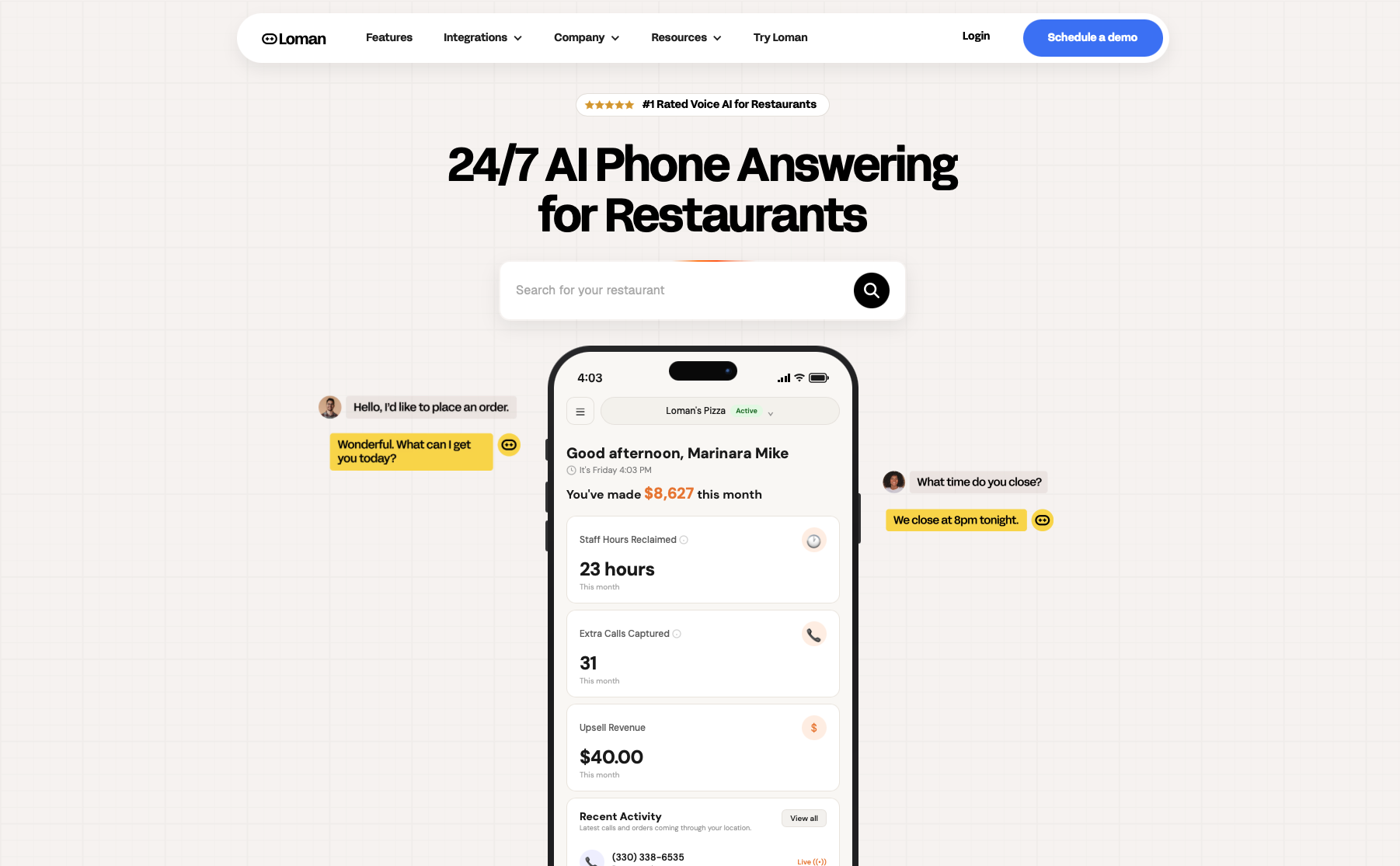
Loman AI is a voice AI phone agent built for restaurants, closing full orders into the POS instead of leaving a message behind. Operators using Loman AI have reported up to 22% higher phone revenue and up to 17% lower labor costs. Midland Pizza Co. estimates it would lose over $200,000 a year without Loman.
Operators put numbers on it:
"This paid for itself in 10 days. Phones are calm, tickets are bigger, and my team refuses to go back."
Nick Haselidis, Owner, Crust Pizza
"With Loman I'm easily able to capture an extra 75-100 orders every month per store, and for a multi-unit operator that's a no brainer."
Michael Hauke, Multi-Unit Operator, Tony Boloney's
Here's how it holds up:
Run your own numbers before your next dinner rush.
Restaurant phone automation closes the full order on the call and pushes a clean ticket to the kitchen. A generic answering service only captures a message, leaving the order to depend on a staffer calling back.
Yes. A voice AI phone agent reads your live POS menu, takes and confirms the order, and drops a finished ticket into your kitchen workflow with no staffer touching the call. This requires bidirectional POS integration, so the system both reads menu data and writes confirmed orders back.
Multiply missed calls per month by roughly 60 to 70% for order intent, then by your average phone order value (around $48 versus $41 online). Set that figure against a fixed cost starting at $199 a month for your baseline return.
A voice AI phone agent answers unlimited simultaneous calls, picks up on the first ring, and sends a clean ticket to the POS so no hold queue forms. Confirm any system has no concurrent call cap before committing.
Pull phone coverage off the floor so the same headcount covers more revenue, since the agent answers every call in parallel. Operators using Loman AI have reported up to 17% lower labor costs on a fixed cost starting at $199 a month.
Restaurant phone automation closes the gap between the calls you're fielding and the orders you're actually capturing. Phone orders average $48 versus $41 online, and the bulk of what you're losing lands in the same two-hour window every night. A system built to handle that window, not a generic answering service, is what changes the number on your P&L. Loman AI is that system: a voice AI phone agent built for restaurants that answers every call, closes the full order into your POS, and keeps your staff on the floor where they belong.
Enter your information in the form to receive a call from Loman and place an order like a customer would!

