The phone rings during your busiest stretch, but nobody grabs it, and that order is gone. It happens dozens of times a week, and each missed ring is real revenue your staff never had a chance to capture. Roughly 85% of callers don't call back, so AI order taking for restaurants keeps coming up as a fix worth trying. But "worth trying" and "worth paying for" are two different questions, and this breaks down both: how it works, what it costs, and whether the math holds up at your volume.
TLDR:
The phone rings in the middle of a Friday dinner rush, and every hand is busy. That call is usually a $48 order, since phone orders average $48 versus $41 online, and when nobody picks up, that revenue walks out the door. Industry estimates put restaurant losses from missed calls at roughly $20 billion a year. Some restaurant industry analyses estimate locations may miss around 150 calls per month, depending on volume, with close to 30% going unanswered at peak.

Research from BIA/Kelsey, as cited by industry publications, suggests roughly 85% of callers do not call back after an unanswered call. Only about 26% of operators currently use AI tools, while adoption of AI voice ordering remains much lower.
A call comes in and the AI answers on the first ring, no hold music. It greets the caller and works through the order like an experienced order taker.
The steps behind a single order look like this:
Restaurant-specific AI handles split toppings, regional item names, and mid-sentence corrections that trip up generic voice assistants, because it was built around how people actually order food by phone. Knowing what to look for in AI ordering helps narrow the field before you compare vendors.
AI order taking sits on top of your existing setup and pushes orders into the same system your counter staff use, so a phone ticket lands in the kitchen like any other.
A direct, two-way restaurant AI POS integration reads live menu data from the POS and writes confirmed orders back automatically. A middleware approach routes through a bridge, adding a step where tickets can stall or need re-keying.
That difference shows up fastest when a line cook 86's an item mid-service. With a live two-way read, the AI stops offering the sold-out item on the next call, no manual update, and tickets reach the kitchen display clean.
Answering a call is table stakes. Whether a system makes money comes down to three things a basic tool skips.
A person five orders into a rush forgets to ask about drinks or a side. Built-in upsell logic doesn't, prompting an add-on on each call. That's where average-ticket lift comes from, as covered in how AI restaurant order processing increases upsells.
Some systems take the order, then require a callback or manual card entry at pickup. In-call payment closes the transaction while the caller is still on the line, so the order is paid for before it hits the kitchen.
The real test comes when four calls land at once mid-rush. Some tools limit simultaneous calls, creating a busy signal exactly when orders peak, a gap that 24/7 restaurant call handling is designed to eliminate.
Three pricing models dominate the market, and each aligns the vendor's incentives with yours differently.
| Model | Typical range | Whose incentives it favors |
|---|---|---|
| Flat monthly subscription | ~$200 to $500 per location | Operator: cost holds whether the phone rings 20 or 200 times |
| Per-call or per-order usage | ~$0.50 to $1 per conversation | Vendor: busy nights cost the most, spiking unpredictably |
| Enterprise contract | Custom, often four figures monthly plus onboarding | Vendor: multi-year commitments and long deployments |
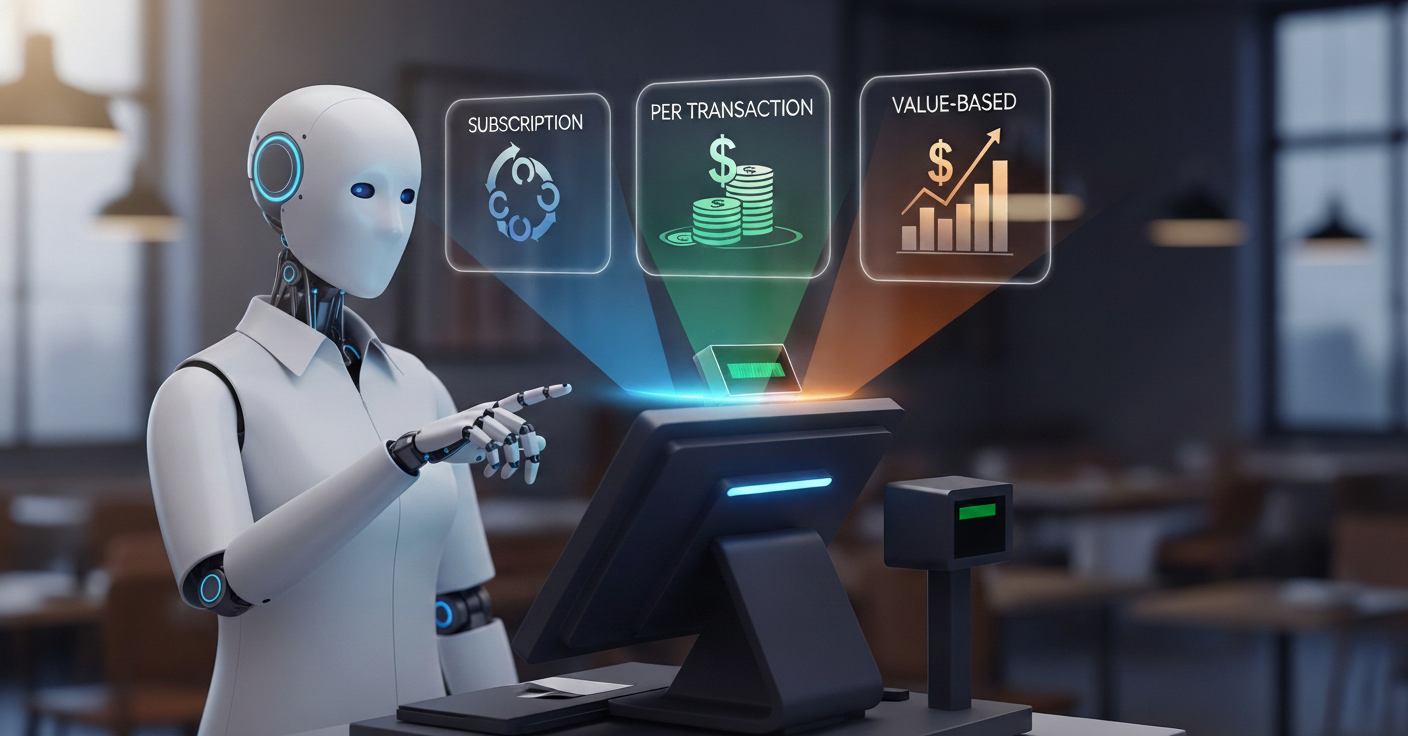
Match the model to your volume: a low-call shop can live with usage pricing, but a high-volume kitchen gets punished at peak. Before you sign, ask for the all-in monthly number, since setup charges and integration add-ons can quietly double the headline price.
Start with a baseline you can actually pull. Your POS call logs show inbound volume and how many rings went unanswered last month. From there, four numbers give you a defensible estimate:
Multiply recovered calls by average order value, add the labor you free up, then subtract the system cost. That single figure is what you hand your accountant. For a deeper breakdown, see AI phone agent ROI for restaurants and how fast it pays for itself.
A menu with heavy customization or hourly specials stresses accuracy, which depends on how carefully your menu data was loaded during setup. Some callers want a person, especially for complaints, so a live-transfer fallback is not optional. Adoption of AI voice ordering remains relatively low at about 6%, meaning best practices are still forming, although there are proven ways to reduce missed restaurant calls with AI that operators can apply now.
Run every option through the same checklist before you shortlist. These are the criteria that separate a system that pays for itself from one that adds a line item.
Log a month of inbound volume, missed-call rate, and average phone ticket before you commit, so you can measure lift against real numbers. Then review how AI phone agents prevent missed calls.
A Deloitte survey of restaurant executives finds 82% plan to increase AI investments this year, and 81% already plan to expand it.
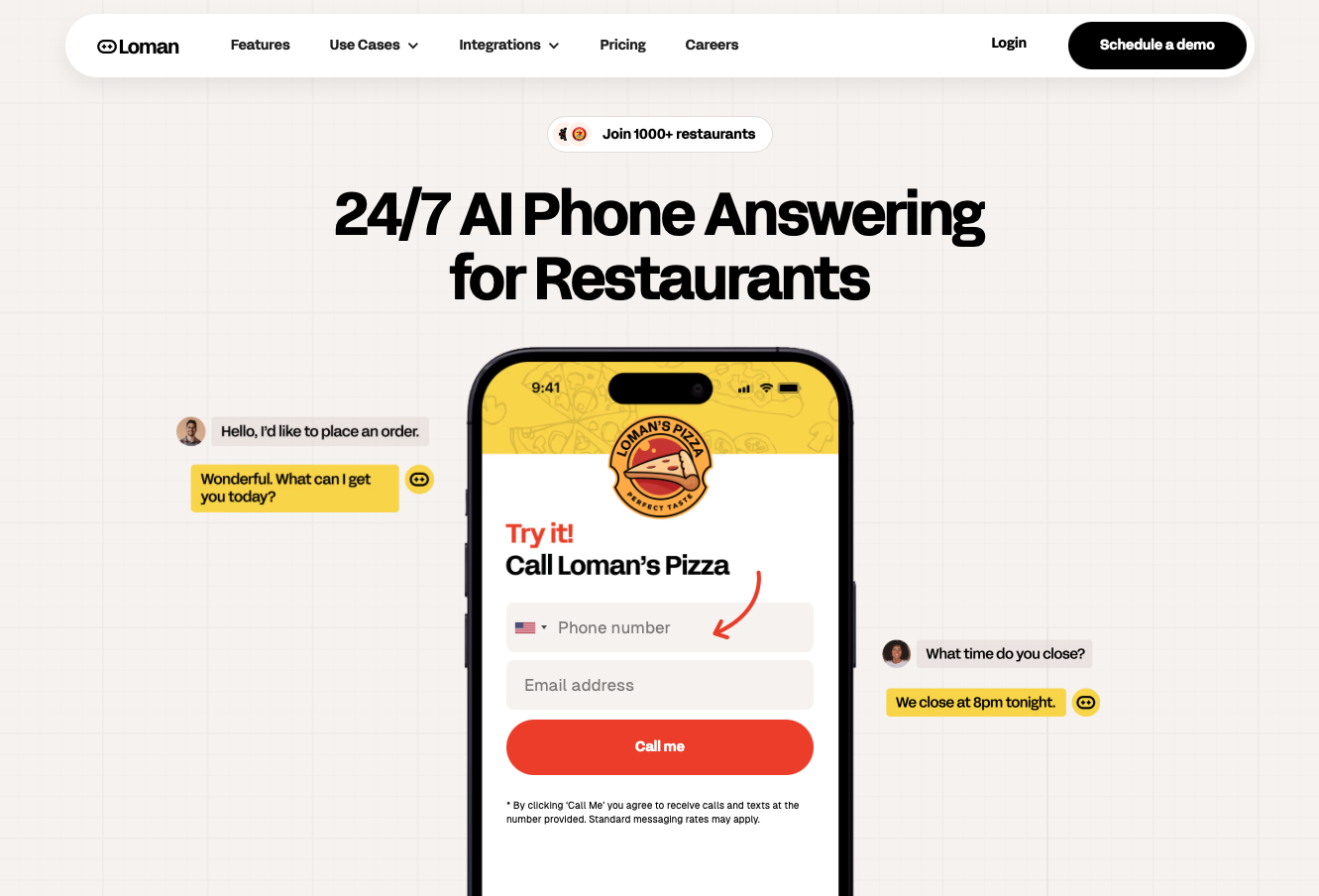
Everything so far describes what a restaurant-specific voice AI should do. Loman AI answers every inbound call, takes full pickup and delivery orders, syncs tickets straight to your POS and kitchen display, and books reservations, all without pulling a staffer off the floor. That includes AI-powered phone agent upselling that lifts the average ticket on every call.
The economics work because the marginal cost of the hundredth call is zero. Pricing starts at $199 per month with no per-minute charges, so the fee holds whether the phone rings 20 times or 200. Orders route into the same ticket the kitchen already reads, no re-keying, and Loman AI connects natively with nine named partners: Toast, Square, Clover, SpotOn, SkyTab, Aloha by NCR, Olo, Stream, and OpenTable. Setup runs under 24 hours, no coding.
The proof sits with operators. Restaurants using Loman AI have reported up to 22% higher phone revenue and up to 17% lower labor costs. Tony Boloney's reports 75 to 100 extra orders per month per location. Midland Pizza Co. estimates it would lose over $200,000 a year without it.
Yes. Restaurant-specific voice AI sits on top of your current POS and pushes orders into it the same way a counter staff member would, with no re-keying and no new hardware required. Loman AI connects natively with Toast, Square, Clover, SpotOn, SkyTab, and others through two-way integrations that read your live menu and write confirmed orders back automatically.
Pull one month of inbound call data from your POS logs, note how many went unanswered, and multiply that number by your average phone ticket (phone orders average $48 versus $41 online). Add the labor hours your staff currently spend on the phone, multiply by your hourly rate, then subtract the flat monthly cost of the system. That figure is what you bring to your accountant. Crust Pizza, for example, reported Loman AI paid for itself in 10 days.
A flat subscription holds at the same cost whether your phone rings 20 or 200 times on a Friday night, which aligns the vendor's incentives with yours during peak hours. Per-conversation pricing spikes unpredictably exactly when your call volume is highest. Some tools charge around $0.59 per call, putting 1,000 calls at roughly $590 in a single month, turning your busiest nights into your most expensive ones.
The phone revenue gap is a solvable problem, and your own logs have the inputs you need to size it. AI order taking for restaurants works best when the pricing model fits your call volume, the POS connection is direct, and the system handles as many simultaneous calls as your busiest Friday night throws at it. Operators who pulled those numbers first made faster, cleaner decisions. Loman AI is built for this. It answers every call, takes full pickup and delivery orders, syncs tickets straight to your POS and kitchen display, and keeps costs flat at $199 a month with no per-minute charges. Restaurants using Loman AI have reported up to 22% higher phone revenue and up to 17% lower labor costs.
Enter your information in the form to receive a call from Loman and place an order like a customer would!

