Your busiest hours are your worst hours for answering the phone. The counter's slammed, the Toast terminal's flying, and every unanswered ring is a caller ready to spend $50 who just moved on. A figure frequently cited in industry sources suggests roughly 85% of them never call again, though this should be treated as an unaudited estimate. If you're searching for the best AI phone agent for restaurants using Toast, the answer starts here: you can close that gap without pulling anyone off the floor, and the order still lands in Toast like a counter ticket.
TLDR:
It's 7:40 on a Friday and the Toast terminal is firing tickets as fast as your counter staff can ring them up. The phone rings a third time. Nobody near it is free, so it keeps ringing, then stops.
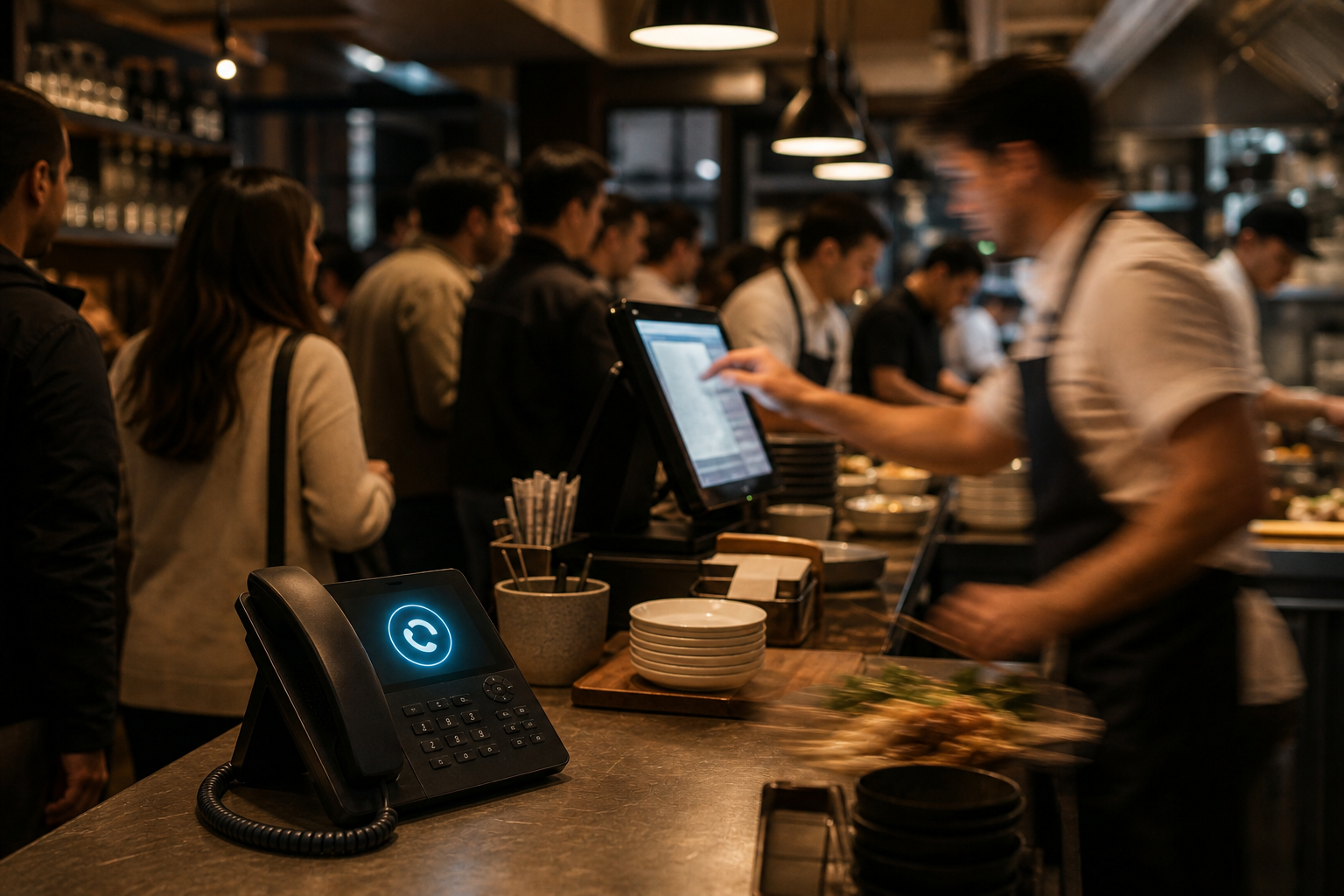
Toast is doing exactly what it was built to do. It rings up in-person tickets, takes payment, and pushes orders to the kitchen. What it can't do is pick up the phone when your counter is buried during the rush. That gap sits open at the worst possible time, and it costs real money every shift, because missed calls drain restaurant revenue shift after shift.
Order entry and payment run through the terminal, so when the line builds, the phone becomes the first thing to drop. A caller ready to place a $50 pickup order won't sit on hold. They hang up and tap the next restaurant instead, per research on missed restaurant calls. Phone volume peaks at the exact hours your staff can least afford to stop and answer, so see how AI phone agents prevent missed calls during those windows.
Industry estimates put roughly 30% of restaurant calls unanswered during peak periods. A figure frequently cited in industry sources, often traced to BIA/Kelsey, suggests roughly 85% of callers never call back after an unanswered call (treat this as an estimate, as the original study has not been independently verified). They move to the next name in their search.
Run the math against your own week. If a Toast operator misses even three $50 pickup orders across a busy Friday and Saturday, that's $150 a shift walking out the door, week after week, while the terminal hums along fine.
A voice AI phone agent connects to Toast through two-way sync, the foundation of restaurant AI phone POS integration. It reads live Toast menu data during the call and writes confirmed orders straight back into Toast POS and the kitchen display, so no one re-keys a ticket after the fact. Because Toast is built for order taking, the work that matters is the flow from phone to KDS: clean tickets, accurate modifiers, and payment captured before the caller hangs up.
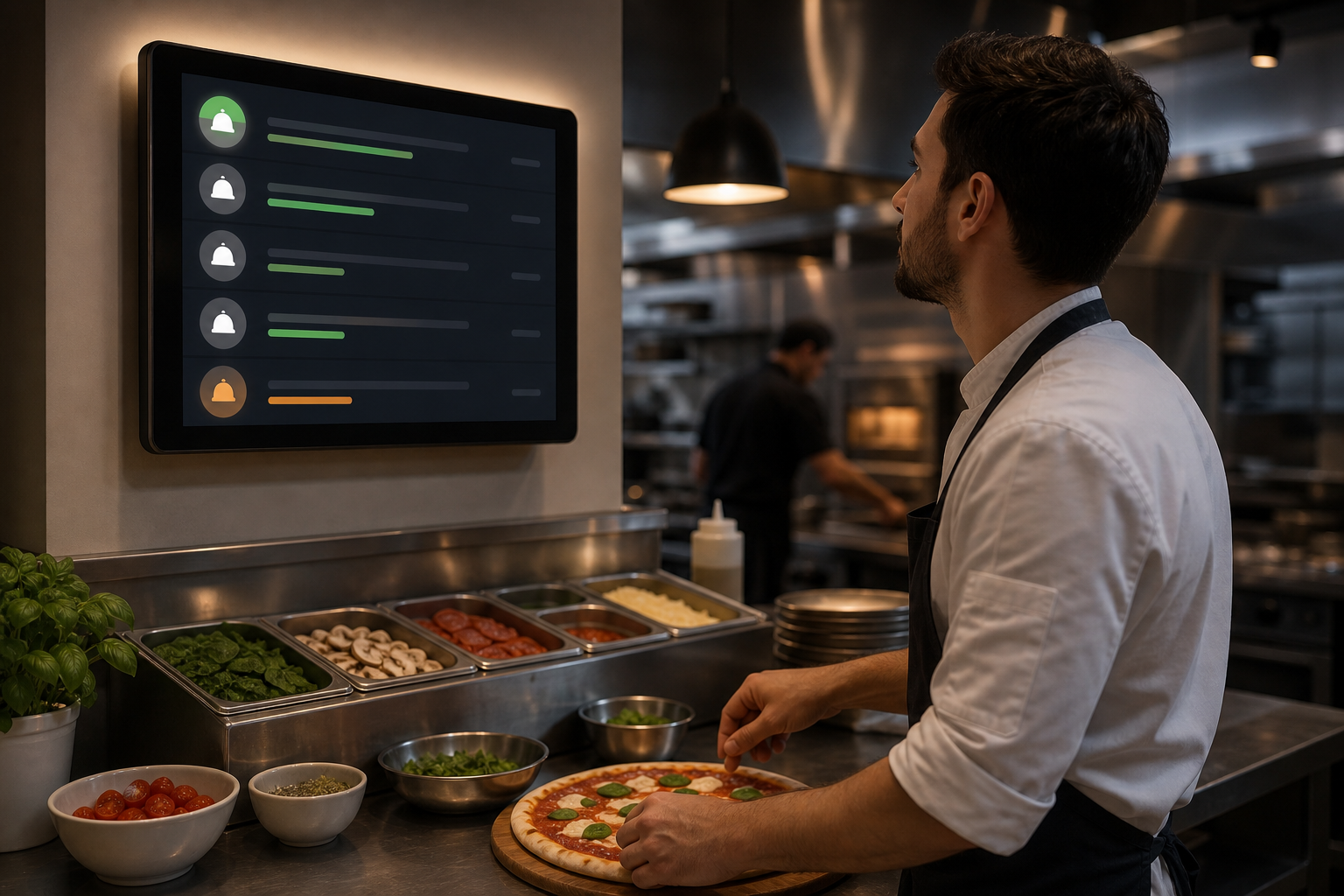
The agent pulls from your Toast menu in real time, so 86'd items, price changes, and specials show up mid-call. Say your kitchen 86s pepperoni at 6:15 and marks it in Toast. On the very next call, the agent stops offering pepperoni. This is how AI phone systems integrate with POS platforms to keep menu data accurate in real time. The caller never hears an item you can't make, and no staffer touches a settings screen.
The difference from a message-taker is order closure. Instead of jotting a callback note, the agent takes the whole order, confirms each modifier, and captures card payment in the same call, then writes the ticket into Toast. Tony Boloney's reported capturing 75 to 100 extra orders per month per location after switching to in-call order closure.
Picture a two-pizza order: half mushroom and half sausage on one, a side salad swapped in for fries on the other. Each modifier lands clean on the KDS exactly as the line cook expects to see it. A built-in upsell prompt can suggest a popular add-on, like garlic knots, to lift the ticket before the caller finishes, a key benefit of Toast POS and voice AI working together. Payment clears in-call, so there's no callback loop and no order left half-finished.
Follow one order from ring to kitchen to see how every step lands in Toast. The agent answers, the caller places a pickup order, and the agent reads live Toast menu data to confirm what's available. Modifiers and special requests get captured as the caller talks, card payment clears in the same call, and the finished ticket writes directly into Toast and routes to the kitchen display.
Once that ticket hits Toast, it clears the same workflow as a counter or kiosk order. Line cooks work from an identical ticket, with every modifier in the spot they already read, a clear example of how POS integration impacts restaurant workflow. No re-keying, no separate phone queue to babysit. Because payment clears in-call, the checkout step at pickup disappears too.
| Stage | What the caller does | What happens in Toast |
|---|---|---|
| Call answered | Places a pickup or delivery order | Agent reads live Toast menu, availability confirmed |
| Order built | Adds modifiers and special requests | Modifiers captured with full fidelity |
| Payment | Pays by card in-call | Payment and ticket sync into Toast |
| Kitchen | Waits for pickup or delivery | Ticket routes to KDS like a counter order |
Crust Pizza owner Nick Haselidis reported that Loman paid for itself in 10 days, with calmer phones and bigger tickets. Tony Boloney's reported capturing 75 to 100 extra orders per month per location. Both are operator-reported outcomes, not audited figures. What stands out is that the Toast workflow absorbed the added volume without new staff friction, since every phone ticket arrives the way a counter ticket already does.
Every phone order landing in Toast carries better economics than the online channel, and the same principle applies across platforms like Loman AI with Aloha by NCR. Phone orders average $48 versus $41 for online orders (a widely cited industry estimate; your own mix may vary), and that premium compounds across a full week of pickup volume. For a Toast operator whose pickup mix leans on the phone, each recaptured call is a bigger ticket than the same guest would place through an ordering page. The agent's upsell prompts add to that on eligible orders.
A recaptured phone order never routes through a third-party app. Base commissions typically run 15% to 30% per order, with all-in costs reaching 30% to 40% once service charges and promotions stack up, per delivery cost research. The Independent Restaurant Coalition notes that commission rates continue to burden independent restaurants at 15 to 30% per order, making direct phone ordering the higher-margin channel. Direct phone ordering keeps that margin inside the restaurant.
Operators using Loman have reported up to 22% higher phone revenue and up to 17% lower labor costs with AI phone agents. Little Italy reported cutting labor costs by more than 24%, an operator-reported result. The National Restaurant Association puts full-service labor above 36% of sales, so every point saved goes straight to margin. Pricing starts at $199 per month, a flat fee covering unlimited calls, so see the full AI phone agent ROI for restaurants to understand how fast it pays for itself.
| Metric | Estimated figure | Source / Context |
|---|---|---|
| Avg phone order ticket | $48 | Industry estimate |
| Avg online order ticket | $41 | Industry estimate |
| Third-party base commission | 15% to 30% per order | Industry estimate |
| Third-party all-in cost | 30% to 40% per order | Industry estimate |
| Phone revenue lift with Loman | Up to 22% | Operators using Loman report |
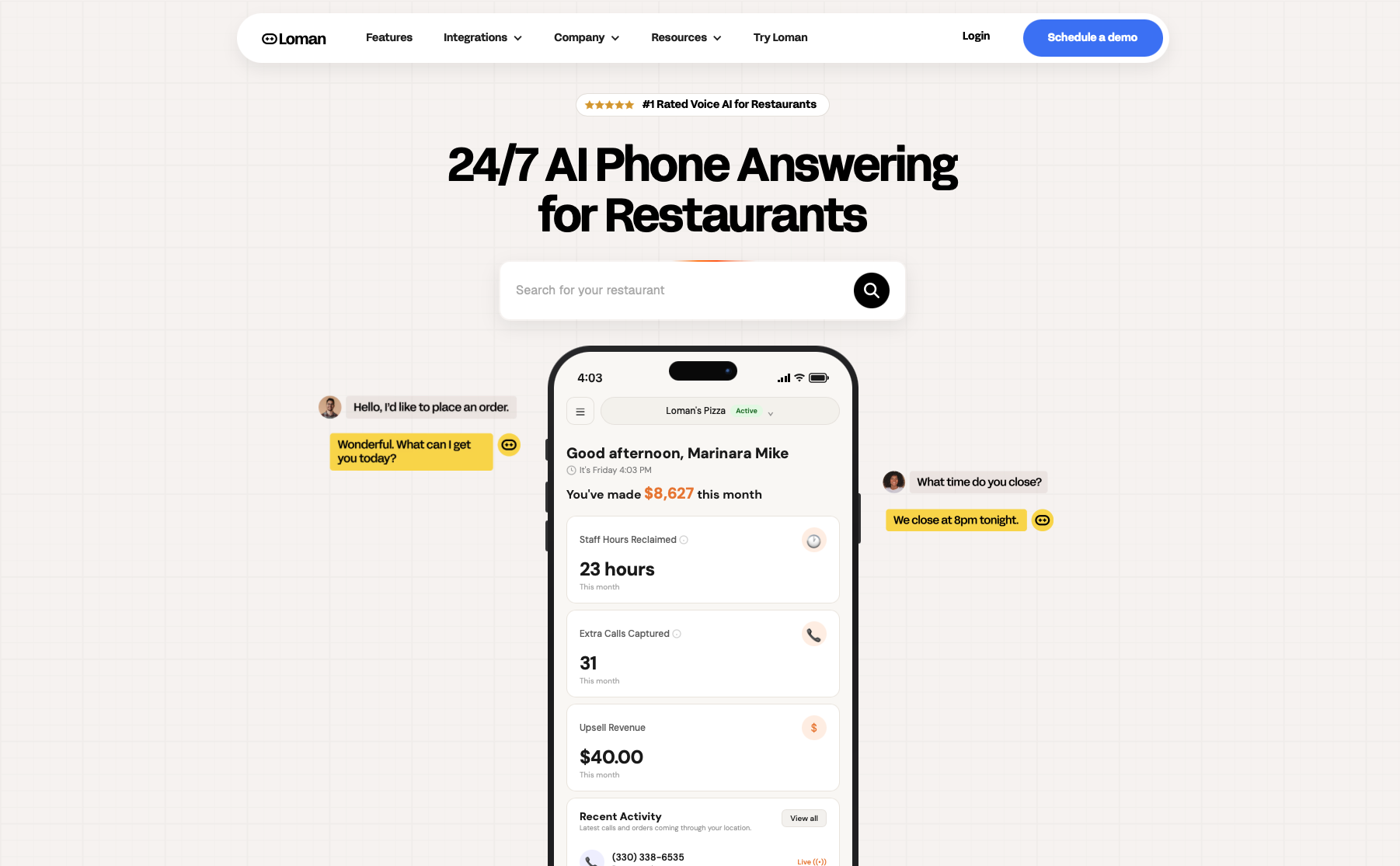
Loman was built around the exact gap Toast leaves open. Toast handles in-person tickets, payment, and kitchen routing at full speed, but when the counter is buried and the phone rings, every unanswered call is a $48 order that walks to the next restaurant on the list. Loman fills that gap through a two-way Toast integration: it reads your live Toast menu in real time mid-call, captures every modifier and special request, processes card payment in the same call, and drops a clean ticket straight into Toast POS and the kitchen display. Your line cooks see it the same way they see a counter ticket. No re-keying, no separate phone queue, no staff pulled off the floor.
The financial case is straightforward. Phone orders average $48 versus $41 for online orders, and Loman's built-in upsell prompts push that ticket higher on eligible orders. Operators using Loman report up to 22% higher phone revenue and up to 17% lower labor costs. Crust Pizza owner Nick Haselidis reported Loman paid for itself in 10 days, with calmer phones and bigger tickets. Tony Boloney's reported capturing 75 to 100 extra orders per month per location. Both are operator-reported outcomes. At $199 per month, a flat fee covering unlimited calls with no per-minute charges, the break-even is typically one or two recaptured orders a week.
Setup takes under 24 hours. Connect your Toast account, import your menu, set your greeting and call-flow rules, and Loman goes live before your next dinner rush. No coding, no dedicated IT, no disruption to the Toast workflow your team already runs. When a call comes in after that, your staff stays at the counter and every phone order lands in Toast exactly where it belongs. Book a free demo to see it handle a live call on your menu before you commit.
Yes. Unlike a message-taker, a voice AI agent like Loman takes the full order, confirms each modifier, and captures card payment in the same call before writing the ticket into Toast. That closes the order end-to-end, so there's no callback loop and no order left half-finished.
No. The agent pulls from your live Toast menu in real time, so 86'd items, price changes, and specials show up mid-call without anyone touching a settings screen. If your kitchen 86s pepperoni at 6:15 and marks it in Toast, the agent stops offering it on the very next call.
Industry estimates put roughly 30% of restaurant calls unanswered during peak periods, and research frequently attributed to BIA/Kelsey suggests about 85% of callers never call back. If a Toast operator misses even three $50 pickup orders across a busy Friday and Saturday, that's $150 a shift walking out the door, week after week.
No. Loman supplements Toast instead of replacing it. Toast handles in-person tickets, payment, and kitchen routing well, but it can't pick up the phone when your counter is buried during the rush, and that's the gap Loman fills.
Every missed call during peak hours is money your terminal never gets to ring up. For any Toast operator looking for the best AI phone agent for restaurants using Toast, the bar is a two-way integration that reads your live menu and drops clean tickets straight into the KDS with no re-keying. See how Loman handles your own calls before the next dinner rush with a free demo.
Enter your information in the form to receive a call from Loman and place an order like a customer would!

