
A phone answering service AI sounds like a solved problem until you run one through a real dinner rush. Short staffing is a big part of why calls go unanswered: the one person near the phone is usually running food and working the register. There's a wide range out there. A basic free AI answering service takes a message and stops. A restaurant-specific AI phone answering service closes the full order and syncs it straight to your POS. Here's how to spot the difference before you commit.
TLDR:
It's 6:40 on a Saturday, the line is six deep, and the phone rings again. Someone has to choose between the counter and the call, and the call usually loses.
Industry estimates put restaurants at roughly 150 missed calls a month, with about 30% of calls going unanswered during peak hours. An estimate reported by QSR Magazine suggests the industry could be losing around $20 billion annually to unanswered calls.

Research frequently attributed to BIA/Kelsey suggests roughly 85% of callers do not call back after an unanswered call. A missed call rarely means a delayed order. It means an order that walked to the pizza shop down the street.
These tools fall on a range, separated by how much of the call they can actually handle.
Some systems only take a message for a human to enter later; others close the order and push a finished ticket straight into the restaurant's existing tools, a gap worth watching when handling high-volume calls. Restaurant-specific agents can match a restaurant's tone, staying casual for a pizza shop or formal for a dining room, and when a caller asks something like whether a dish is gluten-free, a well-built agent offers a confirmed safe option or hands the call to a staffer with the question intact.
Restaurant calls layer decisions in real time: a swap, an allergen question, a second item added late. Generic tools stumble the moment a call branches, which is why restaurants manage high call volumes with purpose-built AI.
The deeper gap is between handling a call and closing an order: pricing items, applying modifiers, confirming payment, and sending a clean ticket. A generic service also runs on a static script, quoting sold-out items and old prices instead of a live menu.
Take a Spanish-speaking caller who asks for "sin cebolla" or "extra salsa." Modifiers like these are where a script built for English can lose the thread, so operators should confirm how any service handles them. Loman AI takes these orders in Spanish from the start and pushes a clean ticket to your POS. Per Census Bureau data for 2017 to 2021, more than 1 in 5 U.S. residents age 5 and older speak a language other than English at home, and about 61% of them speak Spanish.
Generic AI answering services: where they work
Generic AI answering services: where they break down
Before you sign with any AI restaurant phone system, you can verify five things on a demo call: whether it closes the full order, writes it back to your POS, reads your live menu, handles Spanish callers, and bills a flat fee. The table below puts the three common options side by side on those points.
Two more checks do not fit in a table: whether the system caps simultaneous calls during a rush, and whether it transfers to staff with the caller's context intact. Loman answers unlimited concurrent calls and routes edge cases to a live line with the details attached. Here is how the three options compare on the rest.
| Option | Order-taking and POS write-back | Reservation booking | Real-time menu sync | Spanish/multilingual support | Pricing model | Best for |
|---|---|---|---|---|---|---|
| Restaurant-specific voice AI (Loman AI) | Full orders, synced to POS and KDS | Books through OpenTable, Resy, and SevenRooms | Reads live POS menu, including 86'd items | Handles Spanish and multilingual callers | Flat monthly fee from $199, no per-minute charges | Closing phone orders on the call |
| Generic AI answering service | Typically takes a message only | Varies; confirm with vendor | Typically a static script | Varies; confirm with vendor | Flat or per-minute; confirm with vendor | Simple FAQs and call routing |
| Reservation-focused AI tools | Not publicly listed | Books through reservation systems | Varies; confirm with vendor | Varies; confirm with vendor | Varies; confirm with vendor | Reservation-driven restaurants |
Real integration runs both ways: the AI reads your live menu and availability from the POS, then writes the finished order and payment back, so the ticket lands in the kitchen display as if a staffer rang it in.
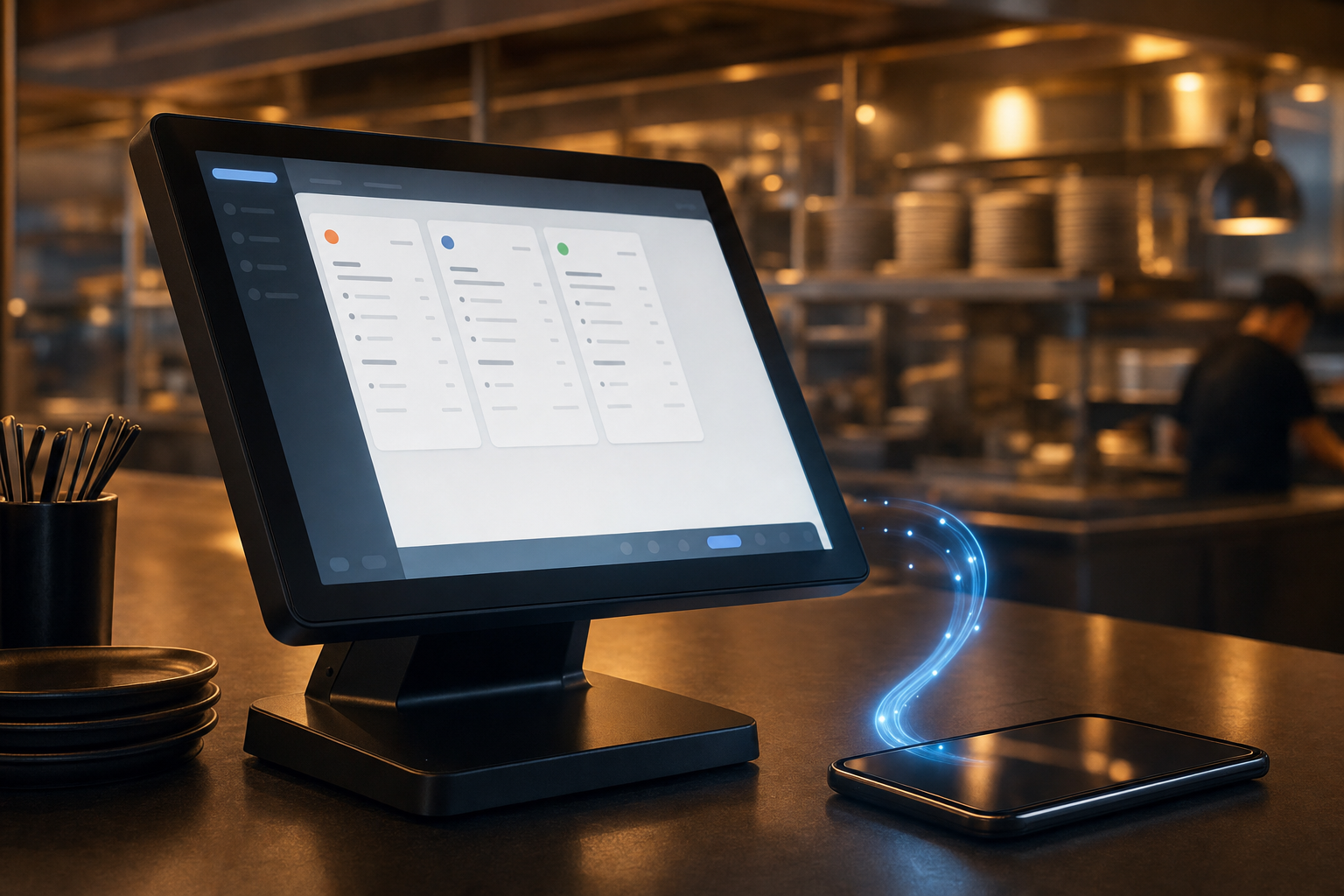
"Integrates with your POS" often means less. A read-only link shows menu data but can't write orders back, and middleware bolted between the AI and the POS adds latency and another point of failure. See how restaurant POS integration with AI should work instead.
Without that write-back, a restaurant AI phone POS integration leaves someone re-keying every phone order by hand. That adds time, introduces errors, and undoes most of the reason you automated the phone in the first place.
Labor is the biggest line on the board. Per the National Restaurant Association's 2025 Restaurant Operations Data Abstract, salaries and wages including benefits ran a median of 36.5% of sales at full-service restaurants in 2024, the largest single operating expense. Front-of-house staff who used to ping-pong between the register and a ringing phone stay on the floor instead, one way operators cut restaurant labor costs with AI agents and how AI phone systems optimize labor without cutting headcount.
The cost math is simple. A flat monthly software fee holds steady whether the phone rings 20 times or 200. Hourly phone coverage does not, since wages, overtime, no-shows, and turnover all swing with the night, a key factor in reducing restaurant labor and overhead costs with AI.
How a service bills you shapes how much a busy night costs. Three structures dominate.
| Pricing model | How it works | Cost predictability |
|---|---|---|
| Flat monthly subscription | Fixed monthly fee | High, bill holds steady |
| Per-minute billing | Cost rises with call length | Low, volume spikes the bill |
| Per-conversation | Charged per interaction | Low, scales with call count |
Per-minute and per-conversation pricing make your busiest Friday the most expensive Friday in software. Flat monthly holds steady no matter how volume climbs. Loman AI starts at $199 a month flat with no per-minute charges, so when you compare any service, ask what the monthly fee covers: full order-taking with POS write-back and live menu sync, or call answering alone.
Phone orders average roughly $48. At that average, recovering about five missed orders a month covers a $199 subscription. See the ROI of an AI phone agent for restaurants.
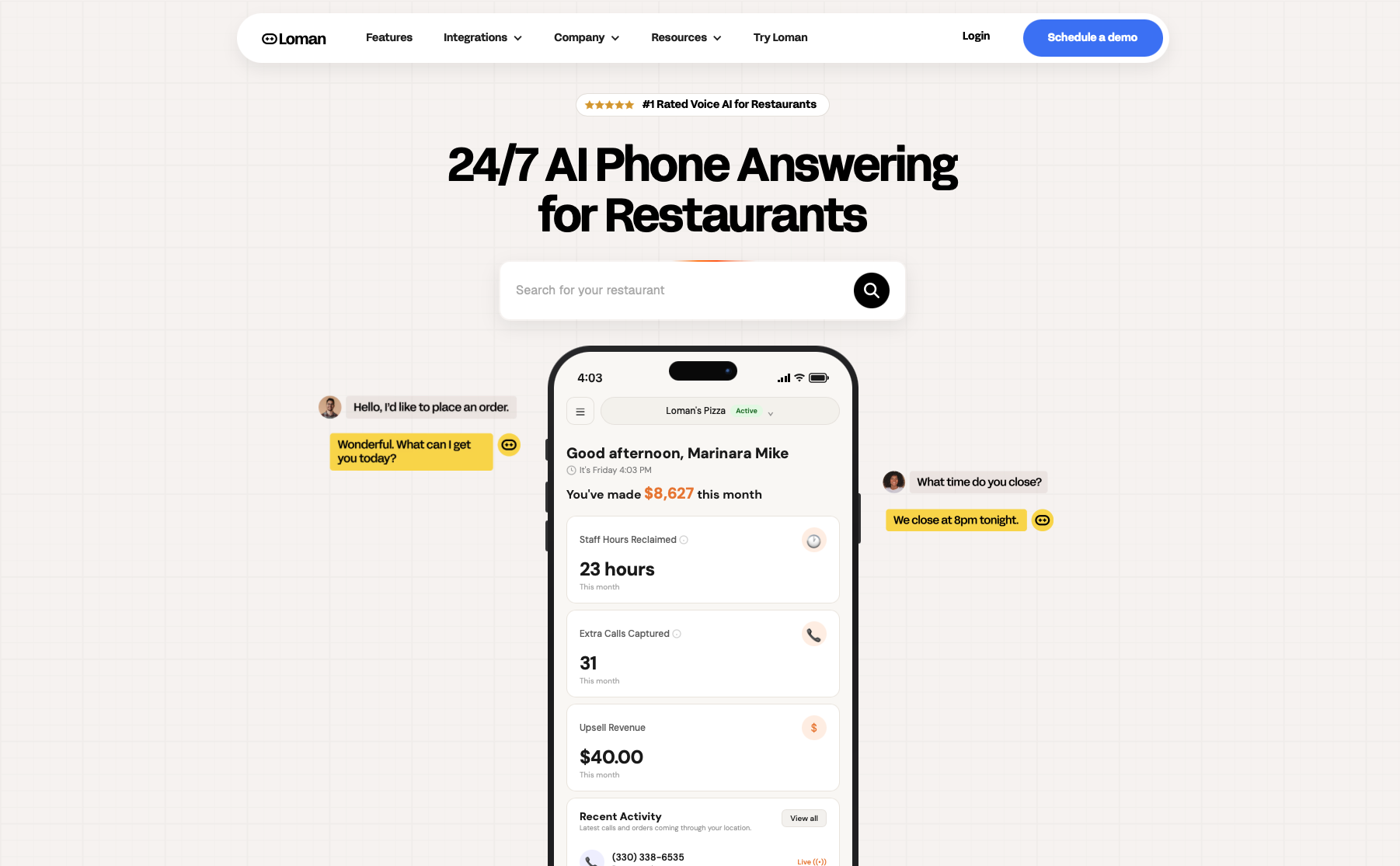
Loman AI is a voice AI phone agent for restaurants, built for 24/7 restaurant call handling. It picks up every call, takes pickup and delivery orders with modifiers and payment, books reservations, answers menu questions, and syncs finished tickets into your POS and kitchen display.
Integrations are native and two-way across Toast, Square, Clover, SpotOn, SkyTab, and Aloha by NCR, plus Olo and Stream. Orders land in the same kitchen workflow as counter tickets with no re-keying. Every call gets answered at once with no concurrency cap, and the built-in upselling engine prompts add-ons and combos to lift the average ticket.
Reservations run through direct OpenTable, Resy, and SevenRooms integrations. Loman checks live availability, books the table, and sends a confirmation before hanging up, so a caller asking for six at 7:30 gets an answer on the spot. VIP and large-party bookings get flagged to staff with the details intact.
Operators using Loman AI have reported up to 22% higher phone revenue and up to 17% lower labor costs. Midland Pizza Co. estimates it would lose over $200,000 a year without Loman AI, and Tony Boloney's reports capturing 75 to 100 extra orders a month per location. Most restaurants go live in under 24 hours with no coding, on a flat monthly fee starting at $199 with no per-minute charges.
Ask whether completed orders push directly into your POS and KDS or a staffer re-keys them. If the answer involves a callback or manual entry, it's a message-taker.
Industry estimates put restaurants at roughly 150 missed calls a month, with phone orders averaging roughly $48. Research frequently attributed to BIA/Kelsey suggests roughly 85% of callers do not call back, and Midland Pizza Co. estimates it would lose over $200,000 a year without Loman AI.
A restaurant-specific voice AI answers from the live POS menu and confirms only what it can verify. When unsure, it hands the call to a staffer with the question intact.
It suggests relevant add-ons, sides, and popular combos on every call while building the order, then closes it into the POS. The lift builds across a shift.
A 24/7 voice AI takes full orders with modifiers and payment and syncs a finished ticket to the POS. Pricing is a flat monthly fee starting at $199 with no per-minute charges.
The phone problem in restaurants is a timing one, and the right AI phone answering service has to close full orders at full speed when your team is maxed out. Loman AI answers every call, closes every order with modifiers and payment, and syncs tickets into your POS so staff stay on the floor. Operators using Loman AI have reported up to 22% higher phone revenue and up to 17% lower labor costs. Book a free demo to see it run on your next rush.
Enter your information in the form to receive a call from Loman and place an order like a customer would!

