Two tools, similar pricing at entry, very different jobs. Hostie is a guest communications layer. Loman is a phone revenue channel. If your calls are mostly reservations and guest inquiries, that difference might not matter. If your phone drives takeout and delivery orders, it matters a lot.
TLDR:
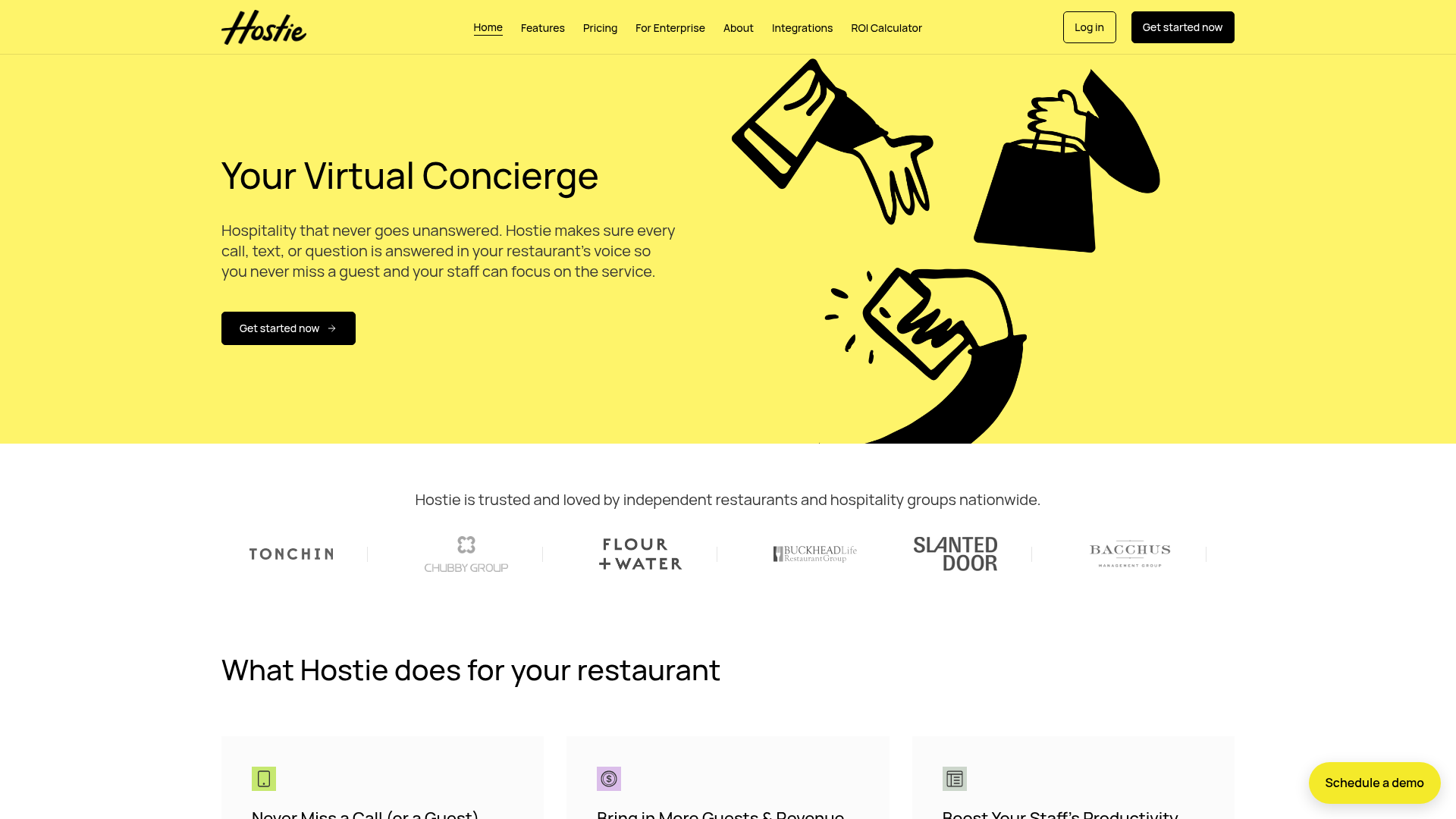
Hostie is an AI voice host that answers calls in a restaurant's own voice and pulls calls, texts, and emails into one inbox. It handles reservations, takeout orders, event inquiries, and guest questions, forwarding complex calls to staff. It is aimed at independent full-service restaurants and multi-location hospitality groups.
Loman is a 24/7 voice AI phone agent built for restaurants. It answers every inbound call, takes complete pickup and delivery orders with secure in-call payment processing, books and manages reservations, and syncs orders and tickets straight into the restaurant's POS and kitchen display system.
It serves independent operators, multi-unit groups, and national brands across the U.S. The result is phone revenue recaptured that would otherwise walk out the door, while staff stay focused on the guests in front of them. No customer sits on hold, no line cook drops a tray to grab the phone, and no $48 order slips through. That is how AI restaurant phone agents prevent missed calls at the busiest moments.
Operators using Loman have reported up to 22% higher phone revenue and up to 17% lower labor costs. Crust Pizza reports Loman AI paid for itself in 10 days. Tony Boloney's reports 75 to 100 extra orders per month per location. These are the numbers behind the AI phone agent ROI for restaurants that show up on the P&L, not abstract promises about what the software might do.
The split between these two systems shows up the moment a caller wants food, not a table.
| Loman | Hostie | |
|---|---|---|
| Starting price (per location/month) | $199 with no per-minute charges | $199 base tier (order taking requires $399 Premium) |
| Phone order taking | Full order closure with modifiers and in-call payment, included on all plans | Available on $399 Premium tier only |
| In-call payment processing | Yes; card collected during the call | Not publicly documented |
| POS ticket injection | Yes; direct to kitchen display, no re-keying | Confirm with Hostie how much of order flow is injected vs. handled as inquiry |
| Named POS integrations | Toast, Square, Clover, SpotOn, SkyTab, Aloha by NCR, Olo, Stream, OpenTable (9) | OpenTable, Resy, Toast, Square (4 documented) |
| Concurrent call handling | Unlimited simultaneous calls, no cap | No public ceiling listed; confirm before signing |
| Setup time | Most restaurants live in under 24 hours; no coding required | Ongoing prompt refinement required as menus change (per G2 reviewers) |
| Menu sync | Real-time sync: 86'd items and price changes update automatically mid-call | Manual prompt updates needed to keep answers accurate |
| Primary design focus | Phone revenue channel: order capture, payment, POS sync | Guest communications layer covering reservations, unified inbox, and concierge |
With Hostie, takeout ordering lives on the Premium plan at $399 per month per location or higher, so the $199 entry tier does not include it. Its documented integrations are OpenTable, Resy, Toast, and Square, though reservation booking is the primary documented use case. Before buying, operators should confirm with Hostie how much of an order gets injected into the POS versus handled as an inquiry.
Loman is built around full order closure. A caller places a complete menu order with modifiers, pays by card during the call, and the ticket lands via restaurant AI POS integration into the kitchen display system with no one re-keying it. That flow is backed by nine named POS and ecosystem partners:
The distinction to verify is simple: does the call end in a paid ticket, or a message someone still has to work. It is a key question covered in any restaurant phone automation guide.
Six callers dialing at once during a Friday rush is the moment capacity stops being theoretical, and that is exactly where handling high-volume calls in busy restaurants becomes critical.
Hostie does not publicly list a concurrent call ceiling, and the product is built primarily around guest communication and concierge workflows. Some systems in this category limit how many simultaneous calls they can handle, which creates a bottleneck at peak service. Operators running heavy dinner-rush volume should confirm concurrent capacity directly with Hostie before signing.
Loman handles unlimited simultaneous calls with no cap. The tenth caller at 7:30 on a Friday gets the same instant answer as the first, so no one hits a busy signal while the counter is slammed.
That matters because the restaurant industry loses an estimated $20 billion a year from missed calls draining restaurant revenue, and roughly 30% of inbound calls go unanswered during peak hours. Every one of those is a ticket that never reaches the kitchen. Unlimited concurrency is the difference you can confirm on a live demo call.
Price is where the two systems diverge on what you actually get for the same entry number.
Hostie publishes three tiers, all per location per month: Hostie's three pricing tiers. One thing to weigh: G2 reviewers note Hostie requires ongoing maintenance, so requires ongoing prompt refinement, otherwise answer quality declines as menus and policies change.
Loman starts at $199 per month with no per-minute charges and no tiers gating order taking, POS sync, or unlimited concurrent calls, in contrast to generic AI phone answering options that fall short on these capabilities. Most restaurants go live in under 24 hours after connecting their POS and importing a menu, with no coding or dedicated IT required and white-glove setup available. Real-time menu sync means 86'd items and price changes update automatically mid-call, so there is no prompt tuning to keep answers accurate.
Hostie makes sense for full-service, reservation-heavy restaurants that mostly need a unified communications inbox and a guest-facing concierge voice. If the core problem is staff phone burnout in a fine-dining room or hospitality group where the reservation is the primary transaction, Hostie's workflow is worth a look.
For most restaurants where the phone is a direct revenue channel, takeout, delivery, catering, and high-volume orders, AI order taking for restaurants closes the transaction Hostie cannot. It takes the complete order, collects payment in-call, syncs the ticket to the kitchen, and answers unlimited simultaneous calls at a starting price of $199 per month with no per-minute charges and no capability paywalls. Operators using Loman have reported up to 22% higher phone revenue and up to 17% lower labor costs, which reflects the gap between a communications tool and a revenue-capturing AI phone assistant for restaurants.
If phone orders (pickup, delivery, catering) are a primary revenue channel, Loman is the right fit: it takes complete menu orders, collects payment during the call, and pushes the ticket directly to your POS and kitchen display with no re-keying required. Hostie's order-taking capability sits behind its $399 Premium tier, so operators running heavy order volume should confirm exactly how much of that order flow gets injected into their POS versus handled as an inquiry before committing.
Loman closes the transaction on the call (modifiers, payment, and a clean ticket to the kitchen) while Hostie is built primarily around guest communication and reservation management, with takeout ordering available only on higher-paid tiers. That gap matters most during a Friday dinner rush when every call needs to end in a paid order, not a message someone still has to work.
Hostie fits full-service, reservation-heavy restaurants (think fine dining or hospitality groups) where the reservation is the primary transaction and a unified communications inbox solves the core staff-burnout problem. Loman serves any restaurant where the phone is a direct revenue channel: pizza shops, QSRs, casual dining, and multi-location groups that need every call answered, every order captured, and every ticket synced to the kitchen at any volume.
Loman reads your live POS menu in real time, so 86'd items, price changes, and specials update automatically mid-call with no manual prompt tuning. G2 reviewers note that Hostie requires operators to regularly review interactions and refine AI prompts, meaning answer quality can decline as menus and policies change without that ongoing effort.
Loman handles unlimited simultaneous calls with no cap, so the tenth caller at 7:30 on a Friday gets the same instant answer as the first. Hostie does not publicly list a concurrent call ceiling, so operators running heavy dinner-rush volume should confirm that capacity directly with Hostie before signing.
If reservations and a unified inbox are your main gaps, Hostie is worth a serious look. But if missed calls and incomplete orders are costing you money on busy nights, the tool you need closes the full transaction and syncs the ticket without anyone picking up the phone. That gap shows up fast on a Friday at 7 PM. See how Loman handles it on a live call.
Enter your information in the form to receive a call from Loman and place an order like a customer would!

