Your staff is juggling ringing phones while trying to keep service moving, and every unanswered call represents lost revenue you never get back. For many restaurants, the phone has become the most unreliable part of the operation: interrupting staff, slowing service, and creating order mistakes during peak hours. When comparing restaurant automation options like
TLDR:
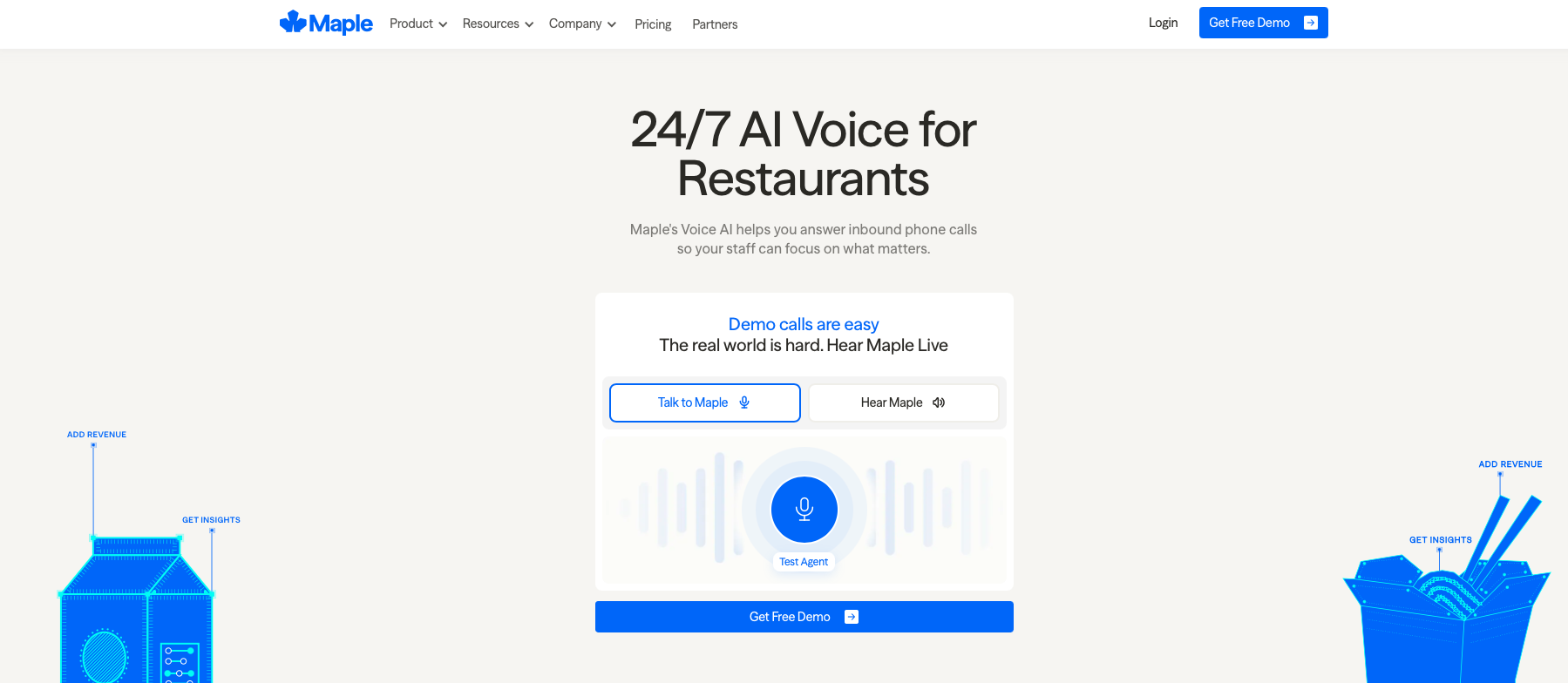
Maple is a voice AI service that answers restaurant phone calls 24/7. The system processes reservations, takeout orders, and common questions about menus and hours.
The service connects with OpenTable for reservation management and syncs with POS systems to handle orders and payments. Maple answers incoming calls, captures customer requests, and sends information to the restaurant's existing systems.
The service is a budget-friendly entry point for restaurants that want to reduce missed calls and minimize staff time spent on phone tasks without a large monthly commitment.
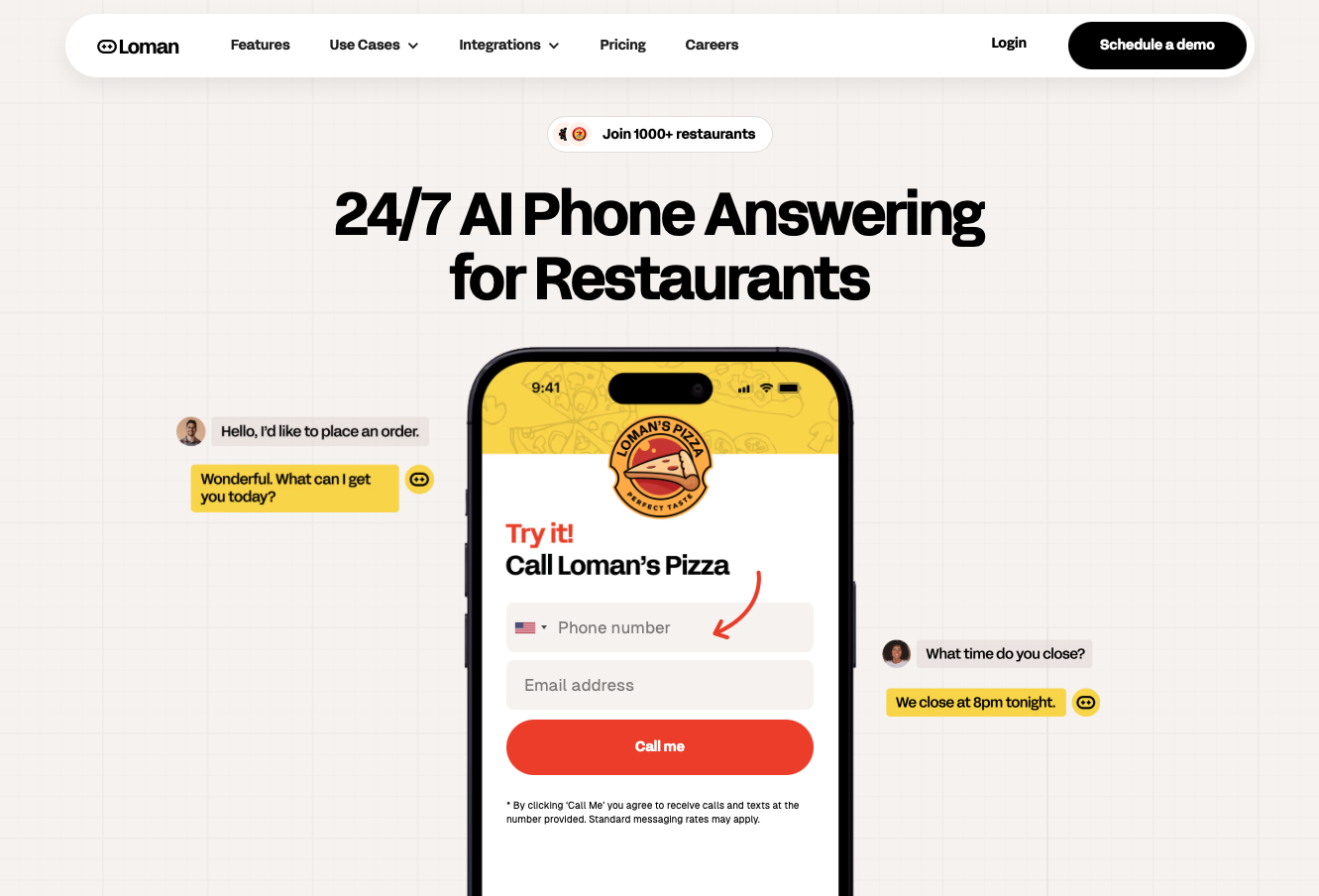
Loman is an AI phone agent designed for restaurants that answers calls 24/7, takes pickup and delivery orders, books reservations, and processes credit card payments over the phone.
The system connects natively with POS systems including Toast, Square, Clover, SpotOn, SkyTab (Shift4), Aloha by NCR, Olo, and Stream. Orders flow directly into existing workflows with no manual re-entry required. Reservations sync with OpenTable, Resy, and SevenRooms, covering the three major booking platforms restaurants use most.
Loman handles unlimited simultaneous calls, so there's no busy signal or hold queue. During orders, the AI suggests add-ons and popular combinations. The system answers questions about menus, allergens, hours, and directions while recognizing repeat callers and supporting multiple languages.
The AI is trained on more than 20 million restaurant calls, giving it the depth to handle real-world complexity — half-finished sentences, mid-order substitutions, allergen questions layered on top of modifier requests, and everything in between. That training base is what separates a system that handles simple orders from one that handles your actual dinner rush.
Both systems connect to your POS, but differ in how they handle order complexity. Maple is a budget-tier option that processes takeout orders and reservations through POS integrations. If your menu includes extensive modifier options, allergen restrictions, or rotating specials, confirm how the system adapts before going live.
Loman handles every detail of a restaurant order. The AI captures substitutions, add-ons, allergen requests, and special instructions while minimizing the need for clarification in most cases. Each instance is trained on your specific menu and business rules, so it processes complicated pizza builds, multi-item family meals, and whatever's on your specials board.
Orders sync directly into your kitchen with zero manual entry. The AI prompts relevant upsells during the order, suggesting sides, drinks, or popular combos that increase average ticket size.
Phone orders average $48 compared to $41 for online orders, a revenue premium that compounds across weekly call volume. When a caller hangs up without placing an order, industry research suggests roughly 85% of them do not call back. Operators using Loman report adding 75 to 100 extra orders per month per location from calls that previously went unanswered, turning what would have been missed revenue into completed tickets sent directly to the kitchen.
Maple is a lower-cost option that syncs with major POS systems to send orders and payments into your existing setup, connecting with reservation systems like OpenTable so data flows from call to kitchen without staff transcription.
Loman connects natively with Toast, Square, Clover, SpotOn, Aloha, Olo, and Stream. When a customer places an order, it appears in your POS exactly as spoken. Payment processing happens through the POS itself, capturing revenue the moment a customer pays.
The integration architecture matters here. Loman's connections are direct and native — the AI speaks to your POS without a middleware layer sitting between them. Maple's POS connectivity relies on middleware-based connections in tested configurations, which can reduce your direct control over menus, modifiers, payment handling, debugging, and the flexibility to adapt workflows as your operation changes. With a middleware layer in place, a change to your menu or a payment edge case has more points of failure to work through before it resolves.
Direct POS integration eliminates typos, missed modifiers, and prep delays that come with manual entry. Your kitchen receives clean, accurate tickets every time, leading to faster prep and less food waste from remakes.
Loman reads your live menu during each call, so 86'd items, price changes, and rotating specials are reflected in real time. A caller ordering the nightly special does not hear a stale menu, and your kitchen never receives a ticket for something that ran out two hours earlier. That accuracy loop from call to POS to kitchen cuts the errors that generate remakes, refunds, and follow-up calls from guests who received the wrong order.
In Loman's proprietary simulated 1,000-call benchmark, Loman completed 99.6% of orders accurately versus 92.1% for Maple in the tested configuration. At 1,000 orders, that gap works out to roughly 4 inaccurate orders for Loman compared to roughly 79 for Maple. Each of those errors carries a cost: staff time to catch it, a remake, a potential refund, a guest-recovery conversation, and a reduced chance of that guest returning. When you add those costs up across a month of call volume, subscription price becomes a less useful yardstick than total operating cost — and that is where the gap between the two systems widens significantly.
Maple is a budget option that offers 24/7 AI phone answering, capturing calls during peak hours and handling multiple calls simultaneously to reduce pressure on front-of-house teams during dinner rushes.
Loman handles unlimited simultaneous calls without hold queues or busy signals. Every caller gets immediate attention regardless of call volume. The AI quotes accurate wait times, provides directions, and recognizes repeat callers.
Restaurants miss roughly 43% of calls during service hours. Loman is designed to scale dynamically during rushes without practical concurrency limits. The system routes edge cases to staff with full caller context when needed. For multi-location groups, each store gets its own number and local routing while analytics roll up centrally.
At an average of $48 per phone order, missing 10 calls on a Friday night means roughly $480 in lost revenue from that single service. Over a month of peak-night misses, a single-location restaurant can lose tens of thousands of dollars in phone orders that could have been captured automatically. Loman converts that variable loss into a fixed monthly line item covering every call regardless of volume, so the math shifts in your favor as call traffic grows.
Maple, as a budget-tier solution, provides call transcripts plus basic reporting on call performance and ordering signals (availability varies by plan and integration).
Loman's analytics dashboard tracks revenue from phone orders, call trends, peak times, and customer patterns in real time. The dashboard displays live calls, transcripts, transactions, and outcomes as they happen, showing which menu items sell and when busy windows occur.
You can filter call activity by day of week, time slot, and order type to identify when your phone line drives the most revenue. The transcript log lets you review any call, confirm modifier accuracy, and catch patterns in customer questions that point to gaps in your menu descriptions, hours copy, or pricing. Operators often find that reviewing a week of call data reveals which items generate the most questions and which specials pull the most interest — information that feeds directly into menu decisions without waiting for a formal review cycle.
You can update menus, hours, and specials directly from the dashboard without support tickets or implementation delays.
Loman's upselling engine prompts relevant add-ons and popular combos during every order. The AI suggests items that pair well, driving higher average ticket sizes.
Operators using Loman report up to 22% higher phone revenue from recaptured calls and smart upsells, plus up to 17% lower labor costs from reduced phone handling.
For restaurant groups, Loman supports per-store menu overrides while rolling up analytics centrally. You get visibility across your entire operation and can compare performance between locations while maintaining local flexibility for specials and hours.
Maple is a budget-friendly option that supports over 1,000 restaurants with configuration assistance for independent and multi-location operators.
Loman launches in under 24 hours through white-glove setup that imports your menu, builds your greeting, and configures business rules so calls are answered immediately.
Single-location restaurants can lose tens of thousands of dollars per year from missed calls, making fast deployment directly tied to revenue capture.
Multi-unit operators can set shared menus across locations while overriding items, prices, hours, or holidays by store. Each location receives its own local number with region-based routing, and analytics roll up centrally while preserving local control.
Loman starts at $199 per month with no per-minute charges and unlimited calls. A dedicated phone-only staff hire carries variable costs including hourly wages, overtime, and turnover that spike precisely when call volume is highest. Loman converts that unpredictable expense into a single fixed line item. For restaurants losing between $3,000 and $5,000 per month in missed phone orders, AI coverage typically pays for itself within the first week of operation.
Maple is the budget choice for restaurants needing basic call answering and reservation support, especially those relying on OpenTable integration. Restaurants with simple takeout menus, moderate call volumes, and tighter budgets may find Maple a sufficient starting point.
Loman was built for restaurants where phone orders represent a meaningful revenue channel. We combine full menu ordering, secure payment processing, unlimited call capacity, built-in upselling, deep POS integrations, and multi-location support.
Where Maple's reservation coverage stops at OpenTable, Loman syncs with OpenTable, Resy, and SevenRooms — giving restaurants flexibility regardless of which booking platform they run. And where Maple handles basic orders, Loman replaces your entire phone operation with software that captures 100% of calls and sends clean tickets directly to your kitchen.
At the NRA Show, 97 out of 100 restaurant operators across a mixed competitive set preferred Loman — not a direct head-to-head with Maple alone, but a signal from operators who had seen the category and made a call on which system they trusted with their phone line.
Operators who made the switch report results they can put numbers to. Crust Pizza owner Nick Haselidis reports that Loman paid for itself in 10 days: "Phones are calm, tickets are bigger, and my team refuses to go back." Tony Boloney's reports adding 75 to 100 extra orders per month per location. Midland Pizza Co. estimates it would lose over $200,000 annually without Loman in place. These are operator-reported figures, and they point to a consistent pattern: when every call gets answered and every ticket lands clean in the kitchen, the revenue gap closes fast.
For restaurants losing revenue to missed calls and order errors, Loman delivers measurable ROI through recaptured sales, higher ticket averages, and reduced labor costs.
Choose Loman if phone orders represent a meaningful revenue channel and you need full menu ordering with upselling, unlimited call capacity, and deep POS integrations. Maple works better as a budget option for restaurants focused primarily on reservations and basic takeout with simpler menus.
Loman captures every detail including substitutions, allergen requests, special instructions, and rotating specials without clarification, then syncs clean tickets directly to your kitchen. Maple processes takeout orders through POS integrations, but you should confirm how it adapts to extensive modifiers or menu complexity before deployment.
Yes, Loman handles unlimited simultaneous calls with no hold queues or busy signals, so every caller gets immediate attention regardless of volume. The system quotes wait times, provides directions, and routes edge cases to staff with full context when needed.
Loman launches in under 24 hours with white-glove setup that imports your menu, builds your greeting, and configures business rules. For multi-location groups, you can set shared menus with per-store overrides for items, prices, hours, and holidays while maintaining local phone numbers.
Restaurants with simple takeout menus, moderate call volumes, and tighter budgets may find Maple's entry-level pricing a good fit for basic call answering and reservation support. Loman is built for restaurants where phone orders drive revenue and require full ordering capabilities, payment processing, and built-in upselling.
Choosing between Loman vs Maple comes down to whether your calls are a core revenue source or a constant interruption. Maple is a budget-friendly option for reservations and basic phone ordering, often chosen by cost-conscious restaurants looking to reduce missed calls and handle routine requests. However, restaurants with high call volumes or more functionally complex ordering workflows may find its depth varies depending on configuration and integration. Loman was built for restaurants where phones drive real sales: handling unlimited calls at once, taking full orders with modifiers and allergen requests, collecting payment during the call, and increasing ticket size through built-in upsells. Instead of forcing staff to step in during rushes, Loman takes ownership of the entire phone experience and delivers clean tickets directly to the kitchen. For operators who want their phone line to consistently convert callers into paying guests, Loman's AI phone ordering system turns missed calls into measurable revenue instead of daily frustration.
For restaurants at the entry level, Maple's lower pricing can be a reasonable starting point to cover basic inquiries and OpenTable reservations. For restaurants where the phone drives real ticket volume, a full-stack solution pays off quickly. Loman's $199 monthly rate covers every call with no per-minute fees, and operators across pizza, casual dining, and multi-location groups consistently report that captured calls translate directly into revenue recovered before the next dinner rush. Walk through the ROI for your own operation at loman.ai/demo.
Enter your information in the form to receive a call from Loman and place an order like a customer would!

