Two tools, both marketed as AI phone answering for restaurants, but they handle the actual order in completely different ways. One closes it on the call; the other texts the caller a link and hopes they follow through. Here's how Loman and Popmenu AI Answering actually compare when the phones get busy.
TLDR:
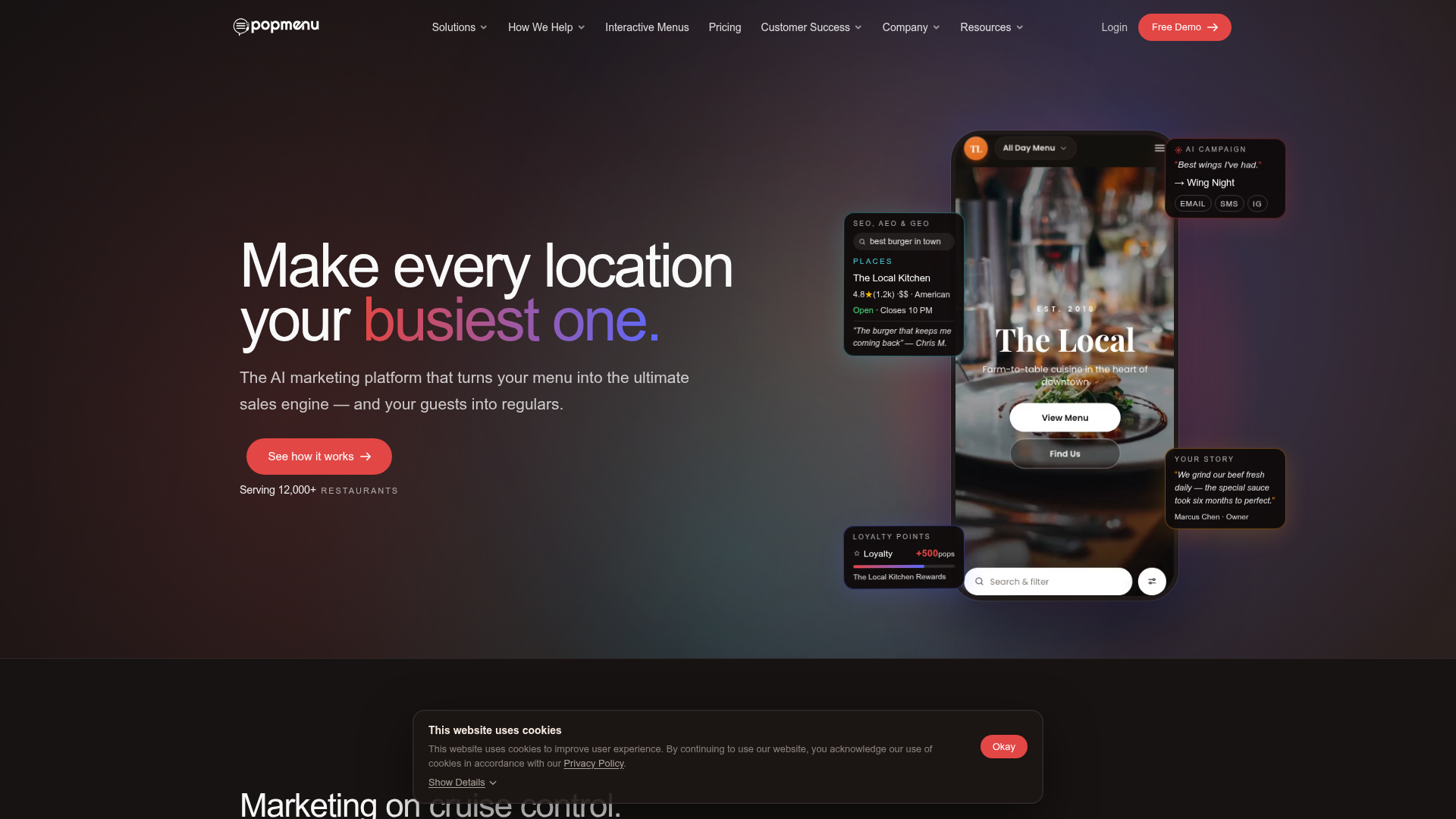
Popmenu AI Answering sits inside a larger restaurant marketing suite. That suite covers website design, interactive menus, online ordering, and automated marketing, and the answering feature is one piece of it, not a standalone phone product. That distinction matters when choosing between generic AI answering vs restaurant-specific solutions.
Here is what it does on a call:
The core pattern is worth noting before any comparison. Popmenu handles the conversation, then hands the actual transaction off to a text link the guest taps later. The call gets answered; the order gets finished somewhere else.
Loman is a 24/7 voice AI phone agent built for restaurants and nothing else. It answers every inbound call, takes full pickup and delivery orders, books reservations, and answers the menu and hours questions guests actually call about. It is a restaurant phone automation approach that closes transactions on the call.
The distinction against a marketing add-on shows up in what happens after the conversation. Loman closes the order on the call itself. It takes the payment in-call and pushes the ticket straight into the POS, so the order lands in the same kitchen workflow as a counter or kiosk ticket with no one re-keying it.
A few practical details for an operator sizing this up:
Picture the same moment at two restaurants: a caller wants a large pie, half pepperoni, light cheese, and a side of wings.
At the Popmenu restaurant, the answering feature takes the conversation and then texts the caller a link to the online ordering page. The order gets finished on the guest's phone, later, if they tap through. Third-party materials note that complex or customized orders still route back to a staff member to pick up the call. The call is answered, but phone traffic converts into online orders instead of closing on the line.
At the Loman restaurant, that whole order gets taken during the call. Every modifier and special request lands on a complete ticket that pushes straight into the POS and kitchen display, no re-keying. Payment is captured in-call, so the transaction closes before the caller hangs up.
That closure changes the order economics. Operators using Loman have reported up to 23% higher revenue per order, driven by recaptured calls and a built-in upselling engine that prompts add-ons on every call. Phone orders average $48 against $41 for online, a premium that compounds across weekly volume.
"Integration" carries two meanings here, and the gap matters once tickets hit the line.
Popmenu's online ordering pipeline pushes confirmed online orders into compatible POS systems, including Square. The answering feature works differently. It converts phone calls by texting the caller a link to the online ordering page, so a phone order reaches the POS only if the guest taps through and finishes online. Operators should confirm how that call-to-link handoff fits their kitchen ticket flow before assuming phone traffic lands automatically.
Loman's POS integrations are two-way and built for phone order injection. Orders taken on the call route straight into the kitchen display alongside counter and kiosk tickets, with no separate online ordering step. See how POS integration impacts restaurant workflow for a deeper look. Loman reads the live POS menu in real time, so callers never hear about an 86'd item. Every modifier, special request, and upsell lands clean on the ticket, no re-keying.
Verified named integration partners include Toast, Square, Clover, SpotOn, SkyTab (Shift4), Aloha by NCR, Olo, Stream, and OpenTable.
The pricing gap comes down to whether phone answering is a standalone product or a line item bolted onto a larger suite.
Popmenu AI Answering is a paid add-on, not part of any base plan. Base Popmenu subscriptions start at $179 per month, and AI Answering runs a separate $349 per month, putting the combined starting cost at $528 per month or more depending on the base tier. If all you need is the phone covered, you still pay for the website, marketing, and menu tools riding underneath it.
| Popmenu AI Answering | Loman | |
|---|---|---|
| Base subscription | From $179/mo | From $199/mo |
| Phone answering | +$349/mo add-on | Included |
| Combined starting cost | $528/mo or more | $199/mo |
| Per-minute charges | Confirm with vendor | None |
Loman starts at $199 per month with unlimited calls included. One flat rate holds whether the phone rings 20 times or 200 times on a Friday night, replacing hourly phone labor with its overtime, turnover, and no-show risk. That makes it a key factor in calculating the ROI of an AI phone agent for your restaurant. Operators using Loman have reported up to 17% lower labor costs using AI phone agents.
The stress test for any phone system is the Friday dinner rush, when lines stack up faster than staff can reach them.
Popmenu AI Answering fields multiple simultaneous calls and answers basic questions around the clock, keeping phones from going unanswered during a spike. The catch sits in how it converts revenue calls. Because orders get handed off through an SMS link instead of closed on the line, a caller who never taps that link is a missed order, not a captured one. There are proven ways to reduce missed restaurant calls with AI technology instead. Restaurants average roughly 150 missed calls per month, and research frequently attributed to BIA/Kelsey suggests roughly 85% of callers do not call back after an unanswered call.
Loman handles unlimited concurrent calls with no ceiling. When six lines ring at once, Loman answers all six, takes all six orders, and pushes all six tickets into the kitchen while staff stay on the floor. The best AI systems for restaurant upselling fire on every call regardless of volume.
Popmenu AI Answering is a reasonable fit for restaurants already running Popmenu's marketing suite that want to cut staff time on routine FAQ calls and steer phone traffic toward their existing online ordering flow. If your operation is marketing-driven and phone orders are secondary, the bundled product does its job.
For restaurants where the phone is a revenue channel, Loman is built for that job. It closes complete orders on the call, pushes tickets straight into the kitchen, and captures payment before the caller hangs up, all at $199 a month for unlimited calls with no add-on. Operators using Loman have reported up to 22% higher phone revenue, because every call becomes a completed transaction instead of a link waiting to be tapped.
The deciding factor is what you can verify before you commit. Book a demo and hear Loman take an order on your own menu before your next dinner rush.
If phone orders are a real revenue channel for your restaurant, Loman is built to close those orders on the call itself: taking payment, pushing tickets into your POS, and firing upsell prompts on every conversation. Popmenu AI Answering is a better fit if you are already running Popmenu's marketing suite and want to reduce staff time on routine FAQ calls, with phone traffic steering toward your existing online ordering flow.
Loman takes the full order on the call, captures payment in-call, and pushes a complete ticket straight into your kitchen display: no re-keying, no separate step. Popmenu AI Answering answers the call and texts the caller a link to finish the order online, so the transaction closes only if the guest taps through later.
Popmenu AI Answering is designed for restaurants already invested in Popmenu's broader marketing suite (website, interactive menus, and automated marketing) where phone answering is a supplementary feature. Loman is built for restaurants of any size where the phone is a direct revenue channel and the priority is converting every call into a completed, paid order.
Loman starts at $199 per month with unlimited calls included and no per-minute charges. Popmenu AI Answering is a paid add-on on top of a base Popmenu subscription, putting the combined starting cost at $528 per month or more. If phone answering is all you need, you still pay for the website, marketing, and menu tools that come with it.
Loman goes live in under 24 hours with no coding or IT resources required. Connect your POS, import your menu, set your hours and call-flow preferences, and the system is answering calls. White-glove setup is available if you want hands-on help configuring greetings, upsell prompts, or multi-location rules.
If phone orders are secondary to your marketing workflow, Popmenu's bundled approach makes sense. If every call is a revenue opportunity, a system that closes the order on the line is a different tool entirely. Watch Loman take a full order and decide for yourself what fits your operation.
Enter your information in the form to receive a call from Loman and place an order like a customer would!

