Most restaurants miss nearly half of their inbound phone calls, quietly losing orders during the exact moments demand is highest. Even when calls are answered, upselling depends on busy staff remembering prompts while juggling service, which leads to inconsistent results and smaller tickets. Restaurant upselling AI changes that equation by answering every call around the clock, guiding customers through full orders, and suggesting add-ons on every interaction. Newer solutions now go beyond call screening to handle payments, menu logic, and POS syncing, turning the phone into a dependable revenue channel. This guide compares the leading options and breaks down what to look for if you are considering modern, AI-powered ordering solutions.
TLDR:
Restaurant upselling AI uses voice and digital ordering systems to suggest add-ons, upgrades, and complementary items during customer interactions. These systems analyze menu items and recommend pairings in real time, whether during phone orders or reservations.
Restaurants miss 43% of incoming calls, costing up to $292,000 annually in lost orders. AI upselling answers every call and suggests add-ons consistently. AI-driven upselling increases tickets by 20% to 40% on average, without staff needing to remember every prompt.
We assessed each system on factors that directly affect restaurant revenue and operations, focusing on real-world performance over marketing claims.
Evaluation criteria included order-taking accuracy, native POS integrations, simultaneous call capacity, upselling consistency, documented revenue lift, setup speed, multi-location support, and labor cost reduction.
Call capture rate matters most. A system that only handles reservations but can't take full orders leaves money on the table every day.
| Platform | Full Order Taking | Payment Processing | POS Integration | Simultaneous Calls | Setup Time | Primary Use Case |
|---|---|---|---|---|---|---|
| Loman | Yes - complete menu orders with modifications | Yes - secure payment during call | Native integration with Toast, Square, Clover, Aloha, Olo, Stream | Unlimited | Under 24 hours | Full-service phone ordering with upselling for all restaurant types |
| Hostie | No - reservations and basic inquiries only | No | Limited - reservation systems only | Unlimited | Not specified | Reservation management and call screening |
| Kea | Yes - scripted QSR ordering flows | Yes | Select QSR POS systems | Limited | Not specified | Enterprise QSR chains and drive-thru operations |
| Slang.AI | No - FAQs and simple interactions | No | None | Unlimited | Not specified | Informational calls and basic call routing |
| SoundHound AI | Yes - voice recognition capabilities | Not specified | Custom builds required | Limited | Extended - requires development | Enterprise chains with dedicated technical teams |
| ConverseNow | Yes - drive-thru focused | Yes | QSR POS systems | Limited | Not specified | Drive-thru automation only, no phone ordering |
| VOICEplug AI | Basic order capture | No - manual payment required | No deep integrations | Unlimited | Not specified | Entry-level voice ordering without advanced features |
| Certus AI | No - call screening only | No | None | Unlimited | Not specified | Small restaurants testing AI for basic inquiries |
| Sadie | No - cannot handle menu orders | No | None | Unlimited | Not specified | Receptionist services and message taking |
| Maple | No - simple call screening | No | None | Unlimited | Not specified | Basic information delivery without order capture |
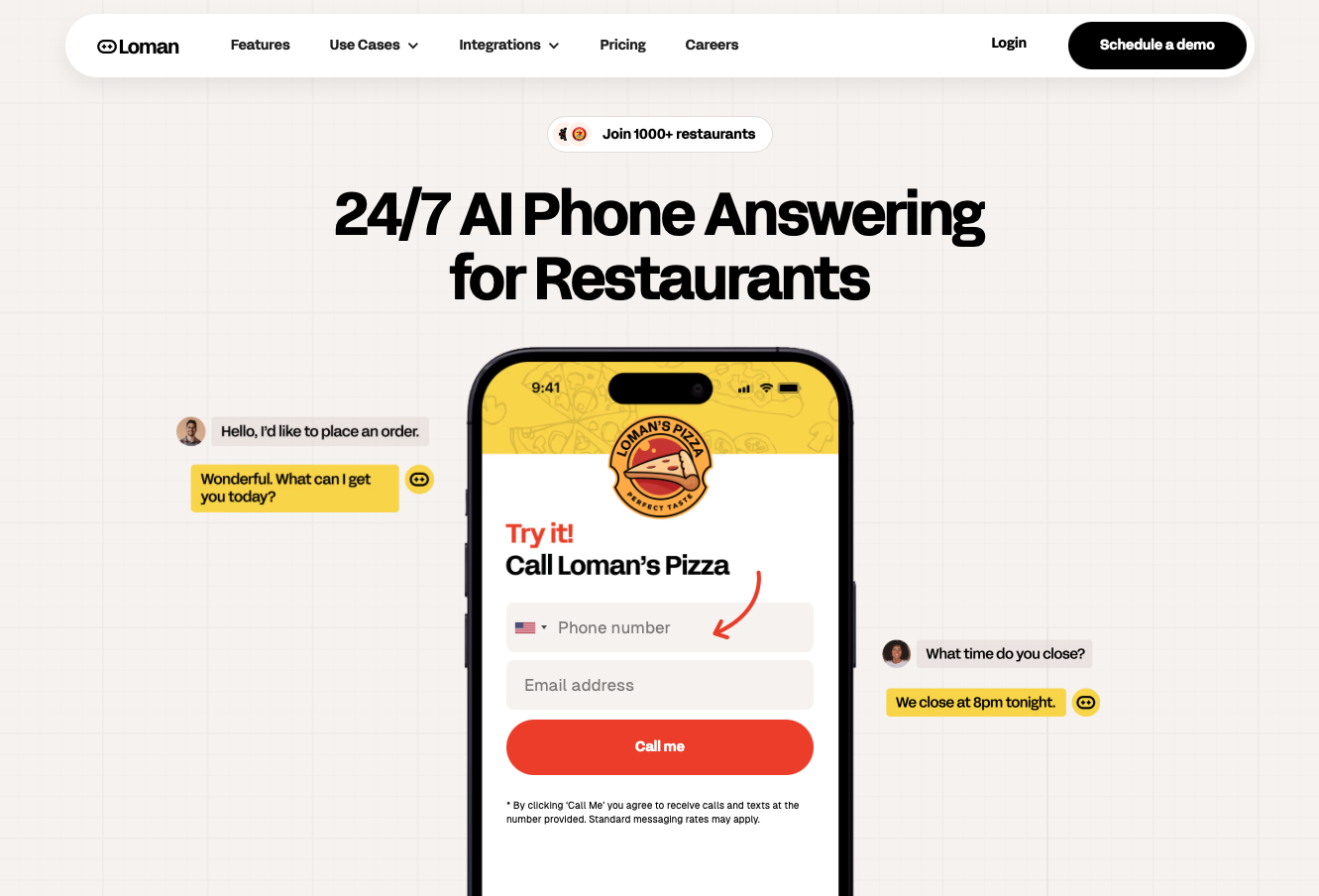
Loman delivers the most complete AI phone agent for restaurants, combining 24/7 call answering with intelligent upselling to maximize phone order revenue. The system takes pickup and delivery orders, processes secure payments, books reservations, and answers menu questions while syncing directly with major POS systems.
Core strengths include native integrations with Toast, Square, Clover, Aloha, Olo, and Stream that eliminate manual order entry, smart upselling prompts that increase average ticket size with consistent add-on suggestions, unlimited simultaneous call handling so restaurants never miss orders during rush periods, and sub-24-hour deployment with full menu training.

Hostie provides AI phone answering for restaurants with a focus on reservation management and basic call handling. The system answers inbound calls, manages bookings, and responds to common questions about hours, location, and general policies, helping reduce front-of-house interruptions during service.
Good for: Restaurants that rely heavily on reservations and receive a high volume of informational calls with limited phone-based ordering.
Limitation: Hostie does not support full menu ordering with item modifications, payment processing, or direct POS syncing, requiring staff to manually enter any food orders and limiting revenue from phone calls.
Kea offers voice AI for drive-thru and phone ordering at quick-service restaurants, with a focus on high-volume environments and scripted ordering flows. The system automates drive-thru interactions, captures phone orders for simplified QSR menus, and integrates with a limited set of QSR-focused POS systems. Kea is built to improve order accuracy and speed during peak periods, making it a fit for standardized menus and repeatable ordering patterns.
Good for: Large QSR chains and drive-thru-focused operators with standardized menus and enterprise budgets for multi-location rollouts.
Limitation: Targets enterprise QSR brands and does not support the full range of POS systems commonly used by independent restaurants.
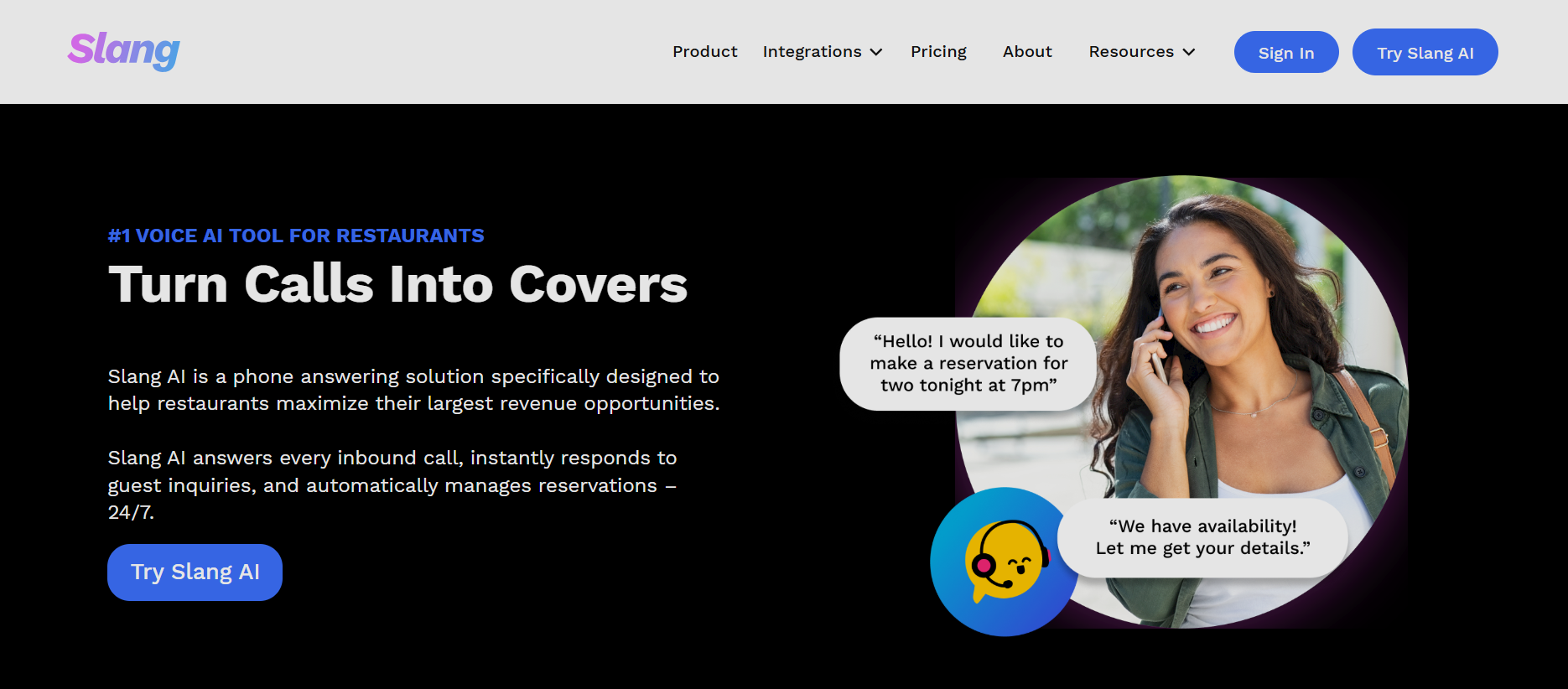
Slang.AI provides conversational AI for restaurant phone calls, handling FAQs and simple interactions. The system answers questions about hours, menu items, and policies, confirms reservations, and routes calls.
Good for: Restaurants receiving many informational calls without needing full order-taking capabilities.
Limitation: Slang.AI cannot take complete menu orders with modifications or process payments, requiring manual follow-up for order placement.
SoundHound AI provides voice recognition technology for restaurant ordering across drive-thru and phone channels. The system captures orders through speech recognition and supports custom voice assistant builds tailored to large restaurant brands with complex requirements. SoundHound is designed as a flexible voice technology layer instead of a ready-to-deploy restaurant ordering solution.
Good for: Enterprise restaurant chains with internal technical teams that can build, customize, and maintain voice ordering systems at scale.
Limitation: Requires substantial development and integration work and does not offer out-of-the-box integrations with POS systems like Toast or Square and typically requires custom development, making setup slower for independent and mid-market restaurants.

ConverseNow delivers voice AI designed exclusively for drive-thru ordering at quick-service and fast-casual restaurants. The system automates the full drive-thru ordering process without human staff involvement, using voice recognition to capture orders, suggest combo add-ons, and reduce errors during rush periods. ConverseNow integrates with QSR POS systems to sync menus and orders in real time, with an emphasis on speed and throughput.
Good for: Quick-service chains with drive-thru operations that need to improve speed and order accuracy in high-volume lanes.
Limitation: Focuses exclusively on drive-thru use cases and does not support inbound phone ordering for pickup or delivery.

VOICEplug AI provides voice ordering technology for restaurant phone calls and digital ordering channels, handling basic conversational order capture and menu recognition. The system can take phone orders through natural language interactions, identify menu items from customer speech, and support simple upselling suggestions. VOICEplug also connects voice ordering with online channels to cover multiple order entry points.
Good for: Restaurants looking to test voice ordering with basic phone answering capabilities and minimal setup requirements.
Limitation: Lacks deep POS integrations and does not process secure payments, requiring staff to manually enter orders and collect payment separately.
Certus AI offers AI phone solutions for restaurant call handling and basic order management. The system provides automated answering for common restaurant inquiries like menu questions and hours, with call routing and voicemail features.
Good for: Small restaurants testing AI phone solutions who primarily need call screening instead of full transactional capabilities.
Limitation: Certus AI does not process credit card payments or sync completed orders directly into restaurant POS systems, creating manual work for staff.
Sadie provides AI receptionist services for restaurant phone calls, handling basic call answering, message taking, and responses to common customer questions like hours, location, and policies. The system is designed to provide consistent phone coverage for restaurants that receive a high volume of informational calls and want to reduce interruptions for on-site staff.
Good for: Restaurants that primarily receive informational calls and need basic phone coverage without full order-taking or payment handling.
Limitation: Sadie cannot take menu orders with item modifications or process payments during the call, which requires callbacks or manual order entry and limits its ability to convert phone traffic into completed sales.
Maple offers voice AI solutions for restaurant communications and call handling. The system provides automated responses to common customer inquiries.
Good for: Restaurants seeking simple call screening and information delivery without complex order-taking requirements.
Limitation: Maple does not support complete order capture with menu modifications or integrate with POS systems for direct order transmission and payment.
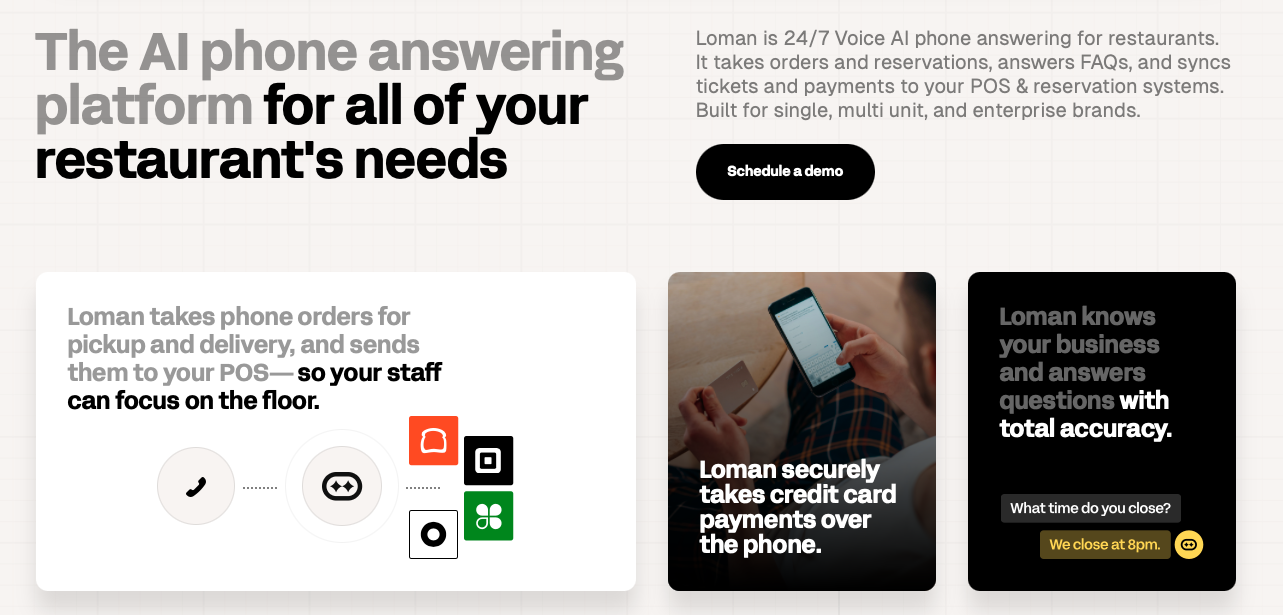
Loman combines order-taking, payment processing, reservation booking, and upselling in one solution. Most alternatives handle only part of the equation, answering questions without taking orders or managing reservations without processing payments.
The system answers every call 24/7, handles unlimited concurrent calls during rush periods, and goes live in under 24 hours with native POS integrations. Restaurants using Loman report up to 22% revenue increases and 17% labor cost reductions.
Loman offers the fastest deployment (under 24 hours) with native POS integrations for Toast, Square, and Clover, making it ideal for independents. Systems like SoundHound require dedicated technical teams and longer implementation timelines.
If phone orders represent considerable revenue, choose a system that takes full orders and processes payments like Loman, Kea, or ConverseNow. If you primarily receive informational calls and reservation requests, Hostie or Slang.AI may be sufficient.
Loman, Kea, and ConverseNow are among the few platforms that process secure payments during the ordering conversation. Other systems require manual payment collection or callbacks, creating friction that can lose sales.
Phone order revenue grows when every call turns into a completed sale instead of a missed opportunity or a callback. Restaurant upselling AI delivers results only when it can manage the full transaction, from customized orders to payment, without adding work for staff. Loman fits that standard by answering calls around the clock, guiding customers through complete orders, suggesting add-ons consistently, and sending paid tickets straight into the POS. The result is fewer missed calls, higher average tickets, and less time spent on manual entry, all with fast setup and immediate impact. For restaurants looking to turn inbound calls into a reliable sales channel, a solution like Loman makes the difference.
Enter your information in the form to receive a call from Loman and place an order like a customer would!

