You've narrowed it down to two options and now you're trying to figure out which one actually drops orders into your POS without a workaround. ConverseNow and Loman are built for different kinds of restaurants, and that shows up most clearly at the integration layer. Here's what the comparison actually looks like side by side.
TLDR:
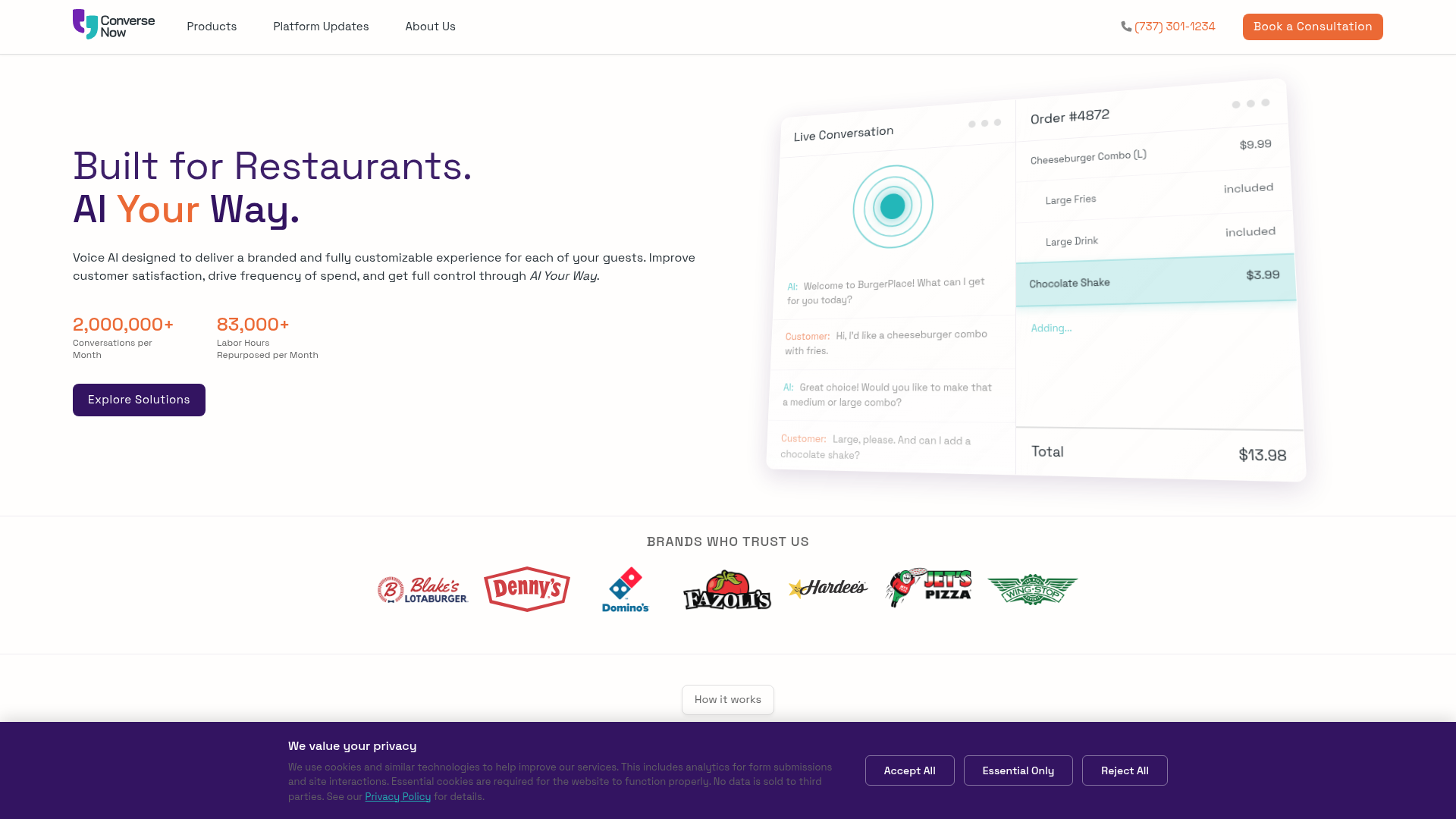
ConverseNow is a voice AI system built primarily for drive-thru automation and phone ordering at quick-service chains. It handles automated order-taking with conversational AI, integrates with major POS systems, and is deployed across 1,200+ stores in 43 states serving national QSR brands like Domino's and Wingstop. Voice AI is reshaping QSR drive-thru operations broadly, and ConverseNow is one of the more active players in that space.
Loman is a 24/7 voice AI phone agent built for restaurants of every size. It answers every call, takes full pickup and delivery orders, books reservations, and syncs tickets and payments straight into your POS, recapturing missed phone revenue while your staff stays focused on the guests in front of them.
| ConverseNow | Loman | |
|---|---|---|
| Primary use case | Drive-thru automation at enterprise QSR chains | Phone ordering for restaurants of every size |
| POS integration method | Routes through Olo and Deliverect (middleware) | Native direct integration with 9 named POS partners |
| Named POS partners | Not publicly listed for Toast, Square, or Clover | Toast, Square, Clover, SpotOn, SkyTab, Aloha, Olo, Stream, OpenTable |
| Deployment time | 8 to 12 weeks | Under 24 hours |
| In-call payment processing | Not publicly listed | Yes, card captured during the call |
| Best fit | 50+ location QSR chains with dedicated IT teams | Single locations to multi-unit groups |
| Starting price | Not publicly listed | $199/month, no per-minute charges |
The difference between these two systems shows up fast at the integration layer. One routes orders through a third-party order management layer; the other connects to your POS directly.
ConverseNow syncs with POS systems through integrations with Olo and Deliverect, letting phone and drive-thru orders flow alongside other digital orders. It does not publicly name direct native integrations with Toast, Square, or Clover on its website, and POS partner documentation is not publicly listed. Operators should confirm which systems their location runs before assuming compatibility.
Loman takes a different path. It integrates natively with nine named partners:
Each POS integration pushes orders straight into the POS and KDS with no manual re-entry, reads the live menu so 86'd items and price changes update mid-call, and syncs tickets and payments end-to-end. SpotOn restaurants can activate Loman from their existing dashboard as of January 2026, with no third-party routing layer in between.
Every week between signing and going live is another week of missed calls draining restaurant revenue walking out the door. That gap matters more than it looks on a project timeline.
ConverseNow can take 8 to 12 weeks to deploy because of its enterprise implementation process. Slower rollouts like this often involve custom hardware installation or configuration across multiple locations, which makes sense for a national QSR fleet but adds lead time before a single call gets answered.
Loman goes live in under 24 hours for most restaurants, with no coding or IT department required. Setup runs through a web dashboard: connect the POS, import the menu, pick a greeting, and set call-flow rules, with white-glove onboarding available. The phone starts capturing revenue the next business day. Restaurants without a dedicated project team should factor that timeline gap into the total cost of evaluation before signing anything.
Once a caller is on the line, the question is whether the system closes the sale or hands the call back.
ConverseNow delivers fully automated voice AI ordering across phone and drive-thru, letting restaurants redeploy labor and drive consistent upsell performance. It also runs real-time Voice Intelligence that measures greeting compliance, upsell effectiveness, and guest experience. In-call payment processing is not publicly listed on its website, so operators should confirm whether card capture happens inside the call or requires a separate checkout step.
Loman takes credit card payments during the call through its POS integration, closing transactions end-to-end with no callbacks. Its AI-powered phone agent upselling engine prompts add-ons and popular combos automatically, and every modifier lands clean in the same kitchen ticket the KDS shows, with no re-keying.
Operators using Loman have reported up to 23% higher revenue per order through recaptured calls and automated upselling. Phone orders carry higher average check sizes than online orders, averaging $48 versus $41, so capturing every call compounds quickly.
This is where the fit question gets concrete. The two systems were built for different restaurants.
ConverseNow targets QSR brands with AI-powered voice assistants built for drive-thru operations, and its solution is less accessible for small single-location restaurants without drive-thru lanes or enterprise budgets. It runs across brands like Panera, Checkers & Rally's, and Fazoli's, so it fits best for large chains with 50-plus locations that need drive-thru automation at scale. Independent operators usually want the opposite: transparent pricing, named references, and setup measured in hours.
Loman is built for restaurants of every size, from a single pizza shop to a multi-unit group with per-store menu overrides. AI order taking for restaurants starts at $199/month with no per-minute charges, so the cost holds whether the phone rings 20 or 200 times a night. Multi-location operators get shared menus with per-store overrides, local numbers, store-specific hours, and analytics that roll up by location. Tony Boloney's reports capturing 75 to 100 extra orders per month per location, and Crust Pizza reported that Loman paid for itself in 10 days.
ConverseNow is a credible option for large enterprise QSR chains that need drive-thru automation and can absorb a multi-week rollout. If you run a national brand with 50-plus locations and a dedicated IT team, it belongs on your shortlist. For the independent operator, the growing multi-unit group, and any restaurant where generic AI phone answering falls short, the fit gets harder to defend.
Loman names its integration partners, goes live in under 24 hours, takes payment inside the call, and the ROI of an AI phone agent starts at $199/month with no per-minute surprises. You can confirm all of it before you sign: which POS systems connect natively, how fast setup runs, whether card capture happens on the call.
When the dinner rush hits tonight, the phone needs a system already in your POS, already answering every call, already pushing clean tickets to the kitchen. That is the standard to hold any voice AI to.
If you want to hear it work on your own menu, run a demo call and place an order the way a customer would. That move starts now, well before the phones pick back up tonight.
ConverseNow and Loman are not really competing for the same restaurants. One was built for national drive-thru chains; the other was built for any restaurant where the phone is the primary order channel. Your call volume, POS system, and setup timeline will tell you more than any feature list will. Run a demo call at loman.ai/demo and see how it handles your menu before the phones pick back up tonight.
If phone ordering drives a meaningful share of your revenue, Loman is built for that use case directly: it takes full menu orders, processes payment inside the call, and pushes clean tickets to your POS with no manual re-entry. ConverseNow is built around drive-thru automation at enterprise QSR chains, so its architecture and deployment timeline are sized for that context, not for a restaurant where the phone is the primary order channel.
Loman integrates natively with nine named POS partners (Toast, Square, Clover, SpotOn, SkyTab, Aloha by NCR, Olo, Stream, and OpenTable), pushing orders directly into the POS and KDS with no manual re-entry. ConverseNow routes orders through Olo and Deliverect without naming direct native connections to Toast, Square, or Clover on its website, so operators should confirm which systems their specific location runs before assuming compatibility.
ConverseNow fits large enterprise QSR brands: think 50-plus locations with drive-thru operations, dedicated IT teams, and the capacity to absorb an 8-to-12-week rollout. Loman is built for restaurants of every size, from a single pizza shop to a growing multi-unit group, with pricing starting at $199 per month, no per-minute charges, and setup measured in hours, not months.
Setup runs through a web dashboard (connect your POS, import your menu, pick a greeting, and configure call-flow rules) with no coding or IT department required, and white-glove onboarding is available. Most restaurants go live within 24 hours, at which point the system starts answering calls and pushing orders to the kitchen; Crust Pizza reported Loman paid for itself within 10 days of going live.
Loman takes credit card payments during the call through its POS integration, closing the transaction end-to-end with no callbacks or separate checkout step, which reduces no-shows and removes friction at pickup. ConverseNow does not publicly list in-call payment processing on its website, so operators considering that capability should confirm directly with ConverseNow whether card capture happens inside the call or requires a separate step.
Enter your information in the form to receive a call from Loman and place an order like a customer would!

