
It's 6:15 on a Friday, your host is walking a party to their table, and the reservation line rings for the fourth time with nobody free to answer. Roughly 30% of restaurant calls go unanswered at peak, and industry research suggests about 85% of those callers never call back, so every dead ring is a booking that lands in someone else's dining room. SevenRooms keeps your book, waitlist, and guest profiles in order, but the book alone can't pick up a handset. This guide covers what the best AI voice agent for restaurants using SevenRooms does: it answers those calls and keeps the SevenRooms book current.
TLDR:
It is 7:40 on a Saturday. The host stand is three deep, two large parties are waiting on tables that have not cleared, and the phone keeps ringing with people trying to book for next weekend. Nobody can grab it. Every server is mid-service, the host is working the waitlist, and the handset rings out.
SevenRooms is doing its job in that moment. The reservation book is accurate, guest profiles are loaded, and the floor plan reflects who is seated where. What the book alone cannot do is pick up a ringing phone when every set of hands is already busy. A reservation book manages the data; without something answering the phone, the call that creates the booking goes unanswered.
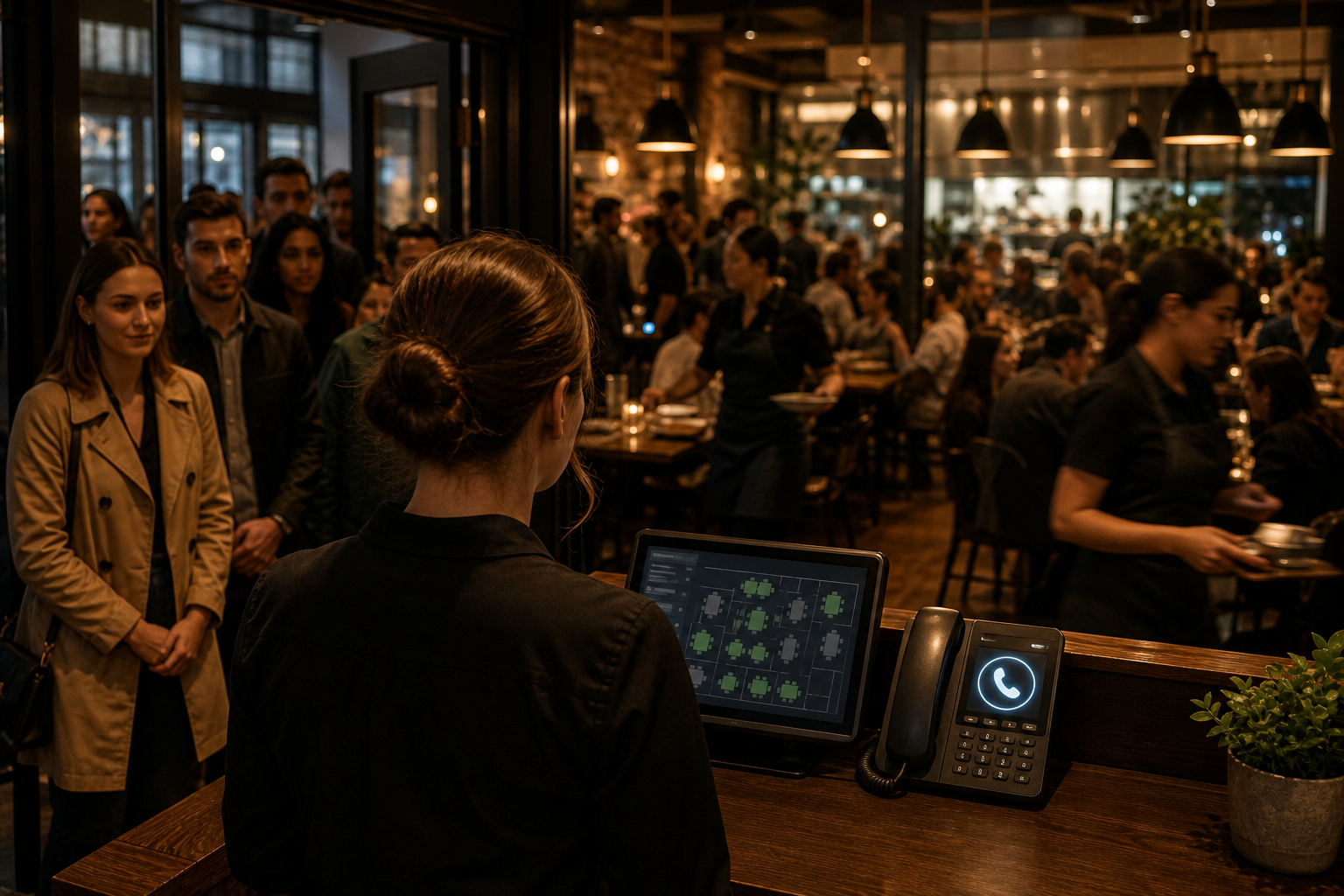
That gap costs real covers. Roughly 30% of calls go unanswered during peak service, and those missed calls drain restaurant revenue in the exact window when reservation demand is highest. One QSR Magazine analysis by Loman CEO Christian Wiens estimates unanswered calls cost U.S. restaurants roughly $20 billion a year. And the caller rarely tries twice. Industry research suggests that around 85% of callers do not call back after an unanswered call, so each missed ring is usually a booking that lands somewhere else or disappears entirely.
The losses compound on the back end too, in a separate way from the missed-call revenue above. Even after a guest books, some never arrive: Resos data covering 3.77 million reservations puts the average recorded restaurant no-show rate at 2.33% (3.17% for U.S. restaurants in the dataset), with late cancellations as a hidden cost on top, per the Resos No-Show Index. That figure measures booked guests who don't show, not unanswered calls. A call that confirms, modifies, or cancels an existing booking keeps that table working, so the seat does not sit empty or get double-promised.
A voice AI phone agent sits on top of SevenRooms and works the book like a trained host would. SevenRooms' reservation and waitlist system holds the book, the waitlist, and guest preference data; the agent reads from and writes to that book in real time over the phone. The sync runs both ways, so a booking taken on a call shows up where the host is already working.
Before quoting a time, the agent checks real-time table availability in SevenRooms for that night. If 7:30 has a four-top free, that is what the caller hears. If it is gone, the agent offers the next real slot. The host can seat a walk-in while a caller books a 7:30 four-top at the same instant, both landing in one book with no double-promised table.
A party drops from six to four, a guest pushes from 8:00 to 8:45, or someone cancels outright. The agent handles each in the call and writes the change straight back to SevenRooms. No sticky notes, no stale holds sitting on a seat another party could have taken. This is what automated restaurant reservation booking looks like in practice: the book stays current, and repeat callers are recognized.
Loman confirms the time, party size, and contact details on the call, and SevenRooms' automated messaging can send pre-arrival reminders and SMS confirmations. Reminder messaging is associated with fewer no-shows, part of how AI restaurant reservations protect covers on the nights the dining room is already full. The data points the same way: reservations with a delivered SMS reminder showed a 16% lower recorded no-show rate in an observed association, not a measured effect, per the Resos No-Show Index. A Cochrane review of text message reminders for healthcare appointments found attendance of 78.6% with reminders versus 67.8% without, a healthcare setting that points the same direction. Fewer seats held under dead reservations means more tables turning when demand peaks.
Follow a single reservation call from the first ring. The agent picks up, pulls live availability from the book, and offers the guest a real open time. Once the caller confirms the time, party size, and contact details, the booking writes straight into SevenRooms, part of how operators automate reservations for better table turnover. No one at the host stand re-enters it later.
The detail matters as much as the booking itself. A nut allergy, a request for a quiet corner, a booster seat for a toddler, a party that grew from four to six at the last minute. Each note attaches to the reservation in the same book the front-of-house already works from, so a server reading the floor sees no difference between a call-in booking and one taken at the stand.
That reliability shows up on day one, echoing the broader benefits of AI-powered reservation systems. Jamie Oweis, owner of BA Tavern, reported that Loman captured six bookings on day one that would have been missed otherwise, on OpenTable, a reservation platform Loman also integrates with.
| Phone interaction | What syncs into SevenRooms | Front-of-house benefit |
|---|---|---|
| New booking request | Confirmed reservation with time, party size, contact | No manual entry at the host stand |
| Party-size change | Updated cover count on the existing booking | Accurate table assignment |
| Cancellation | Freed table slot in real time | Seat reopened for walk-ins or waitlist |
| Special request or dietary note | Guest note attached to the reservation | Service prepared before arrival |
SevenRooms governs the reservation lifecycle here, a core part of optimizing restaurant reservations with AI-powered systems. Order-to-kitchen flow runs through a separate POS path.
For a reservation-driven restaurant, the revenue case starts with the empty seat. Every booking call that rings out is a cover that never gets sat, and on a full Saturday that is a table working at zero while the dining room turns away demand. Answering 100% of calls turns that lost demand into confirmed bookings.

The gains stack from there. Recaptured booking calls fill seats that would otherwise sit cold, tighter seating schedules push more turns through the same floor, and AI-powered reservations and waitlists keep no-shows from eating into peak-night covers. Operators using Loman have reported up to 22% higher phone revenue and up to 17% lower labor costs. Both are operator-reported figures, not audited results.
Pricing starts at $199 a month with unlimited calls and no per-minute charges. The cost holds whether the phone rings 20 times or 200 times a night. A human hired to cover the phone carries hourly wages, overtime, and turnover that spike exactly when call volume peaks during service. Labor already runs high, with the National Restaurant Association reporting that full-service operators spent a median 36.5% of sales on salaries, wages, and benefits in 2024.
None of this replaces SevenRooms, the same way it works alongside OpenTable for other restaurants. The book still governs the reservation lifecycle; Loman supplements it by catching the calls that create and change those bookings. The book stays current, the floor stays covered, and the phone is handled before the next service begins.
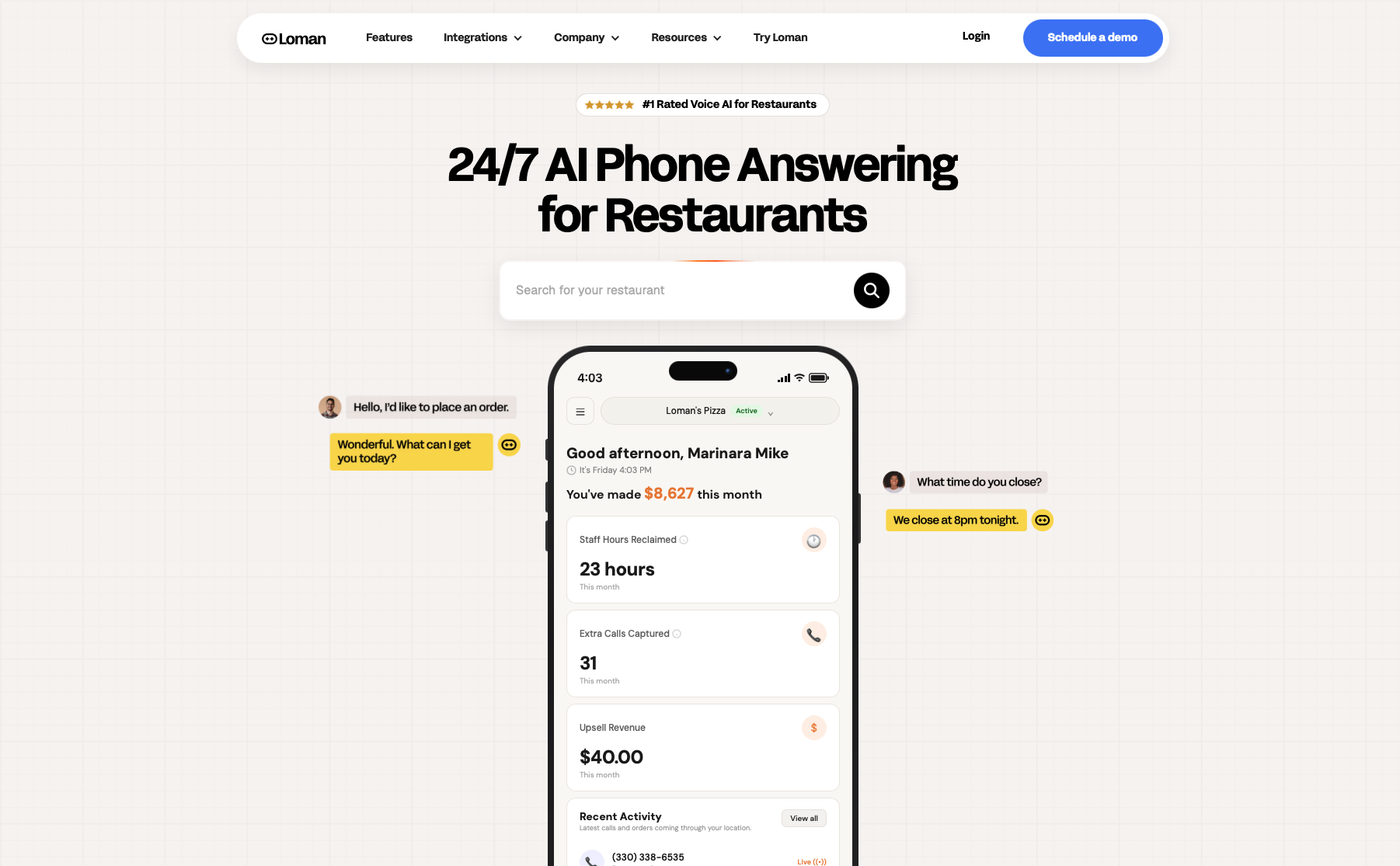
Loman is a voice AI phone agent built for restaurants, and it integrates directly with SevenRooms for real-time reservation sync. On every call it reads live availability, books, changes, or cancels, and writes the result back to the same book your host stand already works from. Loman supplements SevenRooms and never replaces it. It also closes full pickup and delivery orders and takes payment during the call through your POS integration.
Pricing starts at $199 a month with unlimited calls and no per-minute charges, so the hundredth call of the night costs the same as the first. Loman handles unlimited simultaneous calls, so nobody hears a busy signal at 7 PM. Most restaurants go live in under 24 hours: upload your menu, set your hours, and configure the call flow, with no coding or IT required.
Operators using Loman have reported up to 22% higher phone revenue and up to 17% lower labor costs. Nick Haselidis of Crust Pizza says Loman "paid for itself in 10 days," Midland Pizza Co. estimates it would lose over $200,000 a year without Loman, and Little Italy cut labor costs by more than 24%. These are operator-reported results, not audited figures, and the order-taking numbers come from restaurants running POS integrations. The reservation side follows the same logic: a call answered is a cover booked.
Yes. Loman reads live table availability from SevenRooms during the call and writes confirmed bookings, party-size changes, and cancellations straight back into the same book your host stand already works from. The sync runs both ways, so a call-in booking shows up instantly with no manual re-entry.
Put a voice AI phone agent on top of your reservation system so every call gets answered, even when the host stand is slammed. Roughly 30% of restaurant calls go unanswered during peak service, and industry research suggests around 85% of callers do not call back, so each unanswered ring is usually a cover that lands elsewhere.
Loman works alongside SevenRooms, not instead of it. SevenRooms governs the reservation lifecycle, the waitlist, and guest preference data; Loman supplements it by catching the calls that create and change those bookings and writing them back into the book.
Loman attaches each note, such as a nut allergy, a quiet-corner request, or a booster seat, directly to the reservation in SevenRooms. A server reading the floor sees no difference between a call-in booking and one taken at the host stand, so service is prepared before the guest arrives.
Pricing starts at $199 a month with unlimited calls and no per-minute charges, so the cost holds whether the phone rings 20 times or 200 times a night. Operators using Loman have reported up to 22% higher phone revenue and up to 17% lower labor costs, both operator-reported figures, not audited results.
A reservation book is only as current as the calls that reach it. SevenRooms holds the book, the waitlist, and the guest profiles, but the phone still rings when your whole team is committed to the room. The best AI voice agent for restaurants using SevenRooms reads live availability and writes bookings, changes, and cancellations straight back into the book. Loman does this from $199 a month with unlimited calls, and operators report up to 22% higher phone revenue and up to 17% lower labor costs. Here's where you go next: book a Loman demo and watch it work against a SevenRooms book before your next service.
Enter your information in the form to receive a call from Loman and place an order like a customer would!

