
You built a full schedule in SevenRooms, then watched tables sit open because nobody could grab the phone at the busiest hour. That timing forces a choice no operator should have to make: work the floor or work the phone. Finding the best AI answering service for restaurants using SevenRooms means finding one that reads your live availability during the call and writes confirmed bookings straight back into the book, no manual re-entry, no missed rings. Here's how the whole thing flows from a ringing phone to a seated party.
TLDR:
It's 7:40 on a Saturday and the host stand is three deep. SevenRooms is holding the floor together, tracking every cover, every table status, every VIP note. The phone rings anyway, and no one standing there can reach for it.

SevenRooms manages availability and guest data about as well as any reservation system for fine dining on the market. What it can't do is pick up a ringing phone while your host is mid-conversation seating a party of six. The industry loses an estimated $20 billion a year to missed calls draining restaurant revenue, and for a reservation-heavy room, every one of those rings is a booking that may never come back.
Call volume spikes at the exact hour your front-of-house staff are buried in in-person guests. That timing forces a choice no one should have to make: work the floor or work the phone. For a restaurant that lives on reservations, the stakes are sharper than a takeout shop losing an order. A missed call is a missed booking, a table that could have been full now sitting open through a prime seating.
Roughly 30% of restaurant calls go unanswered during peak hours, per research frequently attributed to BIA/Kelsey. And roughly 85% of callers do not call back after an unanswered call. The math is unforgiving: nearly a third of your inbound calls hit a dead line at the busiest moment, and most of those callers never try again. Each one is a lost cover and a table that stays empty when it should have turned.
A voice AI phone agent built for restaurants connects to SevenRooms with a two-way sync, part of how operators now automate restaurant reservation booking: it reads live table availability during the call, then writes confirmed bookings straight back into the reservation book with no manual re-entry. Because SevenRooms manages the reservation lifecycle, the value sits in bookings captured, no-shows reduced, and tables turned cleanly, not in pushing tickets to the kitchen.
Before the agent confirms a time, it checks real-time table availability across party sizes and seating sections, so two callers never land on the same table. A party of six calling for 7:30 pm gets booked and confirmed while the host is busy seating another table, with the slot closing in the book the moment it's taken.
Creation, modification, and cancellation all run over the phone, around the clock, improving customer wait time with automated reservations, and every change writes back to SevenRooms automatically. A guest who calls to add two seats or push a reservation 30 minutes gets it handled on the call, and the book updates without a staffer touching the system.
No-show rates can run as high as 20% of bookings without AI reservation systems that manage no-shows through automated confirmation and reminder systems. Automated confirmations and reminders cut that number, and cleaner booking data supports faster, tighter table turns during prime seatings. Worth noting: reservation integration is a distinct capability set from order-taking POS integrations, and it's part of AI reservation systems for small restaurants, focused on the booking lifecycle, not order flow.
A guest dials in, and the agent answers on the first ring, speaking naturally about the time they want. It checks live availability against the book, confirms an open slot, and the reservation lands in SevenRooms as a finished entry. No one at the host stand re-keys a thing. The party size, requested seating, and the note about an anniversary all attach to the booking exactly where the host already looks, so front-of-house works the same screen they always have.

The flow runs unbroken from greeting to confirmed slot, a clear example of optimizing restaurant reservations with AI-powered systems. A caller asks for Friday at eight, the agent reads what SevenRooms shows open, locks the table, and reads back the confirmation while the host is still seating a walk-in. By the time the call ends, the booking is in the book with no double-booking risk, because the availability check and the write-back run against the same live data.
As voice AI reshapes restaurant reservations, seating preferences, allergen flags, and occasion details ride along into the same fields a host would type them into, so nothing lands on a sticky note that gets lost by the second seating. A guest who mentions a nut allergy or asks for a quiet corner has that noted on the booking before they hang up.
Midland Pizza Co. estimates they would lose over $200,000 a year in missed orders without Loman, an operator-reported result, not an independently audited one.
For a reservation-driven room, the revenue math runs through covers, not tickets. Every call the agent answers is a seat that would otherwise sit empty through a prime seating, and automated confirmations trim the no-show rate that quietly drains peak-service revenue.
An answered reservation call fills a table a dropped call leaves open. Reminders and confirmations keep booked guests showing up, so the schedule you built actually seats.
Pricing starts at $199 per month for unlimited calls, with no per-minute charges. That turns phone labor, which spikes exactly when call volume does, into one predictable line item. The savings show up fast on the schedule: Little Italy reported cutting labor costs by more than 24% after letting the agent cover the phone, freeing staff who had been pulled off the floor to answer calls during the rush. Restaurant labor costs consistently run above 36% of sales, per the National Restaurant Association. Instead of adding hours every time call volume climbs, the cost stays flat at $199 while the covers it recaptures keep rising.
| Metric | Phone handled by staff | Phone handled by voice AI |
|---|---|---|
| Call coverage during rush | Limited, calls dropped | Every call answered |
| Monthly phone cost | Variable hourly wages | Starts at $199 flat |
| Reservation sync to SevenRooms | Manual entry | Automatic two-way sync |
| No-show handling | Ad hoc | Automated confirmations |
Operators using Loman have reported up to 22% higher phone revenue and up to 17% lower labor costs, figures reported by operators and not independently audited. The book stays accurate and the floor stays focused before the next dinner rush.
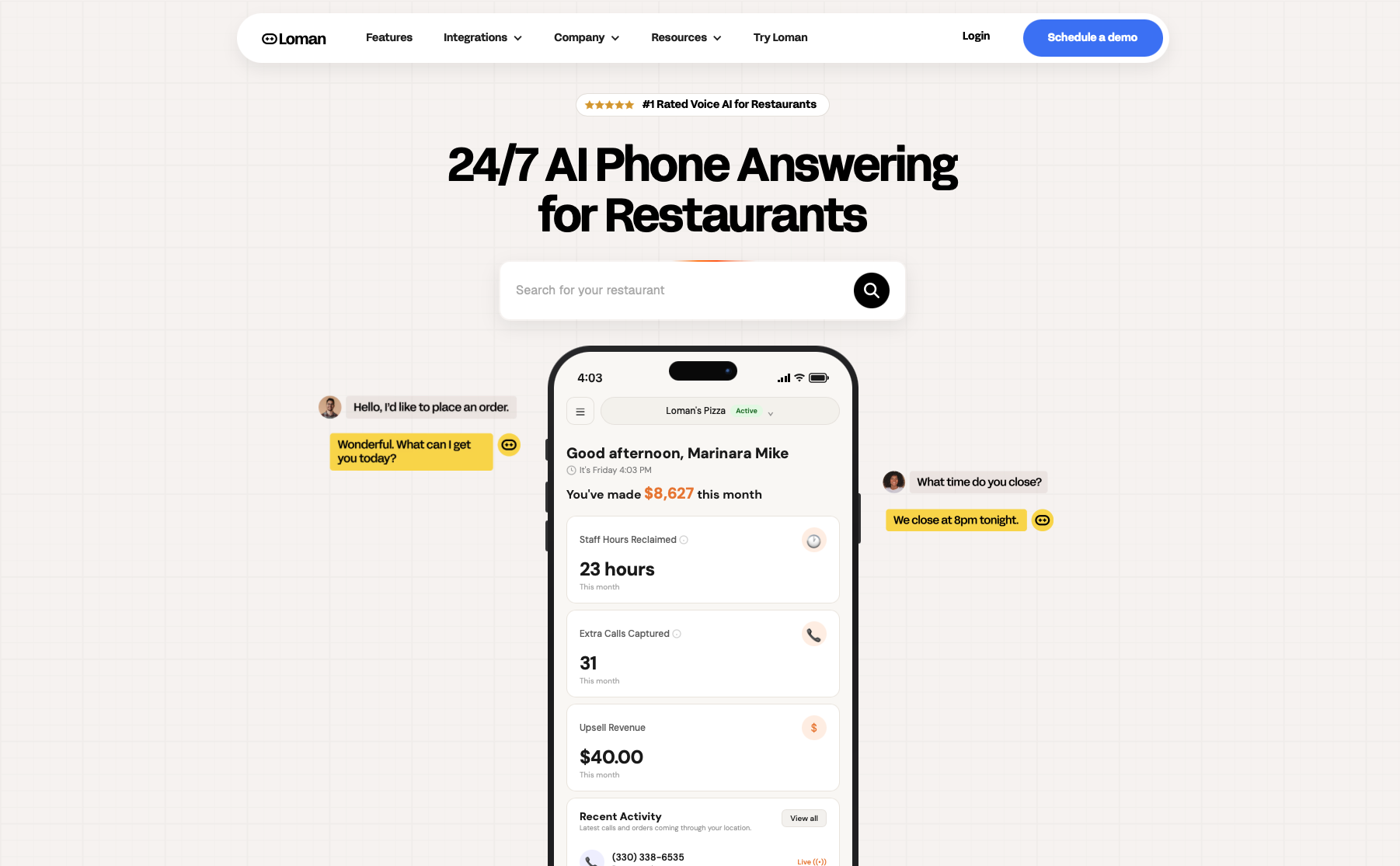
Loman is a voice AI phone agent built specifically for restaurants, not a generic answering service. It connects to SevenRooms through a live two-way sync, reads open availability in real time during the call, and writes confirmed bookings straight back into your reservation book the moment a caller says yes. No manual re-entry, no post-call cleanup, no double-booking risk. Most restaurants go live in under 24 hours with no coding or IT work required.
Where generic answering services stop at taking a message, Loman closes the booking. It handles the full reservation lifecycle (creation, modification, and cancellation) around the clock, and attaches special requests, allergen flags, and occasion notes directly to the SevenRooms record before the caller hangs up. Automated confirmations and reminders go out automatically, cutting the no-show rate that quietly drains peak-service revenue. The host stand works the same screen it always has; the only thing that changes is the phone gets answered every time.
Pricing starts at $199 per month for unlimited calls, turning variable phone labor into one flat line item. Operators using Loman have reported up to 22% higher phone revenue and up to 17% lower labor costs; these are operator-reported figures, not independently audited. For a reservation-driven room, that math shows up fast: more covers seated, fewer no-shows eating into the schedule, and a floor team that stays focused on the guests already in the room. Book a demo to see how it lands in SevenRooms before your next service.
Yes. Loman connects to SevenRooms through a two-way sync that reads live table availability and writes confirmed bookings back into the reservation book, with no coding or IT work required. Most restaurants go live in under 24 hours after connecting their systems and importing menus.
A voice AI phone agent built for restaurants answers every call on the first ring while your host works the floor. Loman is a restaurant-specific voice AI agent that handles full bookings and orders, not a generic answering service. Roughly 30% of restaurant calls go unanswered during peak hours (per research frequently attributed to BIA/Kelsey), and about 85% of callers never try again, so answering every ring keeps those covers from walking.
Both integrate with SevenRooms for reservation management. Slang.ai's public materials center on reservations and guest info, and it's unclear whether they offer full phone order-taking with in-call payment, which Loman handles. For a reservation-heavy room that only needs booking coverage, both read live availability; the deciding factor is what each can confirm against your own systems before you commit.
Loman checks real-time SevenRooms availability across party sizes and seating sections before confirming any time, and the slot closes in the book the moment it's taken. Because the availability check and the write-back run against the same live data, two callers never land on the same table.
Yes. Seating preferences, allergen flags, and occasion details attach to the booking in the same SevenRooms fields a host would type them into, before the caller hangs up. A guest who mentions a nut allergy or asks for a quiet corner has it noted on the reservation automatically.
Your floor stays focused, your book stays clean, and the phone stops being a choice between two jobs. Answered calls fill tables, and automated confirmations keep booked guests showing up. If you've been searching for the best AI answering service for restaurants using SevenRooms, Loman is built for exactly that, restaurant-specific voice AI that handles the full booking lifecycle, not a generic message-taker. Book a demo and see how it lands in SevenRooms before your next prime seating.
Enter your information in the form to receive a call from Loman and place an order like a customer would!

