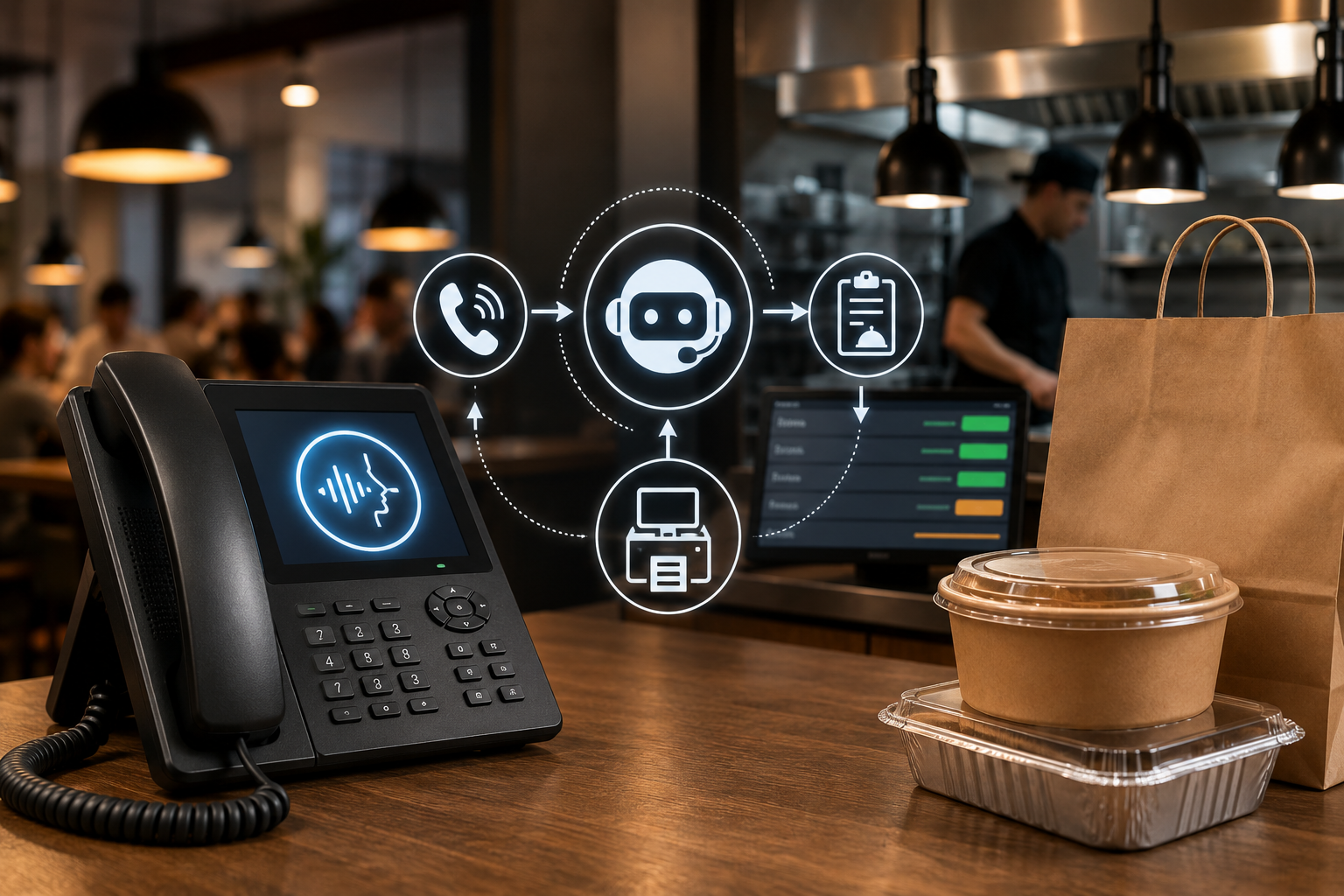
The calls your restaurant misses during a Friday rush don't usually come back, and each one is a $48 order walking out the door. That's the problem voice ordering for restaurants is built to solve, but not every system solves it the same way. Before you sign up for anything, it helps to know what these tools can genuinely handle, where they still struggle, and what a reasonable rollout looks like.
TLDR:
Voice ordering is software that answers the phone, takes a customer's order out loud, and sends it to the kitchen without any staff picking up. The caller talks the way they always have, and the system listens and responds in real time.
On a live call, a voice AI agent does the full job a person would. It greets the caller, works through the menu, and captures each item. When someone wants extra sauce on the side or fries swapped for salad, the agent handles the modifier. It answers questions about hours or allergens, then confirms the total and closes the transaction, often taking payment on the same call.
Generic voice assistants miss regional dish names, modifier logic, and mid-rush phrasing. Restaurant-trained systems learn from real ordering calls (see how voice AI is changing food ordering systems), so they hold up where general tools fall short.
Voice ordering comes down to missed calls draining restaurant revenue: When every call gets answered, orders that hit a busy signal or voicemail turn into tickets instead:
Diners are ready. More than 70% said they would use voice ordering, per a voice ordering consumer survey. Grand View Research's AI voice agents market forecast puts the market at $2.5 billion in 2025, on pace to grow 39% annually through 2033.
Voice AI is not a fit for every call, and the gaps show up fast. Accuracy sets the ceiling. Below roughly 90%, callers correct the system so often that throughput goes negative. Handling high-volume calls in busy restaurants requires systems that hold above that floor; the 90 to 95% band works for simple orders but breaks down on complex modifications.
Other limits worth weighing before you commit:
Rollout takes work too. Your team needs to know what the agent escalates and where transferred calls land. Without a reliable path to a live person, one botched order can cost you the guest.
Voice ordering shows up in three places, and cost and setup vary widely between them.
Phone ordering handles inbound calls for takeout and delivery. It needs no new hardware, making it the easiest starting point for independents and smaller chains.
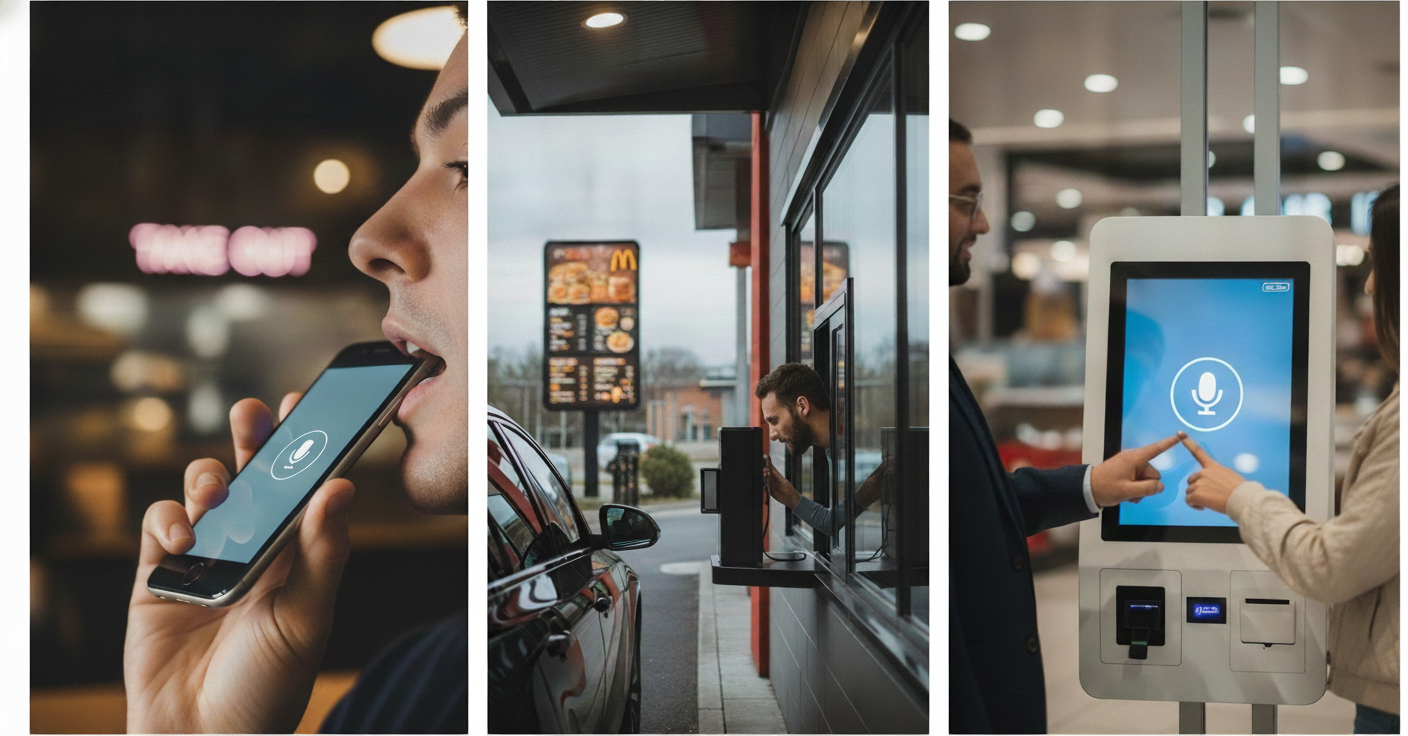
AI drive-thru voice technology takes lane orders at QSRs and fast-casual spots running high volume. Expect more here: outdoor mics, menu boards, and infrastructure that ties into existing lane systems.
Kiosk voice ordering runs in-store self-service, letting guests speak their order at a counter unit instead of tapping through screens.
DoorDash ceased its voice ordering pilot for restaurants a year after adding AI startup talent, according to a DoorDash voice ordering exit report. The product launched in August 2023 to help staff field calls during busy stretches.
What matters is whether a tool was built for restaurant operations from the ground up or bolted on as a side feature by a delivery-focused company (see why generic AI phone answering falls short). Vendors with staying power treat phone ordering as their core business, not a roadmap line item.
Before signing, put each vendor through the same questions:
Start by naming the bottleneck: calls hitting voicemail, staff pulled off the counter, or wrong tickets in the kitchen. That tells you what the system has to fix.
From there, the rollout moves through a few steps:
Most restaurant-specific systems need no IT staff or custom code. Timelines run from a day to several weeks depending on the vendor.
| Pricing model | How it works | What happens at peak |
|---|---|---|
| Flat monthly subscription | Fixed fee, often with unlimited calls | Cost holds steady |
| Per-conversation | Charged per call, around $0.59 each | Bill climbs with volume |
| Enterprise contract | Custom pricing and support terms | Varies by deal |
Per-conversation rates look cheap until a Friday rush stacks hundreds of calls, and the bill spikes when you can least predict it. Understanding AI order taking cost and ROI helps you choose the model that holds at peak.
On "free": tiers exist but typically cap call volume, integrations, or order closure. Treat them as a demo, not a working setup.
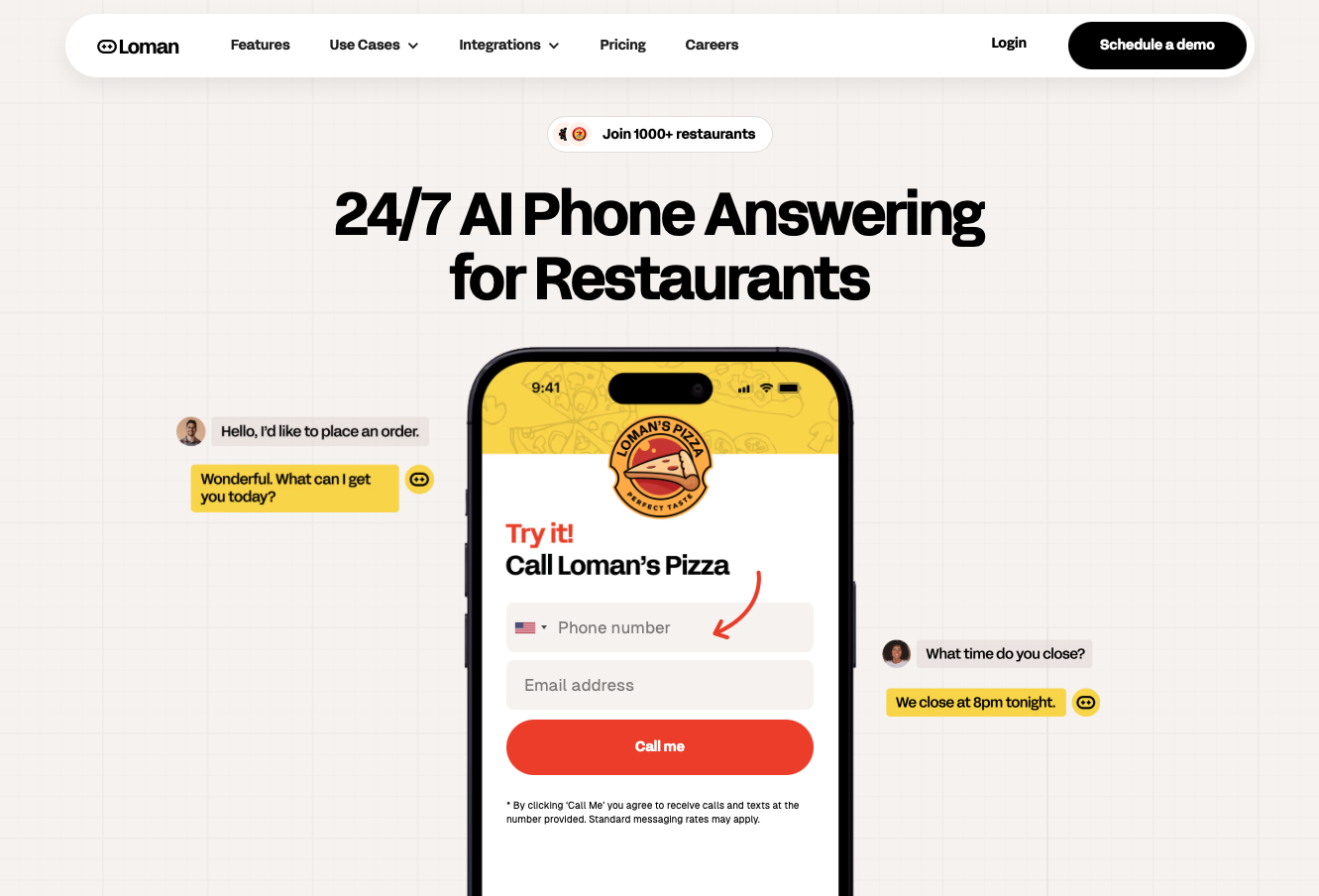
Loman is a 24/7 voice AI phone agent built for restaurants, live in under 24 hours with no coding, starting at $199 a month with no per-minute charges. It answers pickup and delivery orders, reservations, and menu questions, then pushes every ticket straight into the POS so staff never re-key an order.
On the criteria that trip up general-purpose tools, it lines up:
Operators using Loman have reported up to 22% higher phone revenue and up to 17% lower labor costs. Tony Boloney's reports capturing an extra 75 to 100 orders per month per location, and for pizza phone orders handled by voice AI, Midland Pizza Co. estimates it would lose over $200,000 a year without Loman answering phones.
To hear it take a live order, book a demo.
Yes. Flat-subscription systems like Loman start at $199 a month with no per-minute charges and unlimited concurrent calls, so your bill holds steady whether the phone rings 20 times or 200 on a Friday night. Per-conversation pricing models, around $0.59 per call, look affordable until a dinner rush stacks hundreds of calls and the invoice spikes at the worst possible moment.
Restaurant-trained voice AI reads your live POS menu during the call, so it catches swaps, add-ons, and split requests as the caller speaks them, then confirms the full order before pushing a clean ticket to your kitchen display. Generic voice assistants trained on general tasks miss regional dish names, modifier logic, and 86'd items, which is why accuracy below roughly 90% creates more rework than it removes.
Pricing runs from roughly $199 a month for flat-subscription systems with unlimited calls up to enterprise contracts with custom terms. Per-conversation models charge around $0.59 per call, which compounds fast at peak volume. Free tiers exist but nearly always cap call volume, limit POS integrations, or block full order closure, so treat them as demos and not a working setup for a restaurant that relies on phone revenue.
Phone ordering has always been the channel restaurants underinvest in, and voice ordering for restaurants is the straightforward fix for that. Accuracy, POS sync, and concurrent call capacity are the three things worth stress-testing before you sign anything. Every Friday night that goes by with calls hitting voicemail is revenue that does not come back, roughly 85% of callers who go unanswered do not try again, per industry research attributed to BIA/Kelsey. The math on inaction adds up fast, and the fix is no longer a large-budget project. Most restaurant-specific systems go live in under a day with no coding required. Book a demo to see how Loman holds up against your actual menu and call volume before the next dinner rush hits.
Enter your information in the form to receive a call from Loman and place an order like a customer would!

