
When was the last time your host caught every call during the dinner rush? Between seating tables and quoting waits, the line goes to voicemail, and research frequently attributed to BIA/Kelsey indicates roughly 85% of those callers do not call back after an unanswered call. OpenTable keeps your reservations straight, but it can't answer the phone for you. Finding the best AI voice agent for restaurants using OpenTable comes down to one question: which system reads and writes to your book without anyone re-keying a thing.
TLDR:
It's 7:40 on a Saturday and the host stand is three parties deep, menus in hand, when the phone starts ringing again. OpenTable holds the reservation book just fine. What it cannot do is pick up that line while your host is seating a four-top and quoting a wait to the couple at the door.

That gap costs money fast. Roughly 30% of restaurant calls go unanswered during peak hours, by industry estimates, and research frequently attributed to BIA/Kelsey indicates roughly 85% of callers do not call back after an unanswered call. None of that is an OpenTable shortcoming. It is a missed calls restaurant revenue problem that sits upstream of the booking system.
Phone volume spikes at the exact hour your floor staff are stretched thinnest. The host is running the book, bussers are flipping tables, and servers are mid-course. A call for a Friday reservation lands in that same window, so it goes to voicemail or rings out entirely. The busiest nights are when you lose the most bookings. Guests keep calling because they want a person on the line: Cornell research on phone reservations found that diners like the convenience of online booking but appreciate the personal touch of a phone call.
Every unanswered reservation call is a table that may never get filled. When 85% of those callers do not try again, they are dialing the restaurant down the street instead. And an empty two-top at 8pm on a Saturday cannot be sold later that night. The covers are gone, the kitchen idles through a slot it was staffed to serve, and the revenue walks with the caller.
A voice AI agent for fine dining reservations sits between the caller and the OpenTable book, reading and writing in both directions. It pulls live table availability during the call, confirms the details out loud, then pushes the booking back into OpenTable with no one re-keying a thing.
Before the agent confirms anything, it checks what is actually open in OpenTable. A caller asking for a party of four at 7:30 pm hears only the slots that genuinely exist, so a table never gets promised twice. The host stand stays clean, and the book reflects reality the moment the call ends.
Party-size changes, time changes, and cancellations all sync straight to the OpenTable dashboard through automated restaurant reservation booking. No sticky notes, no "I'll update it later," no lost bookings when the floor gets slammed. When a guest calls to drop from six to four or move an 8pm to 8:30, the change lands in the book instantly. Tony Boloney's reports that Loman adds 75 to 100 extra orders per month per location that would have been missed entirely.
The agent handles calls bilingually and recognizes repeat callers, which gives guests a loyalty-like experience without an app download or a points card. For context, more than 67 million US residents speak a non-English language at home, which is one reason voice AI for restaurant reservations that answers in a caller's language captures bookings you might otherwise lose. A returning guest gets greeted with their history already in hand.
A reservation call follows a clean path from the moment it connects to the moment the table shows up in your book. Nothing waits for a staffer to circle back.
As part of improving customer wait time with automated reservations, the agent greets the caller, asks what they need, and checks live OpenTable availability before it commits to anything. Once the guest settles on a time and party size, the agent confirms the details out loud and writes the reservation into OpenTable in real time. The booking surfaces in the same dashboard your host works from, and the guest gets a confirmation on their end. Because the agent only offers slots the book actually shows open, a single table never gets handed to two parties.
Every booking, and every change that follows it, lands in OpenTable exactly as if a host keyed it by hand. A party dropping from five to three, a guest pushing an 8pm to 8:45, a note about a high chair or a birthday dessert, all of it appears in the same record the floor already reads. There is no second screen to check and no end-of-night reconciliation between the phone and the book.
That is the point for front-of-house. Your host is not retyping anything or chasing voicemails between seatings; they are at the stand, greeting guests and running the room. And because every booking and change writes straight to the book, there is nothing to square up at close, no gap between what the phone promised and what the floor sees.
Reservations run on timing. A table that sits empty at 8pm cannot be resold that night, so every answered call protects a slot the kitchen is already staffed to serve. Automated confirmations and reminders matter here as part of managing no-shows with AI reservation systems, because industry data indicates no-show rates can run as high as 20% of bookings without them. In the Resos No-Show Index 2026, which covers 3.77 million reservations, delivered SMS reminders were associated with a 16% lower recorded no-show rate.

Answer the call, hold the table, and confirm it ahead of time, and the no-show math changes, one of the clearer benefits of AI reservation systems. Operators using Loman have reported up to 22% higher phone revenue and up to 17% lower labor costs. Tighter turns and fewer empty prime-time seats compound across a week of service. Operators are leaning that way: the National Restaurant Association's 2026 State of the Restaurant Industry report says operators plan to invest in more technology that strengthens guest connections.
Capabilities vary across the category, and some depend on the vendor's own setup, as seen in comparisons like Slang AI vs VOICEplug. Confirm any row below against your own reservation system before committing.
| Capability | Loman | Slang AI | Popmenu AI Answering | Hostie AI |
|---|---|---|---|---|
| OpenTable reservation sync | Yes, two-way | Books via OpenTable and SevenRooms | Confirm with vendor | Confirm with vendor |
| Full phone order taking | Yes | Reservation and guest info focus | Confirm with vendor | Confirm with vendor |
| In-call payment | Yes, via POS | Does not publicly list | Does not publicly list | Does not publicly list |
| Concurrent calls | Unlimited | Confirm with vendor | Confirm with vendor | Confirm with vendor |
| Starting price | From $199/month | Confirm with vendor | Confirm with vendor | Confirm with vendor |
Loman also syncs with Resy and SevenRooms, so the same reservation flow holds across all three books, which is worth weighing against options covered in Hostie reviews and pricing.
Answered calls stack up, a point covered further in the Loman vs Popmenu comparison. More bookings kept means fuller seats at peak, fewer dead slots means better utilization, and a phone the host no longer chases means labor stays on the floor. The book fills itself, the stand stays calm, and the room runs the way it should before the next dinner rush walks in.
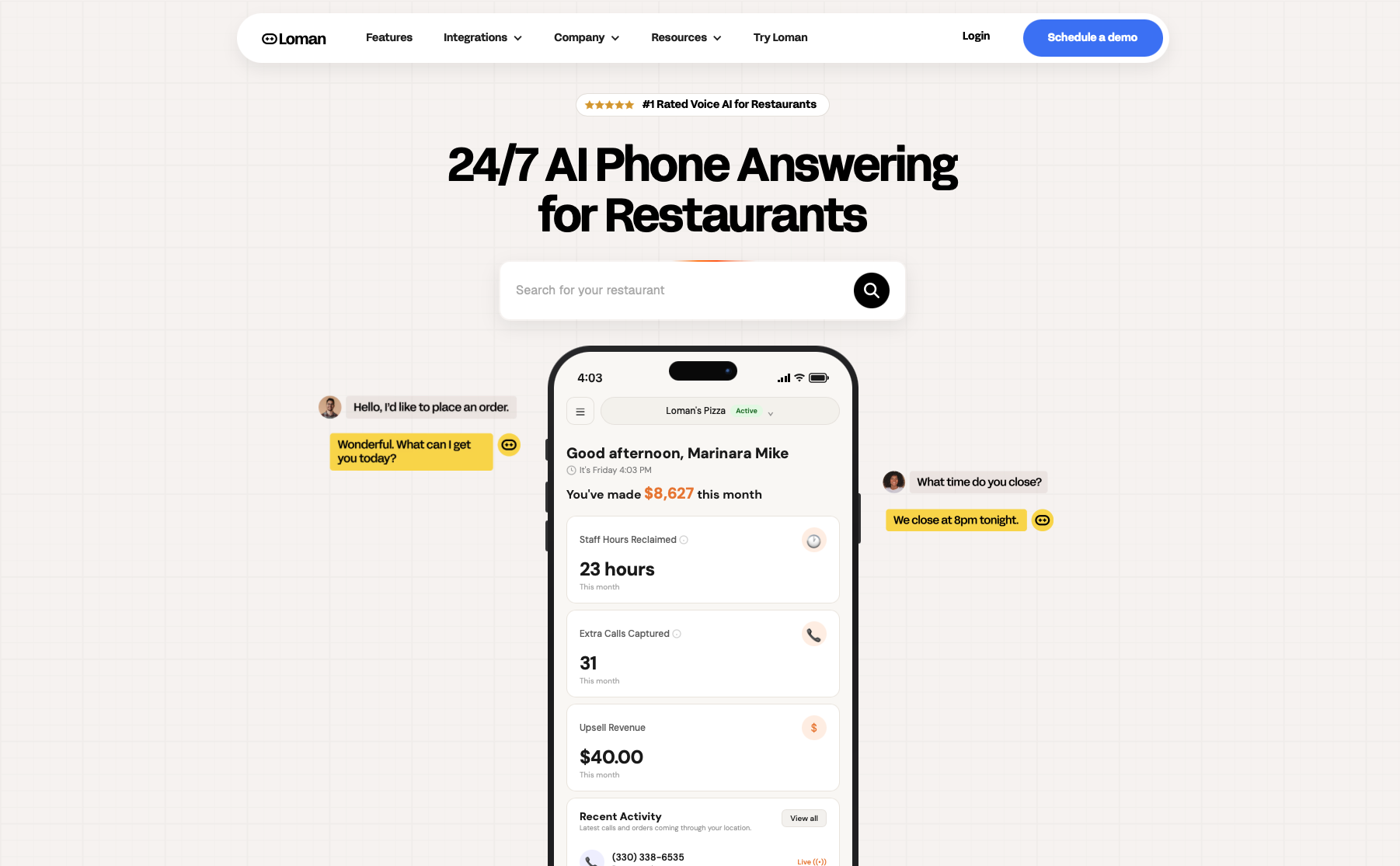
Loman's OpenTable integration is two-way: the agent reads live table availability from your book before it confirms anything, then writes every new booking, change, and cancellation back into the same dashboard your host already works from. There is no second screen, no end-of-night reconciliation, and no table ever promised twice. Jamie Oweis, owner of BA Tavern, put it plainly: "Loman captured 6 bookings I would have completely missed on day 1. That alone is worth it."
Beyond the OpenTable sync, Loman answers every call at once, no busy signal, no hold queue, no call dropped because two parties phoned in at the same time. It converses bilingually, recognizes returning guests, and handles party-size changes, special requests, and cancellations without pulling anyone off the floor. Operators using Loman have reported up to 22% higher phone revenue and up to 17% lower labor costs. Pricing starts at $199 per month with no per-minute charges, so the cost stays flat whether the phone rings 20 times or 200 times on a Saturday night.
Loman also syncs with Resy and SevenRooms, so the same reservation flow holds across all three books. If your restaurant takes phone orders in addition to reservations, Loman handles those too, pushing tickets straight to your POS and processing payment in-call. The setup takes under 24 hours. See how it handles your own calls at loman.ai/demo.
Yes. A two-way voice AI agent like Loman reads live OpenTable availability during the call, confirms the details with the caller, and writes the booking straight into the same dashboard your host already works from. Party-size changes, time changes, and cancellations all sync automatically, so there is no second screen and no end-of-night reconciliation.
Both integrate with OpenTable, but Slang AI is built around reservation management and guest info, while Loman also takes full phone orders and processes in-call payment through your POS. If your restaurant runs on reservations alone, either covers the book; if you also want to recapture phone orders, that distinction shows up fast in day-to-day use. Confirm each vendor's current capabilities against their own materials before committing.
Answering the call, holding the table, and confirming ahead of time changes the no-show math. An automated agent sends the confirmation and reminder every time, so guests who would have quietly forgotten either show up or cancel early enough for the slot to be rebooked, instead of leaving an empty table at prime time.
Yes. Loman syncs with OpenTable, Resy, and SevenRooms, so the same reservation flow holds across all three books. Each change made over the phone writes back to the respective dashboard, which prevents double-booking regardless of which system your floor runs on.
Your book is only as full as the calls you answer, and the busiest nights are when the most slip through. Loman is the best AI voice agent for restaurants using OpenTable; it checks live availability, pushes bookings back into the dashboard, and keeps your seats full without pulling your host off the floor. See how it handles your own calls with a quick demo before your next Saturday rush.
Enter your information in the form to receive a call from Loman and place an order like a customer would!

