Two systems can both answer your phones and still leave you with very different outcomes at the end of a busy shift. Reachify AI and Loman both pick up every call, but what happens next is where they split. If closing the full order on the call matters to you, that split is worth understanding before you commit.
TLDR:
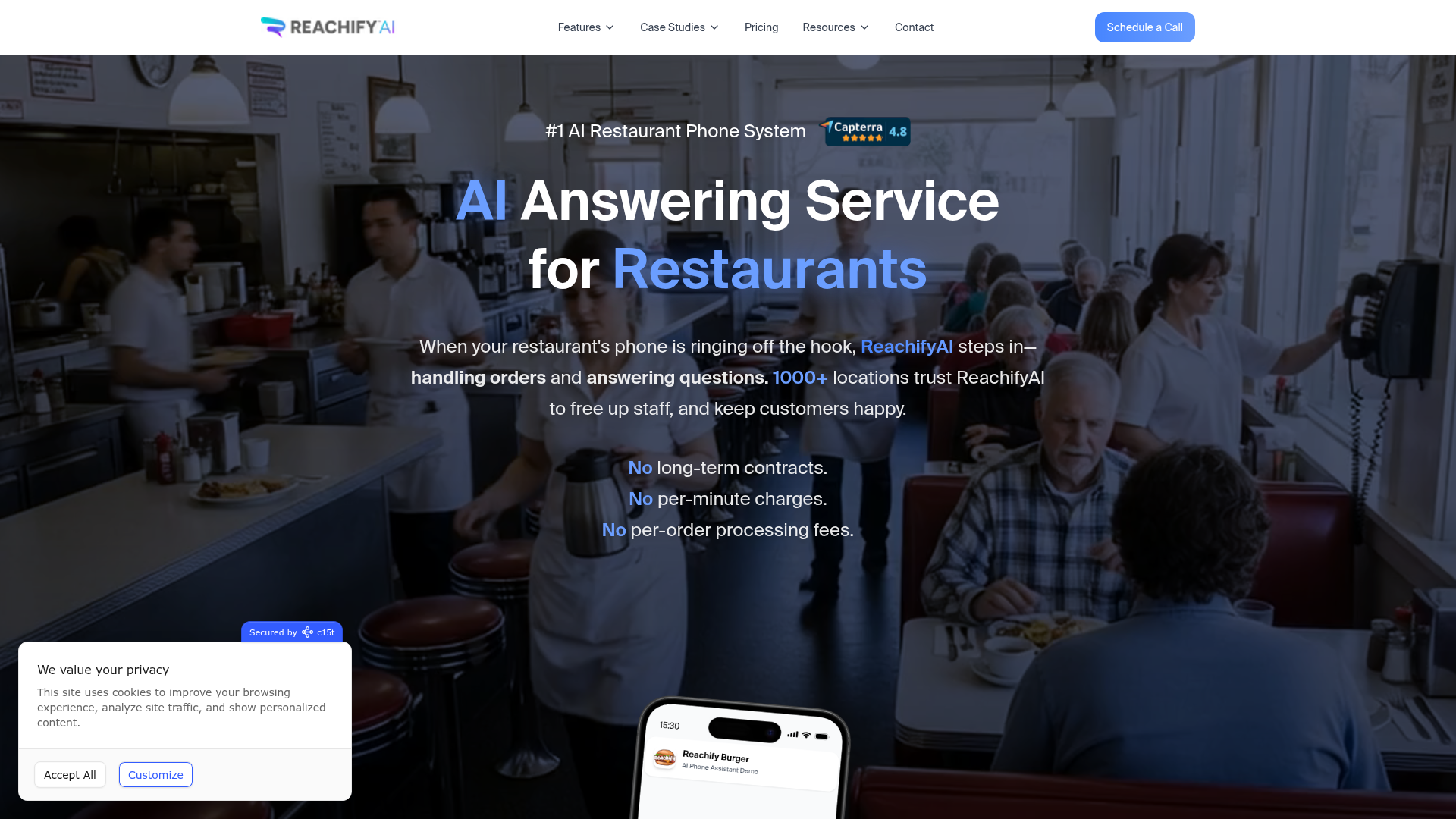
Reachify is an AI-powered restaurant phone system that answers inbound calls, fields common questions, and sends callers texts with actionable links. It speaks more than 50 languages, which makes it a fit for restaurants serving diverse neighborhoods.
The core mechanic worth understanding is how Reachify moves a caller forward. Instead of taking a full order on the line, systems like Reachify route calls or send texts back to keep the order going without a human answering. The caller taps a link and finishes on a web page or ordering flow, so the actual transaction happens outside the phone conversation.
On cost, Reachify starts at $149 per month per location with flat pricing and no per-call or per-order charges. For operators who want predictable monthly billing, that structure removes the uncertainty of usage-based fees during busy stretches.
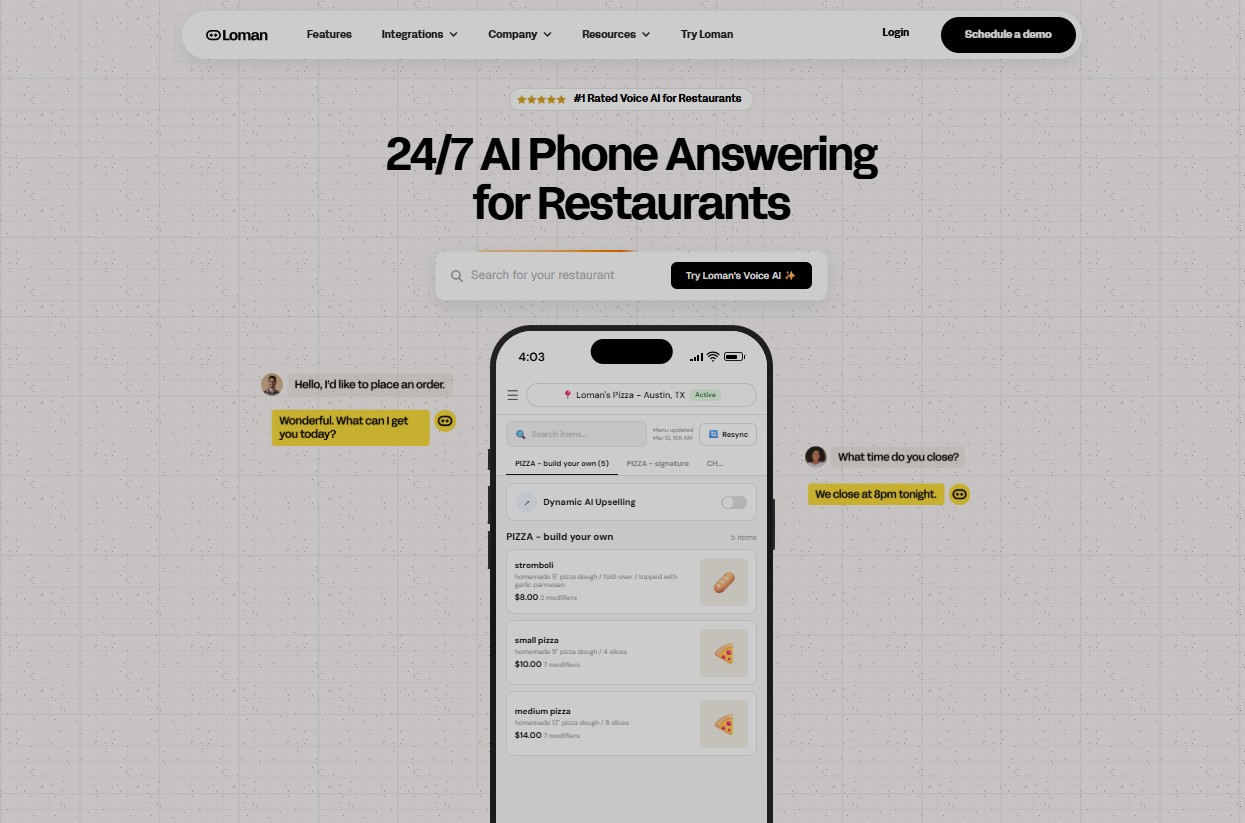
Loman is a 24/7 voice AI phone agent for restaurants that answers every call, takes complete pickup and delivery orders, books reservations, and pushes clean tickets straight into your POS and KDS. No one re-keys an order. No caller sits on hold.
Where a message-taking layer captures a name and a callback number, Loman closes the full order in the call. It reads your menu, handles modifiers and upsells, and drops the finished ticket into the kitchen while the line stays calm.
Pricing starts at $199/month, and most restaurants go live in under 24 hours after menu, hours, and call-flow setup.
The difference between these two systems shows up the moment a call ends. One closes the order inside the POS (see restaurant POS integration with AI technology for how that works). The other hands the caller a link and asks them to finish somewhere else.
Reachify answers calls and sends actionable SMS links back to callers to keep orders moving. Its website now lists named POS partners, including Square, Toast, Clover, and NCR Aloha, describing the integration as providing menu data and availability to the AI. Bidirectional order-push into the POS and KDS is not publicly documented, so operators should confirm whether completed orders land directly in their system or whether the SMS redirect still requires manual re-entry.
Loman's nine named partners (Toast, Square, Clover, SpotOn, SkyTab, Aloha by NCR, Olo, Stream, and OpenTable) cover POS order-push and reservation management across the set. The POS partners share these capabilities:
(OpenTable handles reservation lifecycle management, not POS order-push.)
Every modifier, special request, and upsell lands clean in the kitchen display, a result of AI phone system POS integration. Operators using Loman have reported up to 23% higher revenue per order through recaptured calls and direct order injection.
Payment is where an order either closes or stays open. If the caller has to finish a separate step after hanging up, that step becomes a place to lose the sale.
Reachify's public materials describe answering calls, fielding questions, and sending SMS links to keep guests engaged. In-call credit card processing is not documented as a named feature. Operators relying on Reachify for phone orders should confirm whether payment is captured on the line or handed to a separate step. That matters because every added step compounds abandonment risk, and studies consistently show 67 to 70% of callers hang up when forced into a phone tree instead of a person.
Loman takes the credit card payment during the call through its POS integration, closing the transaction end to end with no callbacks. Collecting payment at order time reduces no-shows, and the kitchen receives a confirmed, paid ticket without another staff touchpoint.
Answering the call is the setup. What happens during it decides the check size.
Reachify's documented functionality covers call answering, FAQ responses, and SMS link delivery. It does not publicly list a built-in upselling engine, and third-party sources describe its menu connection as providing information to callers instead of a real-time two-way sync that reflects 86'd items and modifier changes mid-call. Restaurants with complex, frequently updated menus should confirm how Reachify handles live changes to avoid quoting unavailable items.
Loman's AI-powered phone agent upselling engine offers add-ons and popular combos on every call, with no staff involvement. Phone orders through Loman average $48 versus $41 for online orders, a roughly 17% premium that compounds across weekly call volume. Real-time POS menu sync means Loman never quotes an 86'd item, and every modifier update lands automatically before the next call rings.
During a Friday rush, the question is whether every ringing line gets answered at once. Both systems clear that bar. Reachify handles unlimited simultaneous inbound calls and provides hour-by-hour analytics that help inform staffing decisions, which suits its target buyer: small independents who want a predictable flat-rate cost.
Where the two approaches split is across locations. Reachify's website notes it serves both single and multi-location brands, but does not publicly detail specific multi-location features like per-store menu overrides, location-specific routing, or roll-up analytics, so multi-unit operators should confirm those capabilities directly before committing.
Loman AI + SpotOn is one example of how Loman handles unlimited concurrent calls with no cap, quoting wait times and routing edge cases without ever returning a busy signal. For groups, it supports shared menus with per-store overrides, local numbers, store-specific hours and holidays, and region-based routing, with analytics that roll up by location. Tony Boloney's, an operator using Loman, reported 75 to 100 extra orders per month per location; for context on AI phone agent ROI for restaurants, that figure scales with each unit added.
Answering every call used to be a differentiator. In 2026, it is the floor. A HungerRush survey of 1,000 U.S. diners found that 52% had already used AI-powered tools when ordering food, and 54% said they are comfortable with restaurants using AI to improve speed, accuracy, and convenience. Offshore call centers, once a cost-cutting workaround, have largely fallen away; the guest-experience trade-off proved too costly in incorrect orders and communication friction.
That context changes what the choice between these two systems actually means. Both pick up the phone. The question in 2026 is whether the call closes as a confirmed, paid ticket or passes the caller a link to finish somewhere else. Callers are already comfortable ordering through AI. The extra step a redirect adds is no longer a minor inconvenience in a channel that has matured past it.
| Capability | Reachify | Loman |
|---|---|---|
| Starting price | $149/month per location | $199/month |
| Call handling | Answers calls, sends SMS links to keep orders moving | Answers calls and takes the full order end-to-end |
| In-call payment capture | Not publicly documented | Yes, payment collected during the call via POS integration |
| POS order-push | Lists named partners for menu data and availability; direct order-push to POS not publicly documented | 9 named partners: Toast, Square, Clover, SpotOn, SkyTab, Aloha by NCR, Olo, Stream, OpenTable |
| Built-in upselling | Not publicly documented | Yes, AI-powered upsell engine on every call |
| Real-time menu sync | Menu information provided to callers; live two-way sync not confirmed | Yes, reflects 86'd items and modifier changes mid-call |
| Concurrent calls | Unlimited simultaneous inbound calls | Unlimited with no cap |
| Multi-location features | Not publicly documented (per-store overrides, roll-up analytics) | Per-store overrides, local numbers, region-based routing, roll-up analytics |
| Average phone order value | Not reported | $48 vs. $41 online (~17% premium) |
| Setup time | Not publicly stated | Most restaurants live in under 24 hours |
If every phone order needs to land in your kitchen as a clean, paid ticket with no manual re-entry, Loman is built for that outcome. Its nine named POS integrations (Toast, Square, Clover, SpotOn, SkyTab, Aloha by NCR, Olo, Stream, and OpenTable) push orders directly into the POS and KDS the moment the call ends. No one re-keys a ticket. No caller gets passed a link to finish somewhere else.
In-call payment processing closes the transaction during the call, not after it. That removes the callback loop, reduces no-shows, and sends the kitchen a confirmed order every time. The built-in upselling engine offers add-ons and popular combos on every call, which is where the $48 average phone order versus $41 online comes from. Operators using Loman have reported up to 23% higher revenue per order, and Tony Boloney's added 75 to 100 extra orders per month per location after going live. Setup takes under 24 hours. You can find the full breakdown in the restaurant phone automation guide.
The deciding factor is what happens after the call ends. If your goal is basic call coverage that deflects common questions and points callers to an online flow, Reachify's flat-rate structure covers that need. If every call needs to close as a confirmed, paid, kitchen-ready ticket with no manual re-entry, Loman's direct POS integrations and in-call payment processing are built for that outcome.
Reachify answers the call and sends an SMS link so the caller finishes their order on a separate web flow, meaning the transaction happens outside the phone conversation. Loman takes the complete order during the call, processes payment through its POS integration, and pushes a clean ticket straight to the kitchen display, closing the sale without any additional step.
Reachify fits independent operators whose primary need is keeping calls off voicemail and directing guests toward existing online ordering flows at a predictable monthly cost. Loman is built for restaurants where phone orders are a direct revenue channel, including pizza shops, casual dining, and multi-unit groups that need every call to generate a confirmed, paid order with no staff touchpoint.
The two systems answer calls, but they hand you different outcomes at the end of each one. Reachify sends callers a link and asks them to finish somewhere else; Loman takes the order, collects payment, and drops a confirmed ticket into your POS before the line goes quiet. For operators where every unanswered or unfinished order is real money, that difference shows up fast on a busy Friday. See it in action at loman.ai/demo and verify the integration with your own POS before you sign anything.
Enter your information in the form to receive a call from Loman and place an order like a customer would!

