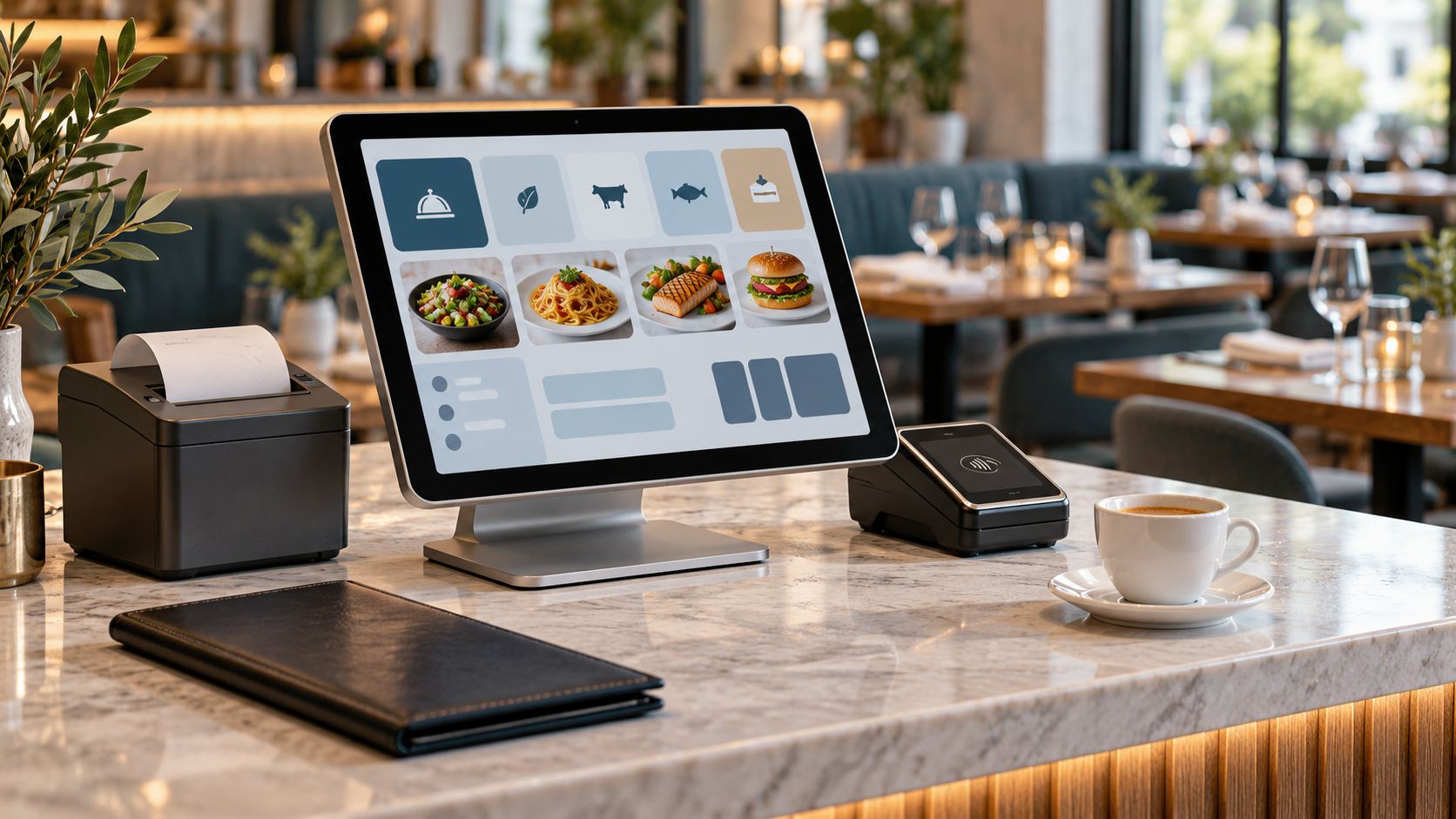
You wanted a straightforward answer on what Revel POS costs. Revel+ pricing starts at $11.99/month per US location, but that number only tells part of the story. In June 2024, Shift4 bought Revel, the platform moved into maintenance mode, and new merchants now get pointed to SkyTab instead. If you are still researching Revel POS pricing, you need to know what the subscription actually ran, what happened to the product, and what the real path forward looks like now.
TLDR:
Revel+ is the subscription tier that underpins the platform's ongoing feature access, cloud sync, and support coverage. Pricing is set per location, so a three-unit group pays three times the listed rate. Every new account qualifies for a 2-month free trial, long enough to run a real-world test across a full billing cycle before your card is charged.
| Region/Currency | Monthly Cost Per Location |
|---|---|
| United States (USD) | $11.99 |
| Canada (CAD) | $15.99 |
| United Kingdom (GBP) | £9.99 |
| European Union (EUR) | €10.99 |
| Singapore (SGD) | $15.99 |
| Australia (AUD) | $17.99 |
All subscriptions include a 2-month free trial period and are billed monthly per location.
The Revel+ subscription covers the core software layer: real-time cloud reporting, menu management, employee scheduling tools, customer relationship management (CRM) features, and access to Revel's integration marketplace, plus premium support access. Given the Shift4 acquisition, the roadmap for new product development is uncertain, so treat today's feature set as largely what you will have going forward. The 2-month free trial is long enough to validate whether the platform fits your workflow, but budget the first two to three weeks for setup, menu configuration, and staff training rather than live testing. Use the remaining weeks to run real transaction volume and test the integrations that matter most, such as third-party delivery platforms, loyalty programs, and kitchen display system routing, since those are the areas where friction tends to show up that a demo will not reveal.
Payment processing fees (Revel has historically listed rates around 2.49% per transaction through its preferred processors) then accumulate quickly at volume. A restaurant doing $50,000/month in card sales pays roughly $1,245/month in processing alone at that rate, dwarfing the $11.99 subscription by a factor of more than 100 (industry interchange estimates for restaurants typically run in the 2.35-2.49% range).
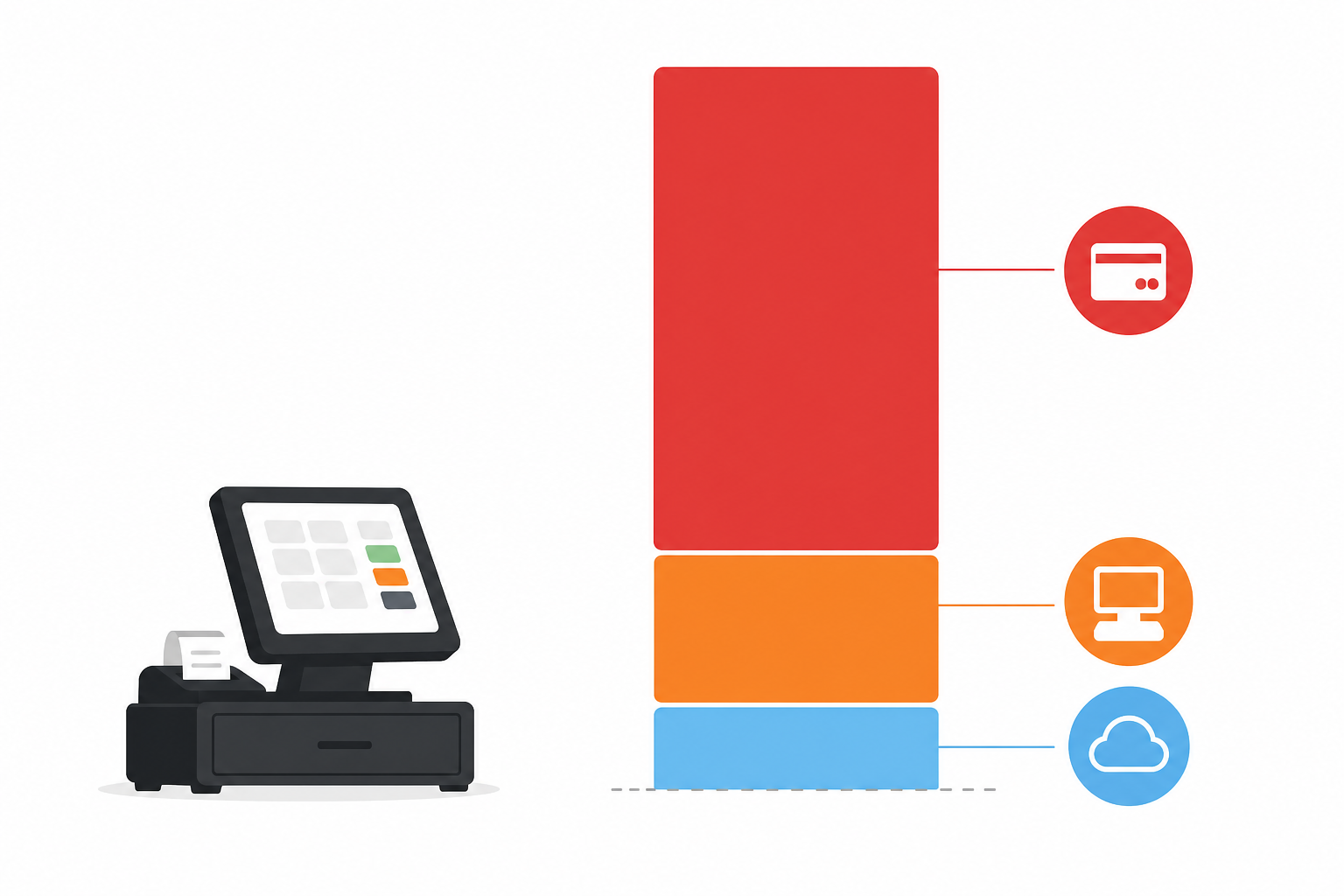
Understanding the ROI of AI phone tools for restaurants can sharpen how you review any recurring technology spend, the same way you would model hardware and processing costs before signing with any POS vendor. A 20-location group hits $239.80/month in subscription costs, still modest as a percentage of total POS spend, but worth tracking as a line item when you are also multiplying hardware refreshes and processing volume across every site. It is worth modeling that full cost stack beyond the subscription line before you sign. Request itemized quotes that separate hardware, software, and processing into distinct columns so you can benchmark each independently. Understanding the ROI of AI phone tools for restaurants can also sharpen how you review any recurring technology spend. For a quick estimate on your own numbers, try the Loman ROI calculator.
Revel Systems was a cloud-based, iOS-native iPad POS platform built from the ground up for complexity. It targeted multi-location restaurants, quick-service chains, and specialty retailers running loyalty programs, kitchen display systems, and multi-channel inventory all on the same platform (Revel carries a 3.6 rating across 300+ verified Revel POS reviews on Capterra). For years, it was one of the few enterprise-capable iPad POS options that did not require a full on-premise server stack. Its architecture was designed to handle the kind of depth that most tablet-based systems could not support: granular modifier trees, real-time inventory depletion across locations, and reporting that consolidated every site into a single dashboard without a back-office server at each location.
In June 2024, Shift4 Payments acquired Revel Systems for $250 million (per Shift4's Shift4 investor press release). Shift4, best known as a payment processing company, absorbed Revel's merchant base as part of a broader move to own the full payments-and-POS stack through its SkyTab platform. The acquisition effectively ended Revel as an independent product. Revel is no longer sold as a standalone system. New merchants are directed to SkyTab POS, and existing Revel merchants are in various stages of migration to that platform.
For operators still running Revel, the practical picture has shifted considerably. Multiple sources within the Revel merchant and reseller community have reported that active bug fixes and new feature development on the Revel platform have stopped since the acquisition closed. Support channels remain open for now, but the product is in maintenance mode at best. That matters for operators who were counting on roadmap items, such as integrations, reporting updates, and hardware compatibility, that are now unlikely to arrive. It also affects how you should think about renewing hardware: investing in new Revel-certified iPad peripherals now is a short-term decision, since those devices will not transfer to SkyTab when migration eventually happens. If you are still on Revel and not yet migrating, treat hardware purchases as temporary and keep your configuration as lean and portable as possible.
The migration path to SkyTab is not straightforward for every operator. SkyTab runs on Android-based hardware (see SkyTab device specifications), which means the iPads and Revel-certified peripherals your locations currently use do not carry over. Menu data, customer records, and loyalty program history require deliberate migration work, and multi-location operators with complex modifier trees or third-party integrations should budget time for reconfiguration. If you are currently researching Revel pricing, the more relevant question is what SkyTab will cost you and whether the transition timeline fits your schedule. SkyTab pricing is largely quote-based and varies by business type, processing volume, and contract length, so the starting-point comparison to Revel's published subscription tiers is not apples-to-apples. Before committing to either platform, request itemized pricing from your Shift4 rep that covers hardware, software subscription, and processing rates separately. Our SkyTab POS pricing guide breaks down what those quotes typically look like. If you are already on SkyTab or transitioning soon, the Shift4 x Loman quickstart guide walks through setup step by step. That is the only way to build a side-by-side comparison against what you are paying today.
| Feature | Revel POS | SkyTab (Shift4) |
|---|---|---|
| Status | Maintenance mode only | Active development by Shift4 |
| Hardware | iPad-based (iOS); $600 to $1,000+ per terminal | Android-based; does not accept Revel iPads |
| Pricing model | $11.99/month per location (Revel+) | Quote-based; varies by volume and contract |
| Multi-location management | Yes, centralized menu and reporting dashboard | Yes, unified dashboard via Shift4 platform |
| New feature development | Maintenance mode, no new features | Active roadmap owned by Shift4 |
| Migration path | Existing merchants migrated to SkyTab | Destination platform for Revel merchants |
If your operation fits one or more of these profiles, Revel's feature set handled your complexity well. The acquisition changes the calculus, though. Businesses in these categories should now consider SkyTab POS (Shift4's replacement platform) or alternatives like Toast and Square for Restaurants, worth evaluating against your own needs. For operators weighing a full stack upgrade, a broader view beyond POS is worth consulting: our roundup of restaurant technology tools operators use in 2026 offers a useful current-state baseline.
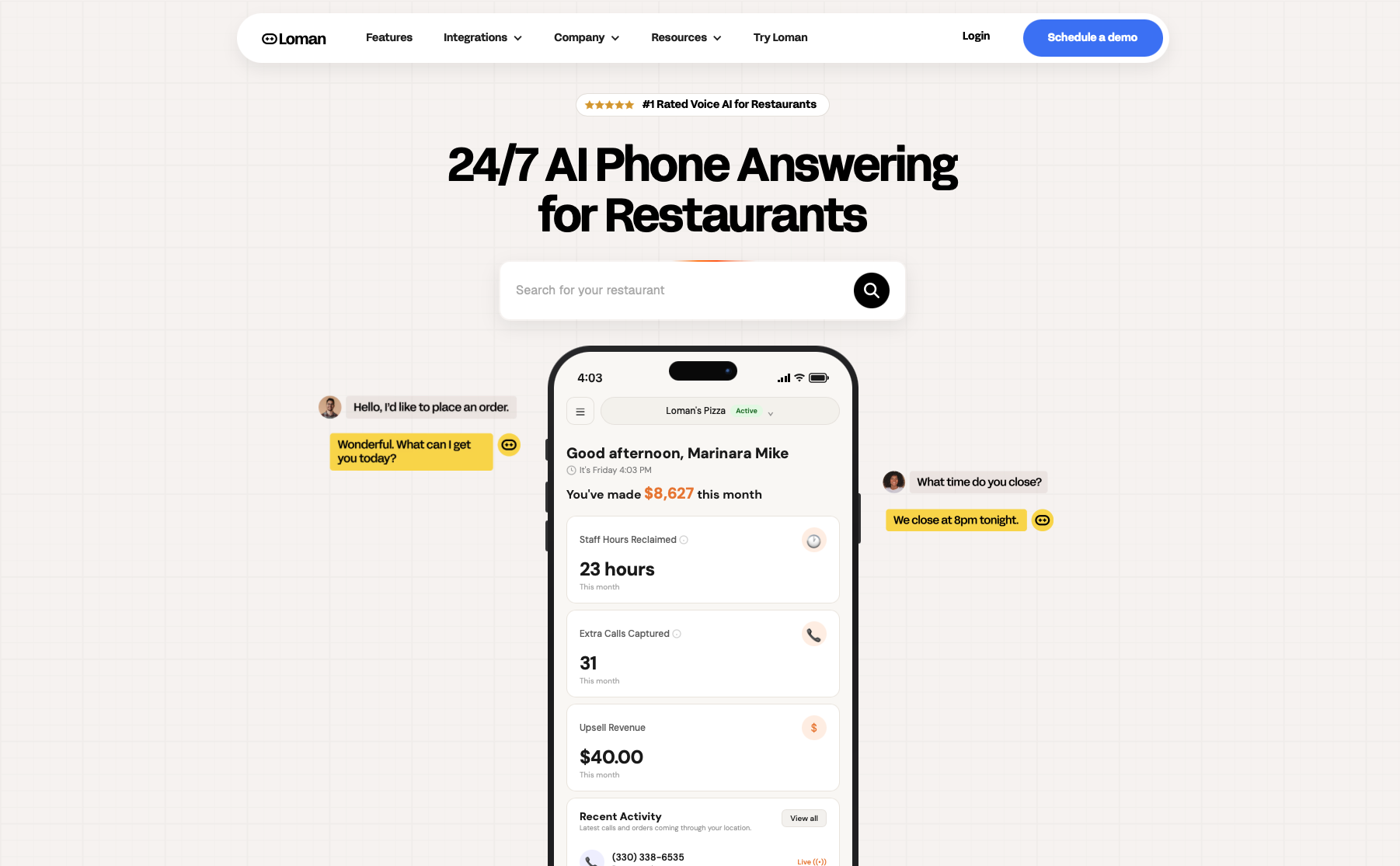
A POS transition has a blind spot that rarely makes the planning checklist: the phone. When a restaurant is moving from Revel to SkyTab, or weighing a new POS stack altogether, staff are busy retraining on new screens, menus are being rebuilt, and hardware is being swapped out station by station. The phone line is the thing nobody is watching. Industry estimates put missed calls at roughly 30% during peak hours, and phone orders average $48 per ticket versus $41 for online orders, so every unanswered ring during a transition is a larger order walking away, not a smaller one.
Loman AI runs independently of whatever POS chaos is happening in the background. It answers every call, day or night, takes pickup and delivery orders directly from the caller, and pushes the finished ticket into whatever POS the restaurant runs, including SkyTab. Crust Pizza, a Loman customer, reports that Loman paid for itself in 10 days. Pricing starts at $199/month with no per-minute charges, and setup goes live in under 24 hours. see how it works.
Revel+ subscription pricing starts at $11.99/month per location in the US. However, Revel is no longer sold as a standalone product following Shift4's acquisition in June 2024. New operators are directed to SkyTab POS, and the subscription fee is only part of the total cost picture once hardware and processing are included.
Yes. Every new Revel+ account qualifies for a 2-month free trial. That is enough time to run real transaction volume and test integrations before your billing begins, though you should plan for two to three weeks of setup and ramp before the platform is running at full capacity.
Revel+ includes real-time cloud reporting, menu management, employee scheduling, CRM features, and access to Revel's integration marketplace. The subscription also covers premium support access and eligibility for partner discounts. Given the Shift4 acquisition, new product development on the Revel platform has effectively stopped, so the feature set you see today is largely what you will have going forward.
No. Revel is no longer sold as a standalone system. Since the June 2024 acquisition, new merchants are directed to SkyTab POS by Shift4. Existing Revel merchants are in various stages of migration to that platform. If you need a new POS today, SkyTab, Toast, or Square for Restaurants are the current alternatives to benchmark.
Revel POS pricing at $11.99/month per location was straightforward on paper, but hardware and processing always made the real number much larger. The Shift4 acquisition has made the pricing question mostly beside the point now: new operators go to SkyTab, and existing merchants are mid-migration. Focus your energy on stress-testing whichever POS you land on, and do not let the phone channel slip in the process. Loman AI keeps every call answered and pushes orders straight into your POS through any transition. Book a quick demo to see how it fits your setup.
Enter your information in the form to receive a call from Loman and place an order like a customer would!

