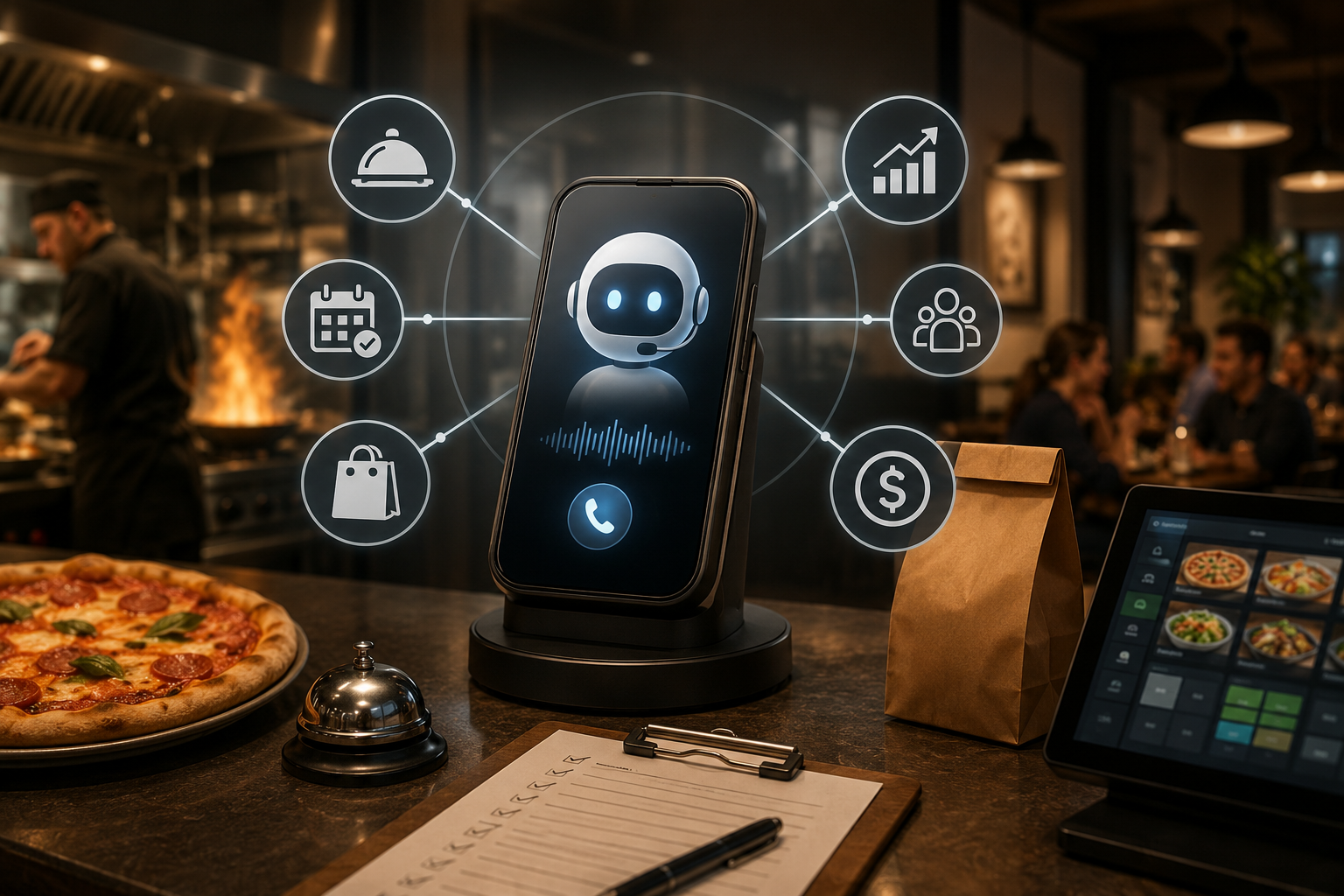
Picture your busiest Friday night and then think about how many calls rolled to voicemail. Industry estimates suggest a typical restaurant misses around 150 calls a month, each worth real money. A restaurant AI receptionist increases revenue from every phone call by answering instantly, taking the full order, and prompting the add-on your staff would've skipped. This post breaks down exactly how that revenue math works.
TLDR:
The phone rings at 6:40 on a Friday. Both counter staff are mid-order with a line out the door. It rings out, and that order goes to the pizza place down the street.
Across the industry, restaurants lose roughly $20 billion a year to calls that never get picked up. A typical restaurant fields around 150 missed calls a month, each carrying $35 to $85 in potential revenue. That's $5,250 to $12,750 walking out the door monthly, before the repeat orders those first-time callers never came back to place.
| Metric | Figure | Source / Context |
|---|---|---|
| Estimated industry revenue lost to missed calls (annual) | ~$20 billion | QSR Magazine estimate |
| Estimated missed calls per restaurant per month | ~150 | Estimated industry average |
| Estimated revenue per missed call | $35 to $85 | Industry estimate |
| Monthly revenue at risk (per location) | $5,250 to $12,750 | Based on 150 calls × ticket range |
| Callers who never call back after no answer | ~85% | BIA/Kelsey research |
| Calls missed during peak hours (5 to 8 PM) | 32% | QSR Magazine analysis |
| Phone order average vs. online order average | $48 vs. $41 | Loman operator data |
At full tilt, the host is seating tables, servers are running plates, and the line cook nearest the phone has both hands on a pan. Line two lights up and rolls to nowhere.
Calls spike at the exact window when your team has the least capacity to take them. A QSR Magazine analysis found that between 5 PM and 8 PM, the average restaurant misses 32% of peak hour calls.
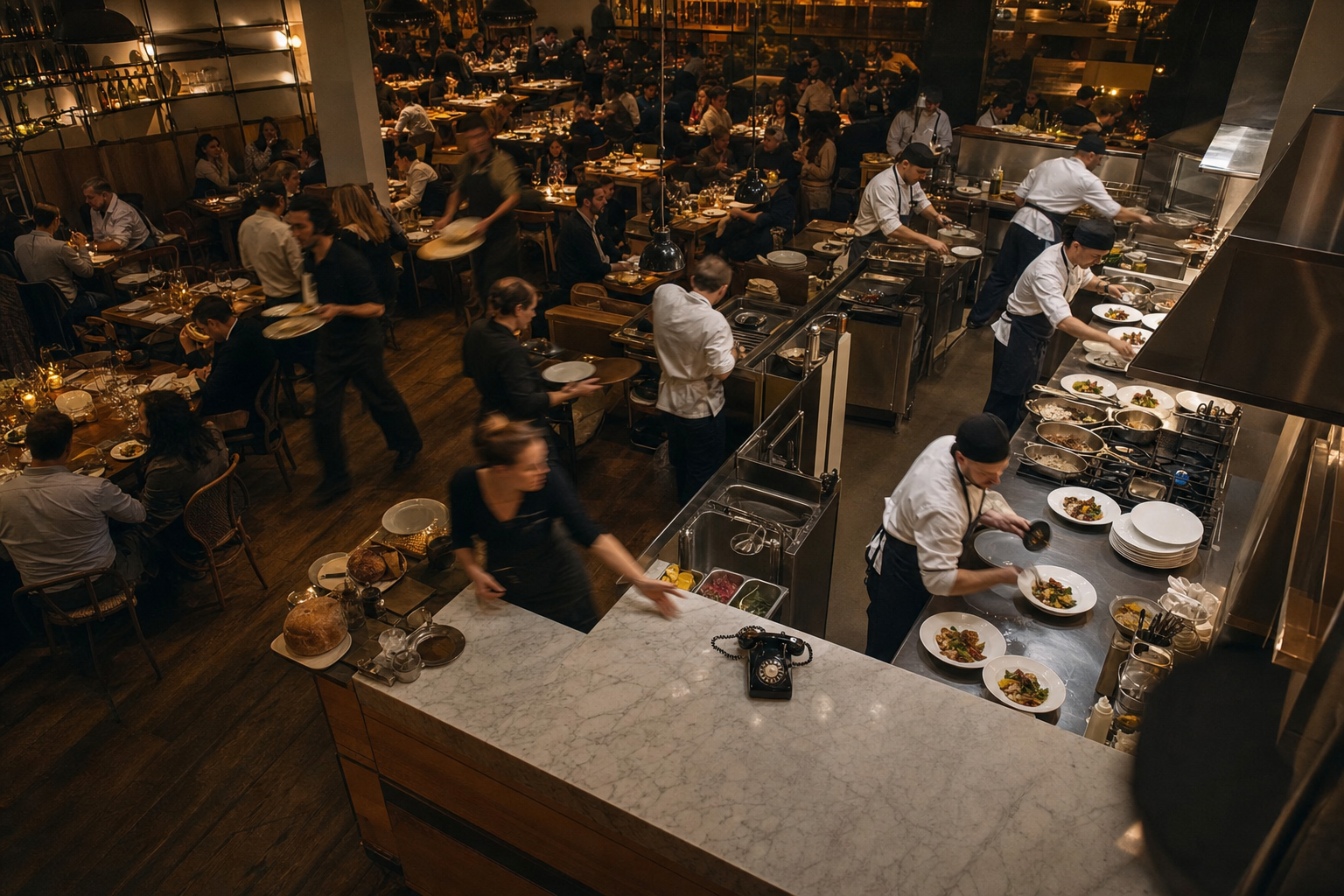
Hiring rarely fixes it. An extra body still gets pulled to bus a table or clear a backed-up window. The mismatch is structural.
And the caller who hears endless ringing usually does not try again. Industry research frequently attributed to BIA/Kelsey suggests roughly 85% of callers do not call back after an unanswered call.
A restaurant AI receptionist picks up every inbound call on the first ring and handles what a floor staffer would if they had the time:
Because it runs in software, it handles unlimited calls at once. The fourth caller during a Friday rush gets the same instant pickup as the first.
One distinction matters: a message-taking tool only parks the caller, while a full order-closure system finishes the transaction on the call, payment included, turning a ringing phone into a closed sale.
During a rush, the upsell suggestion gets dropped.
A voice AI runs the upsell on every call: the add-on, the combo, the popular pairing, on the hundredth order the same as the first. The logic applies to every order, not the handful where a server has a breath to spare.
A few dollars per ticket compounds into real revenue across hundreds of calls a week. Spread across hundreds of calls a week, that lift compounds into real revenue, stacked on top of orders you were already missing.
Phone coverage is labor you pay for whether the line rings once or fifty times. Full-service salaries and wages hit a median of 36.5% of sales in 2024, and for unprofitable operators that figure climbed to 42.9%.
Staffing a person on the phones means an hourly wage that does not flex with call volume. AI phone systems hold steady whether tonight is dead or slammed.
When the phone stops pulling a server off the floor, tables get checked on and orders fire cleaner. The labor you already pay for goes further.
An AI receptionist is only as reliable as its link to your POS, and that connection has to run two ways. The AI reads your live menu, knowing which items are 86'd and what prices changed at open, then pushes finished orders straight into the POS and kitchen display with no one re-keying a ticket.
That live read matters to the caller. If a guest orders the special, hangs up happy, then gets a callback that the kitchen ran out an hour ago, you lose the return visit.
Not every integration works this way. A read-only connection pulls a menu snapshot but still drops the order into a queue someone types in by hand. Handling high-volume calls in busy restaurants requires a native, two-way integration.
Reservations move on a different revenue track than orders. The lift here comes from keeping seats full.
A voice AI phone agent books, confirms, and cancels around the clock, syncing every change to your reservation system so that 24/7 call handling means the same table never gets double-booked. Reminders go out automatically, which matters because some restaurants report no-show rates as high as 20% without reservation reminders.
Taking a card or deposit at booking tightens that further. A guest who has put money down shows up. When a cancellation comes in early, the slot reopens for another party instead of sitting empty through service.
A phone that rolls to voicemail at 9 PM loses the guest planning tomorrow's lunch and the one deciding on weekend plans at midnight. An AI receptionist working 24/7 picks up those calls and turns them into confirmed orders and bookings; see how restaurants manage high call volumes with zero added staffing hours.
A voice AI handles routine work well: pickup orders, reservations, hours, menu and allergen questions, the calls that make up the bulk of your volume. Some calls are not routine, and on those the right outcome is a person picking up.
Hand a person the call when it involves:
A good escalation path makes the handoff clean. The AI detects the edge case, transfers to a live line or captures a transcript with full caller context, and your staff picks up already knowing the name, the order, and what went wrong. No retelling from scratch.
For a single shop, the missed-call math is a leak. Across ten locations, it is the same leak multiplied, which is why multi-unit operators see the revenue case compound fastest.
One centralized agent runs a shared menu while each store keeps its own overrides: local hours, regional specials, a holiday closure that hits one market and not another. The ROI of an AI phone agent compounds fastest at this scale. Roll-up analytics then show call volume trends, peak windows by market, and revenue capture per location in one view.
The brand payoff is consistency. A guest calling your suburban location at 8 PM gets the same answer quality as one calling the flagship at noon.
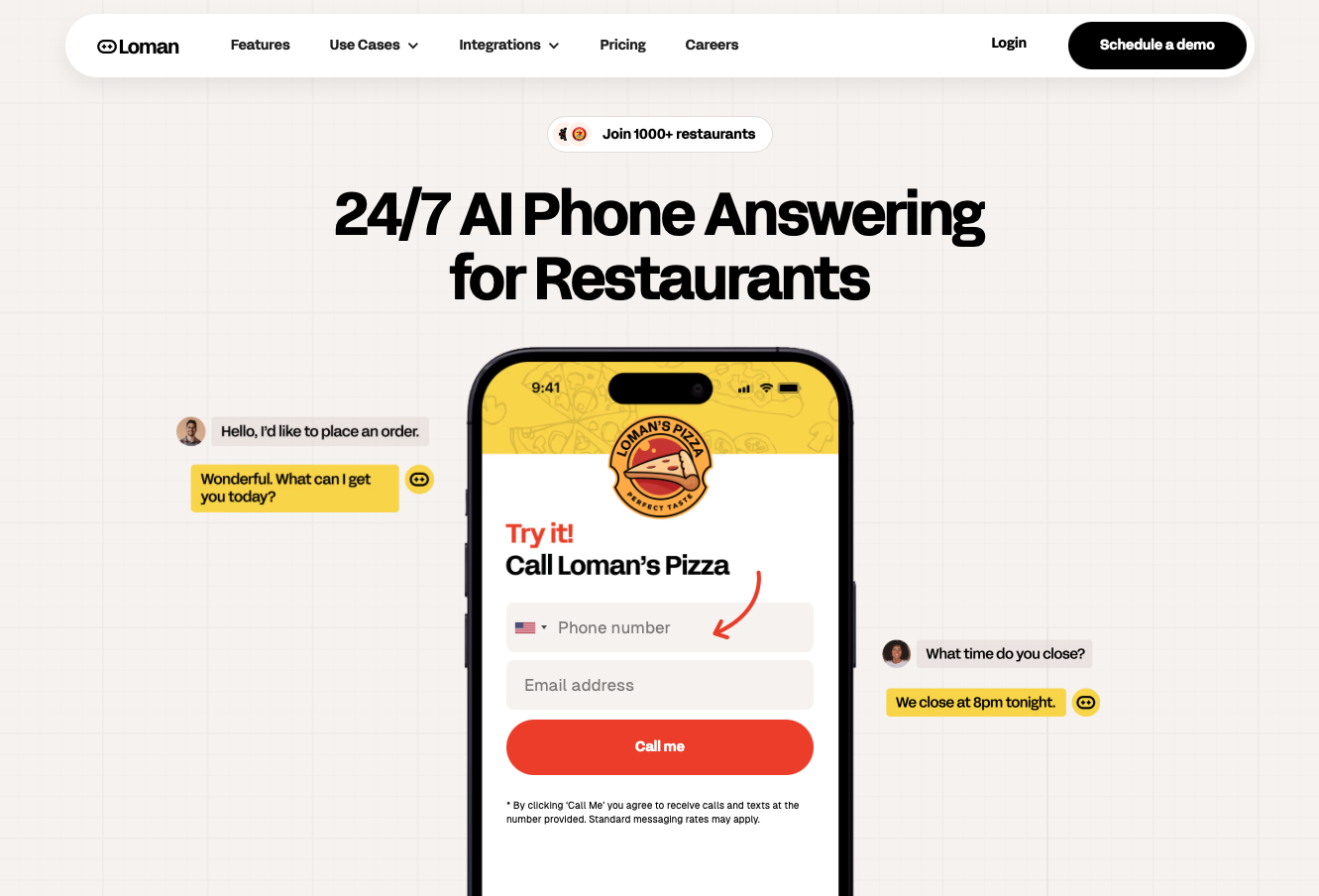
Loman AI answers every call on the first ring, takes full pickup and delivery orders straight into your POS, runs the upsell, books reservations, and hands off anything that needs a person. Every capability covered in this post runs inside one system, at a flat $199 a month for unlimited calls.
The results are documented. Operators using Loman have reported up to 22% higher phone revenue and up to 17% lower labor costs. Little Italy cut labor expense by more than 24%. Midland Pizza Co. estimates they would lose over $200,000 a year without it.
Loman connects natively to nine POS partners plus EZ Cater, goes live in under 24 hours, and requires no coding. The hundredth call on a Friday night costs the same as the first.
A restaurant AI receptionist increases revenue by answering every call on the first ring, closing orders with payment in-call, and running upsell prompts on every single order, even the ones where no staff member has a spare moment. Operators using Loman have reported up to 22% higher phone revenue, with phone orders averaging $48 versus $41 for online orders, a gap that compounds across hundreds of weekly calls.
If your call volume spikes during the lunch and dinner rush, which is exactly when every staff member is already occupied, a dedicated phone hire still gets pulled to bus tables or clear a backed-up window. AI phone answering holds steady whether the night is slow or slammed, at a fixed monthly cost that does not carry overtime, no-shows, or turnover risk. Restaurants using Loman have reported up to 17% lower labor costs alongside the revenue gains from recaptured calls.
The math is straightforward: restaurants average around 150 missed calls a month, and industry research suggests roughly 85% of callers who reach a dead line do not call back. At a phone order average of $48, even a fraction of those unanswered calls represents thousands of dollars walking out the door each month, and that figure doesn't account for the repeat orders those first-time callers never came back to place.
Your phones are already generating revenue leads on every shift. A restaurant AI receptionist makes sure those leads don't walk to the place down the street because your counter staff had both hands full. It answers on the first ring, takes the order, books the table, and closes the sale, every time, at no extra labor cost per call. That is exactly what Loman AI is built to do. Operators using Loman have reported up to 22% higher phone revenue and up to 17% lower labor costs, and getting started takes under 24 hours. If your phones are ringing and your team can't always get to them, that is money leaving the building. A dedicated AI receptionist stops that before the next dinner rush.
Enter your information in the form to receive a call from Loman and place an order like a customer would!

