
If your restaurant misses 30 calls per day at a $45 average ticket, you're losing $492,750 annually. That's the real cost of understaffing your phones during rush hours. The question isn't whether Loman AI is worth it for your restaurant; it's whether you can afford to keep bleeding revenue. Restaurants using Loman report up to 22% revenue increases and 17% labor cost reductions, with most seeing positive ROI within 30 days. We'll show you the actual math, capabilities, and trade-offs so you can calculate whether this works for your operation.
TLDR:
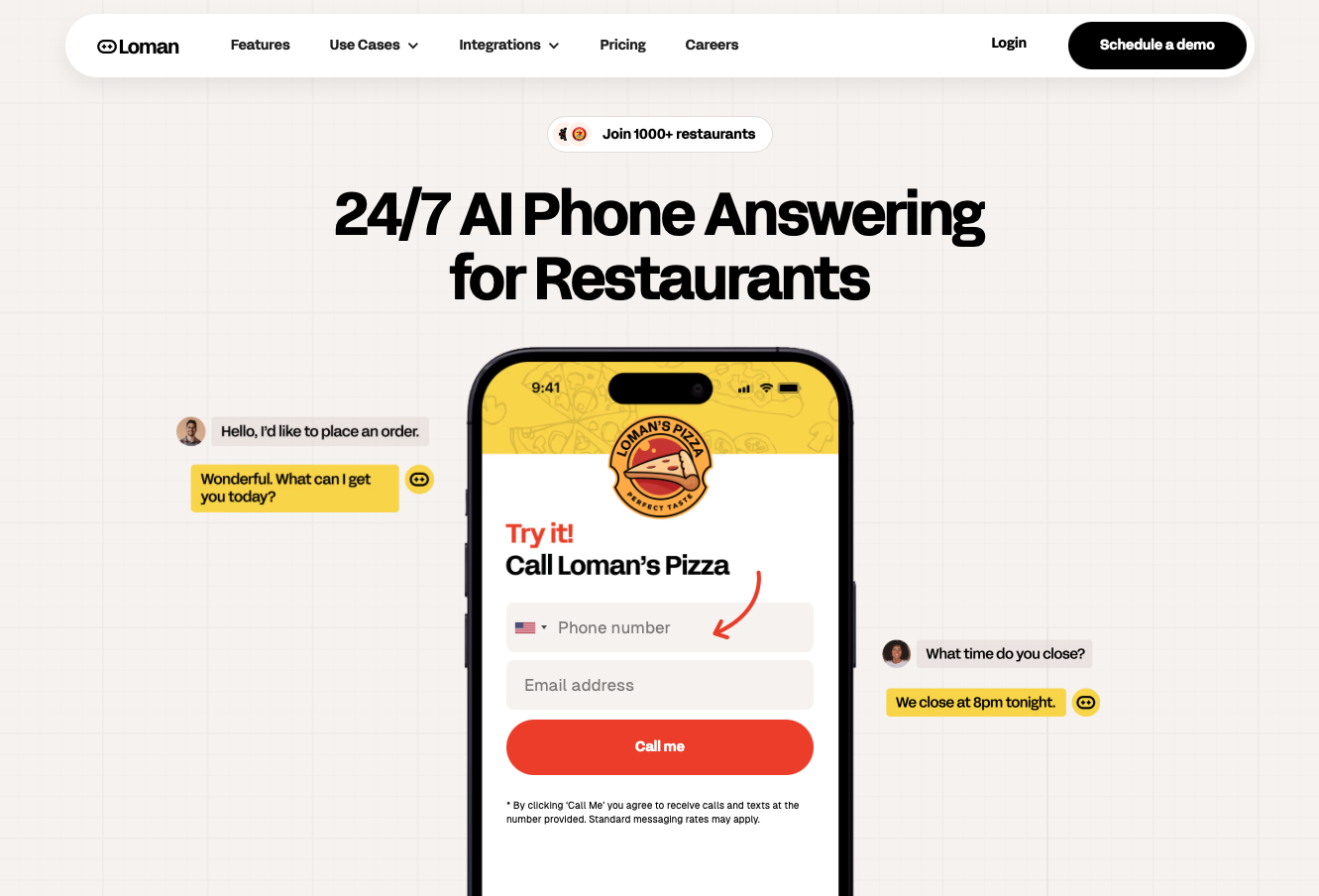
Loman AI is a 24/7 voice AI phone agent that answers every call to your restaurant in real time. It takes pickup and delivery orders, books reservations, answers menu questions, and can securely capture payment details over the phone when activated without sending callers to voicemail or leaving them on hold.
The AI integrates with your POS and reservation systems, so orders and bookings sync automatically into your existing workflow. This removes manual entry and keeps your staff focused on in-person guests.
We serve single-location restaurants, multi-unit groups, and national chains across all restaurant types. Whether you operate a busy pizzeria, casual dining concept, or QSR with multiple locations, Loman handles high call volumes and prevents missed orders that directly impact revenue.

Phone calls still drive restaurant revenue, but answering them has become nearly impossible. Roughly 70% of restaurant operators are either using or piloting AI to improve operations, with 80% of executives planning to increase AI spending in the next fiscal year.
Right now, 43% of restaurant calls go unanswered, and the industry loses approximately $20 billion annually from missed calls. Worse, 60% of customers who encounter a missed call won't call back, meaning they're likely calling competitors instead.
If your restaurant misses just 30 calls a day, you're leaving about $492,750 a year on the table.
The staffing crisis makes this worse. Turnover sits at 80% annually, and 45% of restaurant operators can't fully staff their operations. Your team is already stretched thin serving guests in the dining room. Asking them to also answer phones, take orders accurately, and process payments creates errors and slows service.
This isn't a minor inconvenience. It bleeds revenue every single day.
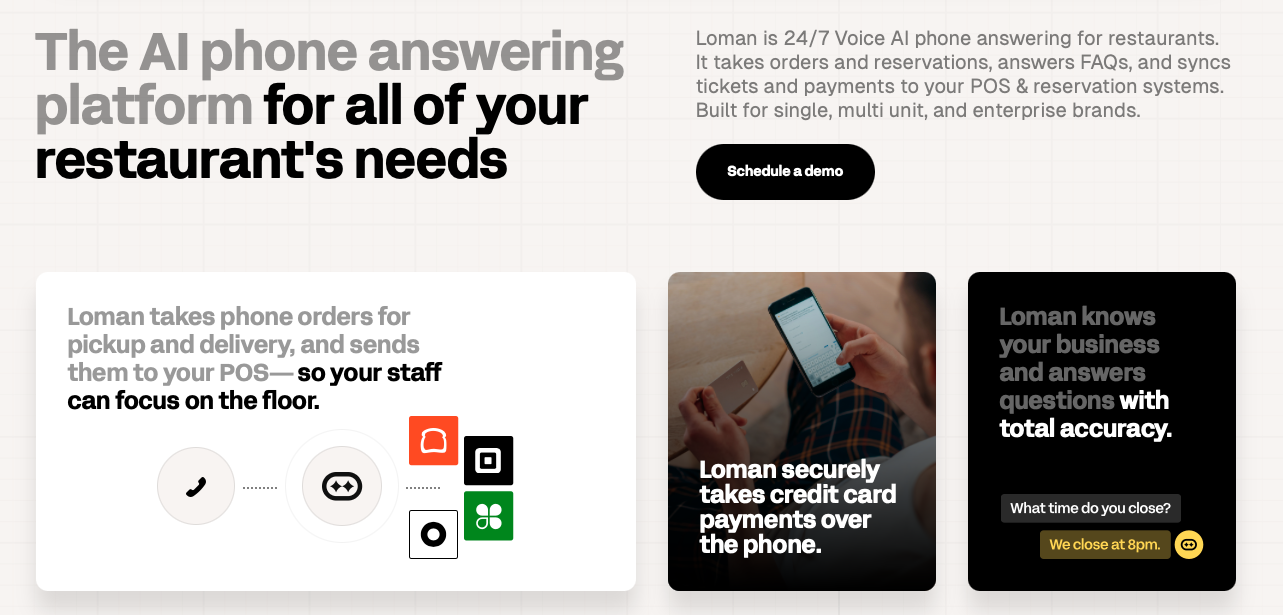
Loman handles the full scope of inbound restaurant calls without routing anything to staff. When a customer calls, the AI picks up instantly and can take a complete order from your menu, process the payment, book a table, or answer questions about ingredients and hours.
The system walks callers through your entire menu, handles customizations and special requests, and sends clean tickets directly to your POS. Payments happen over the phone through secure credit card processing integrated with Square, Toast, Clover, and other major POS systems. The guest pays, the order prints in your kitchen, and your staff never needs to touch the phone. Loman books reservations and syncs them to OpenTable in real time. It also answers recurring questions about allergens, wait times, directions, catering options, and daily specials. The AI recognizes repeat callers and can switch languages mid-conversation to serve bilingual customers. Unlike a human host station, Loman answers unlimited calls at once. During dinner rush or a snowstorm, every caller gets through immediately.
Loman integrates natively with Toast, Square, Clover, SpotOn, Aloha, Olo, and Stream. When the AI takes an order, tickets sync directly to your kitchen or printer with modifiers, special instructions, and payment already captured. No one logs in to re-key details or transcribe voicemail.
Setup takes under 24 hours for most restaurants. You connect your existing systems, upload your menu, choose a greeting style, and set house rules or seasonal specials. White-glove onboarding is available for multi-location overrides or complex menus.
Other AI phone services claim POS compatibility but still route orders through email or require manual entry. Some need weeks of training before they can handle your menu. Loman trains on your business in hours and starts answering calls the same day you activate it.
Restaurants using Loman report up to 22% higher revenue from two sources: calls that previously went unanswered and AI-driven upsells during order taking. The system suggests add-ons at the right moment, increasing average ticket size without any sales training or staff effort.
Labor savings reach as much as 17%. With back-of-house wages now consuming 25-35% of total payroll as restaurants compete for skilled kitchen staff, reducing front-of-house phone duty costs becomes even more critical. Instead of paying hourly wages to someone whose sole job is answering phones, you pay a predictable software fee.
The AI never calls in sick, never takes a break during rush, and doesn't need onboarding or training refreshers.
The calculation is straightforward. If you're missing calls because your team can't pick up during peak hours, every answered call is revenue that would have disappeared. For many restaurants, recaptured revenue alone covers the subscription cost within the first month.
Most restaurant voice AI providers focus on narrow use cases. Slang AI focuses on reservations and FAQ and has limited order-taking capabilities. SoundHound and ConverseNow target enterprise drive-thru operations, not sit-down or pickup-focused restaurants. Hostie and Kea offer call answering but have more limited order-taking and payment workflows for many operators.
Loman covers the full call lifecycle: answering, order taking, payment processing, reservation booking, and FAQ. Where competitors route tickets through email or require manual POS entry, Loman syncs orders directly into Toast, Square, Clover, Aloha, Olo, and Stream with zero transcription. Other systems cap concurrent calls or queue callers during peak volume. Loman answers unlimited calls at once.
Setup time separates Loman too. Competitors can take weeks to train on your menu and policies. Loman goes live in under 24 hours. The built-in upsell engine is another difference: most voice AI simply takes orders as spoken, but Loman prompts upsells that increase tickets.
High-volume takeout restaurants see the fastest return. Pizza shops, wing joints, Chinese restaurants, and QSRs that live on phone orders recapture revenue immediately when every call gets answered. If you're turning away business during Friday dinner rush or weekend lunch, Loman pays for itself in missed orders alone.
Restaurants with complex menus or frequent customizations benefit from error-free order entry. The AI handles modifiers, substitutions, and allergy requests without misheard instructions or illegible notes. Fine dining and full-service concepts that take reservations alongside takeout orders can manage both workflows through one system.
Multilingual neighborhoods are another strong fit. If your staff struggles to serve Spanish, Mandarin, or other language speakers by phone, Loman switches languages mid-call and takes orders accurately without language barriers costing you customers.
Multi-location groups get the biggest advantage. You can deploy Loman across every store with shared menus and location-specific overrides.
While Loman handles most calls effectively, edge cases like irate customers or highly complex complaints get routed to voicemail with transcripts or transferred to staff if available. If your team doesn't monitor these handoffs regularly, some issues may linger.
Restaurants with frequently rotating menus or hundreds of modifier combinations may need a short adjustment period while the AI adapts to new policies. Many callers treat the AI like a human conversation, but a small percentage will request a person, so you'll need a protocol in place.
Outdated menu data creates problems. If you don't update specials, hours, or pricing in the dashboard, the AI will relay incorrect information to customers.
Start by calculating what missed calls are costing you right now. Count how many calls go unanswered during your busiest four hours this week, multiply by your average phone order value, then annualize it. If that number exceeds Loman's annual cost and you're already using a compatible POS like Toast, Square, or Clover, the ROI becomes clear.
Next, assess your labor situation. If you're paying someone to answer phones full-time or pulling hosts and servers away from tables during rush, compare that hourly cost against a fixed monthly software fee. Factor in turnover, training time, and the cost of order errors.
After launch, track three numbers weekly: total calls answered, revenue from phone orders, and tickets per labor hour in front-of-house. Compare these metrics to your pre-Loman baseline to measure impact. Most restaurants see measurable improvements within the first two weeks, with full ROI realized in under 30 days as previously missed calls convert to closed orders and labor hours shift from phone duty to higher-value guest service.
Most restaurants go live in under 24 hours after connecting their POS, uploading their menu, and setting greeting preferences. White-glove onboarding is available for complex setups or multi-location groups.
The AI detects these edge cases and either transfers the call to your staff line if someone is available or captures a voicemail with full transcript so you can follow up directly.
Loman includes a built-in upsell engine that suggests add-ons and popular combinations at the right moment during order taking, which helps restaurants lift their average ticket size without any staff training.
Loman AI is worth it if you're losing revenue to missed calls or paying staff to answer phones when they should be serving guests. The math is simple: if your missed calls exceed the subscription cost, you're leaving money on the table. Most restaurants see positive ROI within 30 days by recapturing previously lost orders and reducing labor hours spent on phone duty. Start by running the numbers on your operation. Calculate your daily missed calls, multiply by your average ticket, and annualize it. If that figure is higher than Loman's annual cost and you're using a compatible POS, it becomes easier to decide. Book a demo, connect your systems, and track phone order revenue for the first 30 days. The data will confirm whether Loman AI delivers the ROI your restaurant needs.
Enter your information in the form to receive a call from Loman and place an order like a customer would!

