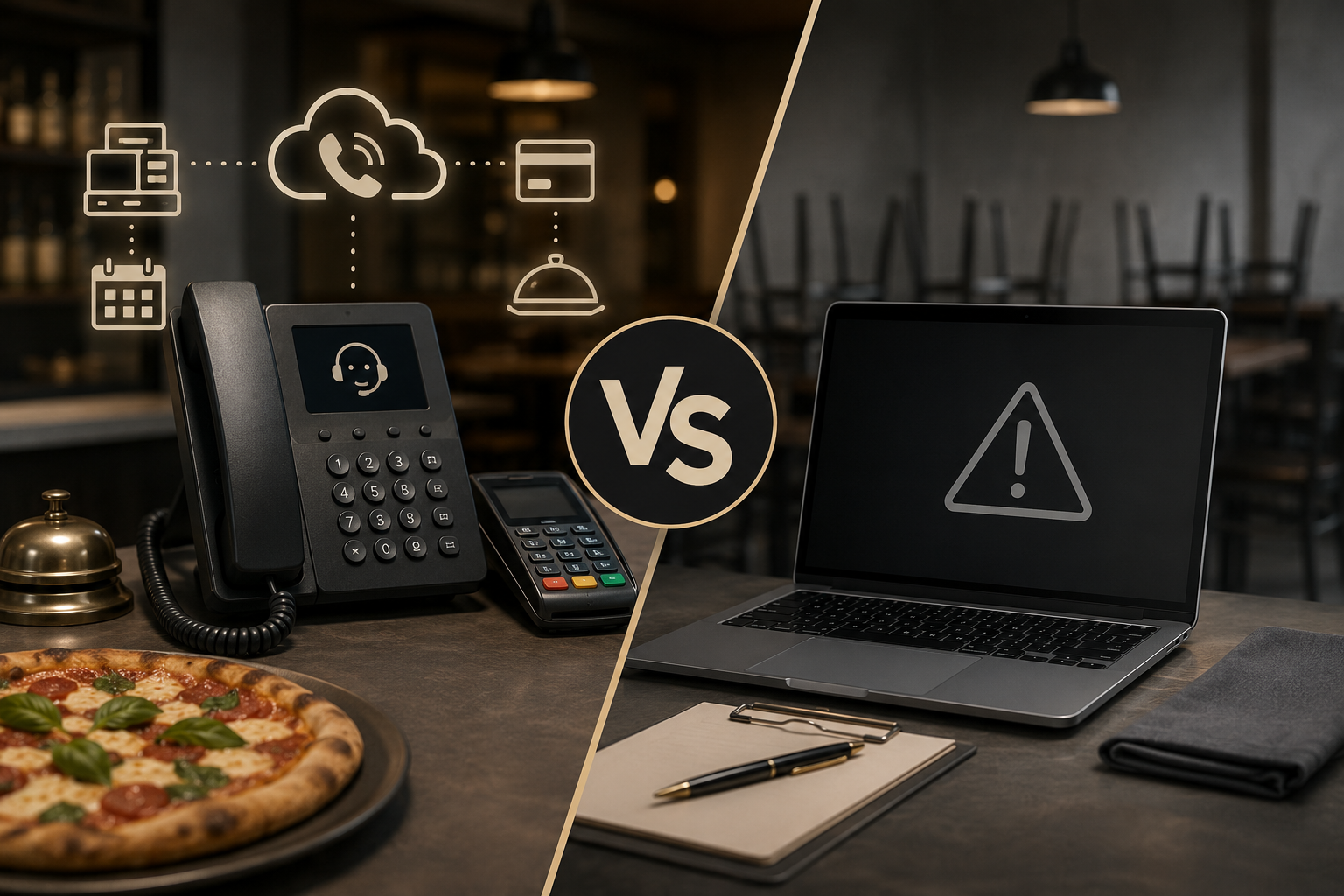
The clearest sign a vendor isn't ready is when their site goes down during your research. You're trying to compare Loman vs. Trybytes, but one of those options returns a blank page where the pricing should be, no integration partners you can verify, and no way to see how it handles a live call. That's not a close call. We ran both through the same checklist in June 2026 and the gap isn't subtle.
TLDR:
Trybytes.ai presents itself as a voice AI tool for restaurants, though confirming what it actually does is harder than it should be. When we went looking in June 2026, the company's website returned technical errors, which blocked any close look at its features, pricing, or how it handles a live call.
That left us with little to go on. We could not find named integration partners, published customer testimonials, or documented case studies through the usual industry channels. The product also does not show up in the competitive write-ups that track the restaurant voice AI space.
None of this points to a bad product. It points to a thin public record, and a thin record makes it tough for an operator to judge fit before signing up. Where we can verify and describe Trybytes.ai's capabilities, we do. Where the information is missing, we say so plainly.
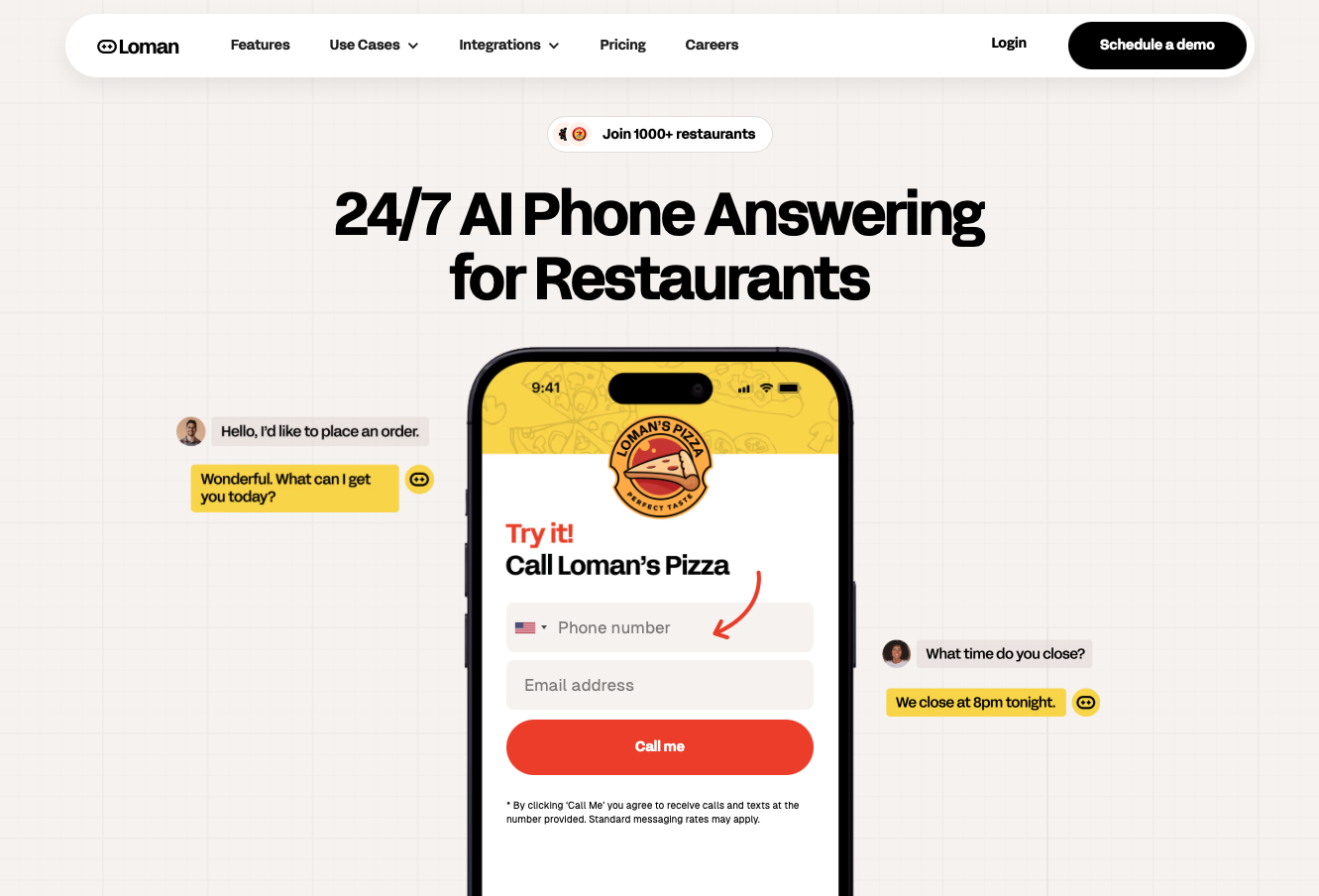
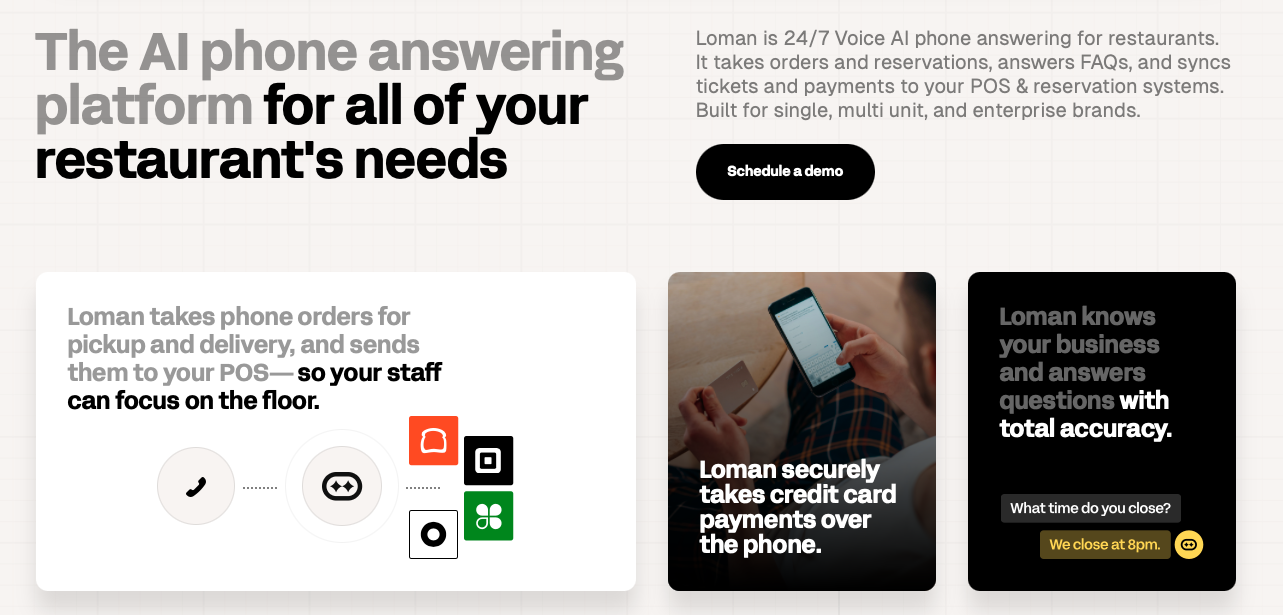
Loman is a 24/7 voice AI phone agent built for restaurants. We answer every inbound call, take complete pickup and delivery orders, and process payment during the call so nothing waits on a callback.
The product handles more than orders. It books and modifies reservations, answers menu and policy questions, and recognizes repeat callers. Orders push straight into the POS, with native connections to Toast, Square, Clover, and SpotOn, so no one on staff re-keys a ticket.
Restaurants running Loman report up to 22% higher phone revenue and up to 17% lower labor costs, with missed calls eliminated entirely.
Pricing starts at $199 a month, a flat fee that covers unlimited calls with no per-minute charges.
The core job here is turning a ringing phone into a paid order. That is where the two diverge most.
Without accessible product docs or a working site, we cannot verify whether Trybytes.ai takes orders, processes payments, or connects to a POS at all. That gap could mean the product is early in development, working through technical issues, or aimed at a different segment than restaurant phone ordering. We will not guess at capabilities we cannot confirm.
Loman takes the full order, including swaps and modifiers that trip up generic voice tools, then captures the card payment during the same call through direct POS integration. Orders land as clean kitchen tickets in Toast, Square, Clover, SkyTab, Aloha by NCR, Olo, and Stream, with no one re-keying a thing.
Collecting payment at order time cuts no-shows by up to 30% and removes the checkout wait at pickup. Phone orders run through the same kitchen workflow as counter and kiosk tickets, so the line cook sees one queue.
| Provider | Order Taking & Payment | POS Integrations | Concurrent Calls & Availability | Setup Time |
|---|---|---|---|---|
| Loman | Takes full orders with modifiers and processes card payment during the same call through direct POS integration | Native connections to Toast, Square, Clover, SkyTab, Aloha by NCR, Olo, Stream, SpotOn, and OpenTable for reservations | Handles unlimited simultaneous calls with 24/7 operation including holidays and after hours | Live in under 24 hours with no coding or dedicated IT required |
| Trybytes.ai | Could not verify order taking, payment processing, or POS connectivity due to inaccessible product documentation | No publicly documented POS integration partners or reservation system connections found through web research | Concurrent call capacity and round-the-clock availability cannot be confirmed without technical specs | No published deployment timeline or setup requirements found during June 2026 research |
A voice agent that cannot pass orders into the systems a restaurant already runs creates more work, not less. Here is how the two compare.
We could not verify any POS integration partners or reservation system connections for Trybytes.ai through web research. Because we could not verify documented integrations, we could not determine how order data would flow into restaurant systems.
Loman connects natively with nine named integration partners plus EZ Cater for catering. Real-time menu sync keeps things current: 86'd items, price changes, and specials update automatically, so a caller never hears about a dish the kitchen ran out of an hour ago.
The integration runs both ways. The agent reads live table availability and menu data while pushing confirmed orders and bookings back into your systems. Multi-location groups get shared menus with per-store overrides, local numbers, and analytics that roll up by location.
The Friday dinner rush is when call volume spikes and staff have the least time to answer. How a voice agent holds up under that load matters.
Concurrent call capacity and round-the-clock availability cannot be confirmed without technical specs or product documentation. Most voice tools need real infrastructure to field several calls at once, and whether Trybytes.ai is built for that load stays unverified.
Loman takes unlimited simultaneous calls, so no guest hits a busy signal when ten phones ring at 7 p.m. The agent quotes wait times, sends directions, and answers in multiple languages without adding headcount.
It runs 24/7, including after hours, holidays, and closed days, catching late-night pickup orders and early-morning catering questions that would otherwise go to voicemail. When a request falls outside its scope, smart routing hands the call to staff with the full conversation context attached.
Onboarding is where a smooth pitch meets reality. Here is how the two stack up.
We could not find a published deployment timeline or any setup requirements for Trybytes.ai. The non-functional website during our research period raises a separate question about readiness: if the site is down, an operator trying to onboard would have no clear path to support, configuration, or a go-live date.
Loman gets you up and running in under 24 hours. You connect your systems, import the menu, pick a greeting, set hours and call rules, then run a test call before going live. Most restaurants are live the same day, and our team can handle a white-glove setup if you would rather have it done for you.
No coding or dedicated IT is required. Menu updates, business hours, and routing rules all change in real time from the dashboard.
When a product's site is down and its proof is missing, an operator cannot judge fit. Loman gives you the opposite: a verifiable record. We close orders and payment end-to-end, connect to the POS you already run, and go live in under 24 hours. Staff stays on your guests while every call gets answered, with results visible the first week.
The numbers behind that record are operator-reported, not projected. Midland Pizza Co. estimates they would lose over $200,000 a year without Loman covering their phones. Little Italy cut labor costs by more than 24% and will never open another location without it. Tony Boloney's adds 75 to 100 extra orders per month per store, a figure that compounds fast once you run more than one unit.
For any operator weighing options right now, the deciding factor is what you can verify before you commit. You can request a live demo, watch Loman take a real order from your menu, and confirm every integration before signing anything. That is the standard to hold any voice AI to before handing it your phone line.
Start with what you can verify. Loman provides documented POS integrations, published pricing, and named customer testimonials. Trybytes.ai lacked an accessible website and verifiable product details when we researched in June 2026, which makes it impossible to judge fit or confirm capabilities before signing up.
Loman takes the full order including modifiers, processes the card payment during the same call, and pushes a clean ticket straight into your POS with no staff re-keying. We could not verify whether Trybytes.ai takes orders, processes payments, or connects to a POS at all.
Loman serves single-location independents, multi-unit groups, and national brands that rely on phone orders, takeout, or reservations. The product handles high call volumes and complex menus across pizza shops, QSRs, casual dining, and fine dining equally well, with native POS connections to Toast, Square, Clover, SpotOn, and six other major systems.
Yes. You connect your POS, import the menu, set hours and call rules, then run a test call before going live. Most restaurants go live the same day with no coding or dedicated IT required, and white-glove setup is available if you would rather have our team handle configuration.
Loman's fast setup means you can switch without extended downtime. Menu data imports from your POS in real time, so there is no manual menu rebuild, and native integrations mean orders start flowing into your existing kitchen workflow as soon as you go live.
When proof is missing, the Loman vs. Trybytes choice gets easier. Loman answers every call, closes the order with payment on the spot, and integrates with the POS you already run. Try it on your next shift. Trybytes.ai could be building something real, but without a working site or documented results, you are stuck guessing.
Enter your information in the form to receive a call from Loman and place an order like a customer would!

