Traditional phone systems with their robotic “press 1 for this, press 2 for that” approach have become increasingly obsolete as customers demand more intuitive, conversational experiences. This shift has given rise to AI virtual receptionists, which are sophisticated systems powered by artificial intelligence that can understand everyday spoken language, engage in human-like conversations, and handle complex customer interactions without human intervention. These platforms bring together advanced speech recognition, spoken language understanding, and machine learning technologies to create virtual receptionists that work around the clock, handling multiple calls simultaneously while maintaining consistent, professional service.
TLDR:
AI virtual receptionists fundamentally differ from traditional IVR systems through their use of everyday spoken language understanding and machine learning algorithms. Instead of forcing callers to work through predefined menu options, these systems can understand spoken requests in conversational language. The technology works by converting speech to text, analyzing the intent behind the words, and building appropriate responses in real-time. Modern AI voice platforms use sophisticated voice synthesis that sounds remarkably human, eliminating the robotic quality that often frustrates callers.
The core technologies powering these platforms include automatic speech recognition (ASR) for accurately transcribing spoken words, natural language understanding (NLU) for interpreting the meaning and context of requests, and natural language generation (NLG) for creating coherent, contextually appropriate responses. Many platforms also incorporate sentiment analysis to detect emotional cues in a caller’s voice and adjust responses accordingly. Some advanced systems even feature voice biometrics for secure caller authentication without requiring PINs or passwords.
What truly sets modern AI virtual receptionists apart is their ability to learn and improve over time. Through machine learning algorithms, these systems analyze past interactions to refine their understanding of customer queries and optimize response patterns. This adaptive capability makes sure that the virtual receptionist becomes increasingly effective as it handles more calls, essentially growing more intelligent with each customer interaction. Additionally, integration capabilities with CRM systems, calendars, and other business applications enable these AI assistants to access relevant customer information and provide personalized service.
While the platforms discussed above serve various industries, restaurants require specialized AI solutions built for restaurants that understand their unique day-to-day needs. Loman's 24/7 AI phone agent is purpose-built for restaurant environments, offering smooth POS integration with systems like Square, Toast, and Clover. Unlike generic virtual receptionists, Loman's system is trained on restaurant menus, policies, and customer preferences, keeping accuracy high when handling orders, reservations, and complex dietary inquiries.
Restaurants using Loman benefit from dramatically reduced missed calls and shorter wait times, with operators reporting up to 22% higher phone revenue and up to 17% lower labor costs (Loman customer data). The platform includes built-in analytics and real-time insights that help restaurant managers make better day-to-day decisions, from identifying peak call times to understanding customer preferences. With fast setup that gets restaurants live in under a day, Loman scales well for single locations, chains, or franchises, positioning itself as the specialized alternative to general-purpose platforms like CloudTalk, RingCentral, and Nextiva when restaurant-specific functionality matters most.
Generic voice AI platforms handle routine calls well enough. What they miss is the day-to-day reality of a restaurant: a caller asking to swap fries for a side salad on a half-and-half pizza during Friday dinner service, while two other lines are ringing simultaneously. That gap is why a separate category of restaurant-specific AI phone answering came about, and why the choice between platforms comes down to whether the system can actually take orders, or just answer questions.
Here is how the leading options stack up for restaurant operators in 2026:
Purpose-built for restaurants from the ground up. Takes full pickup and delivery orders, books and modifies reservations, and processes in-call payments. Integrates natively with Toast, Square, Clover, SpotOn, SkyTab, Aloha, OpenTable, Resy, SevenRooms, and Olo. Handles unlimited concurrent calls with no per-minute charges. Starts at $199/month. Operators using Loman have reported up to 22% higher phone revenue and up to 17% lower labor costs. Live in under 24 hours.
Focused on reservation management and guest communication. Answers calls, provides restaurant information, and books reservations via OpenTable and SevenRooms. Does not take full phone orders directly into a POS or process in-call payments, making it better suited to reservation-driven restaurants than high-volume takeout or delivery operations. See a detailed breakdown in Loman vs. Slang AI order capture.
Enterprise-grade conversational ordering across phone, drive-thru, and kiosk. Deployed by large chains (Jersey Mike's, White Castle, Church's Chicken). Strong for brands with dedicated IT and custom integration budgets; deployment timelines and support contracts make it less accessible for independent operators or small groups.
Voice AI for phone and drive-thru ordering. Has broad POS integration claims but lacks publicly confirmed native integrations with Toast, Square, and Clover, so verify directly before committing if those are your systems. For a side-by-side breakdown, see Loman vs. ConverseNow POS integration.
Handles inbound calls, answers menu questions, and routes reservations via OpenTable and Resy. Priced at approximately $0.59 per conversation (roughly $590/month at 1,000 calls, with no published ceiling). No publicly listed POS integration partners and no in-call payment processing.
| Platform | Takes Full Phone Orders | POS Integration | Reservation Booking | In-Call Payments | Starting Price |
|---|---|---|---|---|---|
| Loman AI | Yes | Toast, Square, Clover, SpotOn, SkyTab, Aloha, Olo | OpenTable, Resy, SevenRooms | Yes | $199/month |
| Slang.ai | No | Not publicly listed | OpenTable, SevenRooms | No | Not published |
| SoundHound AI | Yes | Enterprise/custom | Enterprise/custom | Not publicly confirmed | Enterprise pricing |
| ConverseNow | Yes | Broad claims; Toast/Square/Clover not publicly confirmed | Not publicly listed | Not publicly confirmed | Not published |
| Revmo | No | Not publicly listed | OpenTable, Resy | No | ~$0.59/conversation |
The clearest dividing line in this category is full order closure versus call handling. Systems that only answer questions, route callers, or log messages do not convert phone calls into revenue. For restaurants where phone orders represent a meaningful share of sales, such as pizza shops, QSRs, and casual dining with active takeout, the platform needs to close the order and push it to the kitchen, not hand off to a staff member for completion.
AI virtual receptionists have crossed from early-adopter technology into mainstream business infrastructure. The virtual receptionist market reached $4.64 billion in 2026, per Business Research Insights, with the broader voice AI agents market growing at a 34.8% CAGR toward $47.5 billion by 2034. U.S. small business AI adoption jumped from 39% in 2024 to 55% in 2025 in a single year (U.S. Chamber of Commerce), and a Salesforce survey of SMBs found 91% of AI-adopting businesses report revenue improvements. Modern AI receptionists now resolve 73% of calls without human involvement and respond in under 600ms, and caller acceptance is no longer a barrier.
For restaurants, the question has a sharper edge. A missed phone order is a lost ticket, and a ticket pushed through a third-party app costs 15-30% in fees that a direct phone order avoids. Loman AI was built for that gap: unlimited concurrent calls, real-time POS order sync, and in-call payment capture. Operators using Loman have reported up to 22% higher phone revenue and up to 17% lower labor costs.
Imagicle's AI Virtual Receptionist is built for Webex Calling environments, handling call transfers, missed-call notifications, FAQ responses, and appointment booking across six languages with no technical setup. CloudTalk suits sales and support teams with customizable call flows and deep CRM integration (HubSpot, Salesforce, Zendesk). RingCentral bundles AI reception into a full unified communications suite, routing calls by department or schedule through natural-language voice interaction.
Dialpad adds real-time transcription and sentiment analysis on top of call handling, giving teams an automatic record of every conversation. Nextiva takes a conversational IVR approach, capturing caller intent and routing to the right person, with a strong uptime record. Both surface communication patterns over time. The deciding factor is usually what the rest of your tech stack already looks like, since none of these are built for restaurant-specific workflows like POS order sync or in-call payment capture.
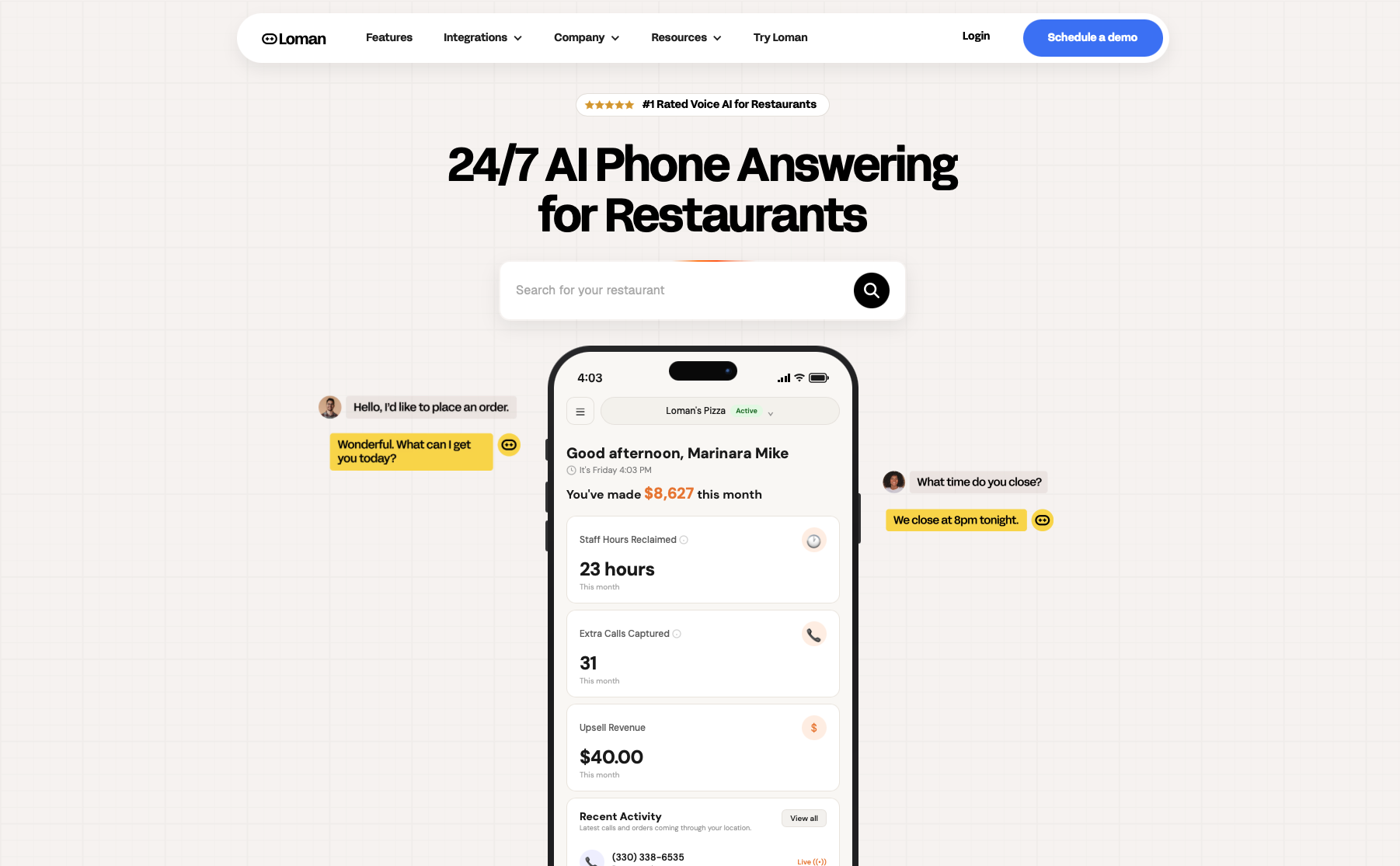
Generic call-handling systems manage general inquiries well enough. Restaurants need something narrower and deeper, a system trained on the actual language of food service: modifiers, 86'd items, table counts, delivery windows, and mid-call substitutions. Loman AI was built from the ground up for that environment. It answers every call 24/7, takes full pickup and delivery orders, books and modifies reservations, and pushes everything directly into your POS and kitchen display with no staff re-keying a ticket.
The economics hold up on a single busy shift. Loman starts at $199/month with no per-minute charges, so the cost stays flat whether the phone rings 20 times on a slow Tuesday or 200 times on a Friday. Operators using Loman have reported up to 22% higher phone revenue through recaptured calls and built-in upselling, and up to 17% lower labor costs. Crust Pizza's owner said it plainly: "This paid for itself in 10 days. Phones are calm, tickets are bigger, and my team refuses to go back."
Setup takes under 24 hours (connect your POS, import your menu, set your greeting) and Loman handles calls from there. It integrates natively with Toast, Square, Clover, SpotOn, SkyTab, Aloha by NCR, Olo, and Stream, plus OpenTable, Resy, and SevenRooms for reservations. For restaurants where phone orders drive a meaningful share of sales, it converts calls into clean tickets instead of missed revenue. See it live at loman.ai/demo.
AI receptionists cost $600 to $4,800 per year versus $30,000 to $60,000 for a full-time human receptionist, according to Brilo AI's 2026 industry analysis, an 87% to 97% cost reduction. Loman starts at $199/month with no per-minute charges, so the fee stays flat whether the phone rings 20 or 200 times on a Friday night, replacing unpredictable hourly labor costs with a single fixed line item.
For high-volume phone ordering, Loman AI is the stronger choice: it closes full orders into your POS and processes in-call payments, while Revmo handles inbound calls and routes reservations but has no publicly listed POS integration partners and no in-call payment processing. Revmo also prices at approximately $0.59 per conversation, roughly $590/month at 1,000 calls with no published ceiling, compared to Loman's flat $199/month regardless of call volume.
Ask the vendor one question: does the system close the order and push a paid ticket to my kitchen, or does it hand off to a staff member for completion? Systems that only answer questions, route callers, or log messages do not convert phone calls into revenue. For restaurants where phone orders are a meaningful share of sales, the system needs to confirm the order, capture payment, and sync the ticket to the POS, with no callbacks, no re-keying, and no manual step in between.
Call routing and order closing are not the same thing, and for restaurants where phone revenue is real money, that distinction is worth getting right before you commit. The category has matured enough that you can verify integrations, test accuracy, and confirm POS compatibility before signing anything. Operators using Loman have reported up to 22% higher phone revenue and up to 17% lower labor costs. Run a live demo at loman.ai/demo.
Enter your information in the form to receive a call from Loman and place an order like a customer would!

