Picking the wrong business phone system costs you calls, customers, and time you can't get back. This Grasshopper vs Nextiva breakdown covers two of the most popular VoIP options as of August 2026, but they serve very different kinds of businesses. Nextiva is a full unified communications suite built for growing teams that need CRM integrations, video conferencing, and advanced call routing. Grasshopper is a lean, flat-rate phone service aimed at solopreneurs and small teams who just need a business number and basic call forwarding. Restaurants have a third option worth knowing: AI phone agents built specifically for food service, which now integrate directly with the major POS systems and go live in under a day. This comparison breaks down current pricing, features, integrations, reliability, and support so you can see exactly which one fits your operation.
TLDR:
Understanding the cost structure of each platform provides key insight into their target markets and value propositions. The pricing models reveal fundamental differences in how these companies approach business communication services.
| Category | Nextiva | Grasshopper |
|---|---|---|
| Starting Price | $15/user/month (Core, annual) | $14/month flat rate |
| Pricing Model | Per-user; scales with team size | Flat rate; add-ons can greatly increase costs |
| Unlimited Calling | Yes | Yes |
| Auto Attendant / IVR | Multi-level, AI-powered (Google Dialogflow, IBM Watson) | Basic menu only; no conversational AI |
| Video Conferencing | Yes (HD video) | No |
| Call Recording | Up to 6 months storage | Not available |
| CRM Integrations | Salesforce, HubSpot, Zoho, Microsoft Dynamics, Oracle, and more | None |
| Third-party Apps | Thousands via Zapier (Slack, Trello, QuickBooks, Calendly, Mailchimp) | Google Voice and Skype only |
| Analytics | Dashboards with interactive maps, graphs, and KPI tracking | Limited reporting |
| G2 Support Score | 9.0 (3,600+ reviews) | 7.7 (161 reviews) |
| Reliability | 8 carrier-grade data centers, full redundancy | 12 reported downtime incidents in the past year |
| Scalability | Omnichannel; grows with the business | Limited; often requires migration as needs grow |
| Best For | Growing teams and mid-sized businesses | Solopreneurs and very small teams with basic needs |
Nextiva operates on a per-user pricing model that scales with your organization. Their Core plan pricing starts at $15/user (billed annually), covering core voice solutions, while higher tiers (Engage at $25, Scale at $75) introduce advanced AI-powered engagement tools for larger operations. This structure can deliver strong return on investment by consolidating multiple communication tools into a single platform, though costs increase proportionally with team size.
Grasshopper, conversely, uses flat-rate pricing starting at $14 per month for a single user, making it immediately more attractive for budget-conscious small businesses. However, this lower price point comes with notable trade-offs. Users frequently report hidden fees and limitations in functionality. One Grasshopper customer explicitly mentioned finding the desktop and smartphone applications difficult to use while simultaneously being surprised by unexpected charges on their bill.
When weighing these platforms, several cost factors deserve careful attention:
The pricing differential becomes most apparent when you look at included features. Nextiva’s seemingly higher costs actually deliver superior value through wide-ranging integration capabilities, advanced call routing, video conferencing, and CRM functionality. Grasshopper lacks many of these enterprise-level features, focusing instead on providing basic phone services at an accessible price point.
For startups and small teams with modest communication needs and limited budgets, Grasshopper's straightforward pricing model offers immediate financial advantages. However, businesses anticipating growth should consider how Grasshopper's affordability might eventually be offset by functionality limitations that could necessitate migrating to a more capable system like Nextiva in the future, potentially creating additional transition costs and disruption. If you want a third option in the mix, our Grasshopper vs Vonage vs Nextiva breakdown covers how Vonage compares on price and features.
Both Nextiva and Grasshopper include unlimited calling, but how each handles those calls tells you which type of business each was built for.
Nextiva's multi-level auto attendant, call routing, and unified inbox get calls to the right person fast. The Call Pop feature surfaces caller history, sentiment, and account value before the rep picks up. Call recording stores up to six months of audio, and voicemail transcription plus adaptive scripting tools help agents handle complex calls.
Grasshopper covers the basics for small teams: call forwarding, voicemail transcription, and custom greetings. It also offers instant text replies for missed calls and Ruby Receptionist support for live call handling. No video calling or file sharing, which limits it for teams that need more than a phone line.
For low call volumes with simple needs, Grasshopper gets the job done at a lower cost. For high volumes, complex routing, or detailed call records, Nextiva's feature set makes the price gap worthwhile.
The ability to connect your phone system with existing business tools can dramatically impact workflow productivity and data consistency. This area reveals one of the biggest differences between these two platforms.
The ability to integrate your phone system with other business applications has become increasingly critical for smoothing workflows and maintaining consistent customer data. Nextiva and Grasshopper show dramatically different approaches to integration capabilities, reflecting their distinct market positioning.
Nextiva connects smoothly with major Customer Relationship Management (CRM) systems used by businesses of all sizes, including Salesforce, Zoho, Microsoft Dynamics, and Oracle Sales Cloud. For entrepreneurs and small businesses focused on marketing and sales, Nextiva integrates with popular platforms like HubSpot, Pipedrive, and Zendesk, allowing for alignment between outreach efforts, customer support, and internal communication. This lets businesses synchronize interactions across multiple customer journey touchpoints. Particularly valuable for small teams, Nextiva’s support for Zapier provides access to thousands of potential app connections without requiring custom development, linking Nextiva to key tools like Slack, Trello, QuickBooks, Calendly, and Mailchimp. The platform also offers email and Single Sign-On (SSO) integration for secure access across systems.
The stark difference in integration capabilities represents a critical decision factor:
In stark contrast, Grasshopper offers only two business integrations: Google Voice and Skype. While this minimal integration approach may suffice for businesses requiring only basic phone functionality, it creates serious limitations for entrepreneurs relying on connected technology stacks to maintain productivity and responsiveness. Grasshopper cannot connect with CRM systems, automation platforms, or support tools, positioning it as a standalone solution instead of an integrated communications hub.
This integration disparity is one of the biggest differentiators between the two platforms. Organizations with complex workflows requiring data synchronization across multiple systems will find Nextiva’s extensive integration capabilities indispensable, while businesses with simpler needs focused primarily on basic telephone functionality might not find Grasshopper’s limited integrations problematic. The decision in the end depends on how central integration requirements are to your business operations and how your technology ecosystem needs to function cohesively.
Both Nextiva and Grasshopper claim 99.999% uptime, but their infrastructure histories reveal real differences in how well those claims hold up.
Nextiva runs 8 carrier-grade data centers across North America with full redundancy. If one center goes down, another picks up without service interruption. The company monitors the network around the clock and maintains a live status page so customers can check performance at any time. Grasshopper, by contrast, logged 12 downtime incidents in the past year according to GetVoIP, suggesting its infrastructure lacks the same level of redundancy and proactive monitoring.
On the support side, Nextiva provides 24/7 phone and live chat, with agents who help configure call flows and holiday scheduling beyond basic troubleshooting. G2 reviewers rate Nextiva's support at 9.0 from more than 2,600 reviews, compared to Grasshopper's 7.7 from 106 reviews. Grasshopper also offers 24/7 service, but user experiences vary. Some report knowledgeable interactions, while others describe problems that eventually led them to switch providers.
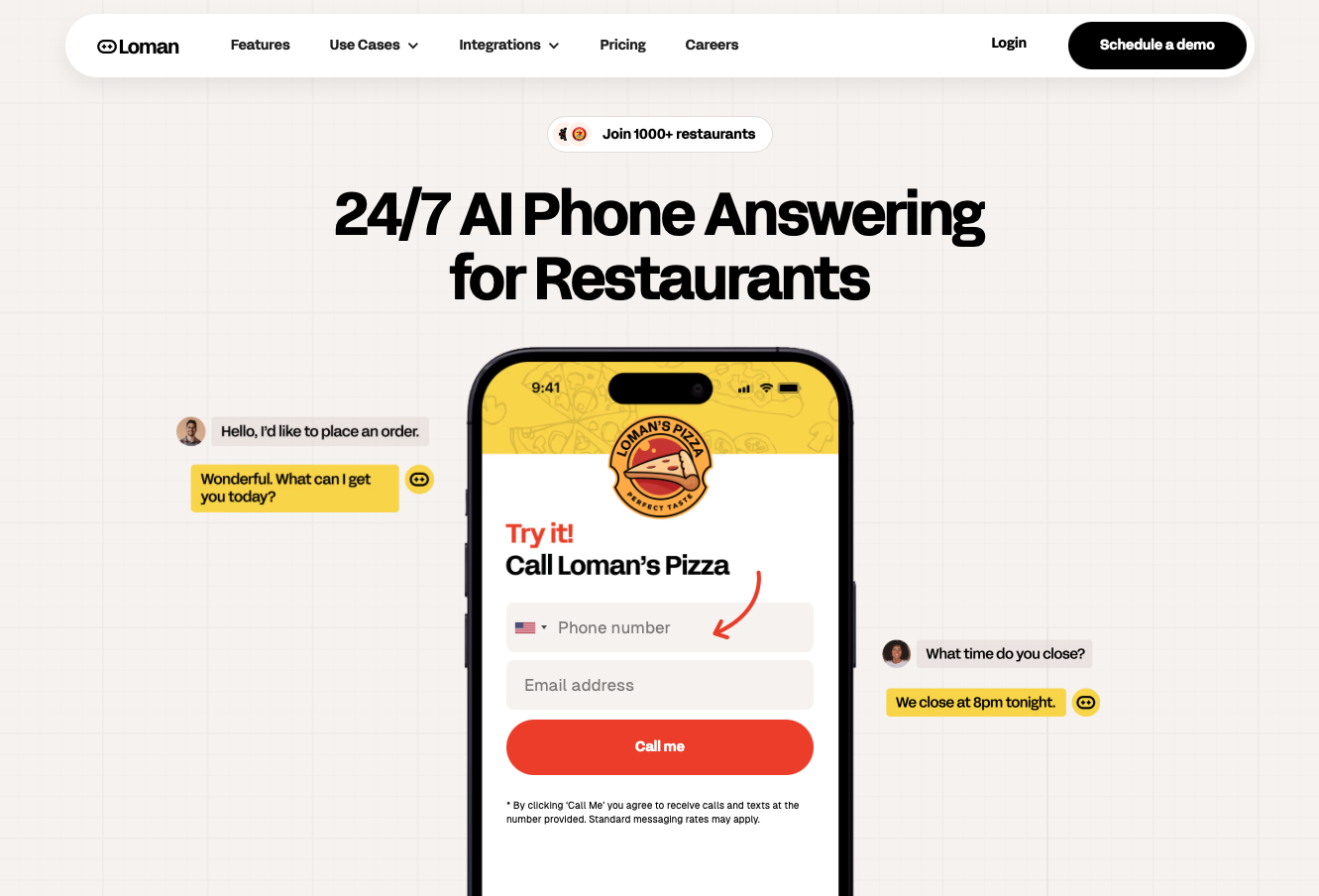
While general business VoIP solutions like Nextiva and Grasshopper serve various industries, restaurants require specialized communication capabilities that go beyond basic call handling. AI for restaurants offers a reshaping approach to managing the unique demands of food service operations, particularly during peak hours when missed calls cost restaurants revenue they can't recover.
Loman offers a 24/7 AI phone agent purpose-built for restaurant operations, integrating smoothly with popular POS systems including Square, Toast, and Clover. Unlike traditional phone systems that require human staff to handle orders, reservations, and customer inquiries, Loman is trained on restaurant menus, policies, and customer preferences to deliver accurate responses while reducing missed calls and shortening wait times. The system handles unlimited simultaneous calls and includes built-in analytics and real-time insights that help restaurant owners identify peak calling periods, optimize staffing decisions, and track important revenue metrics.
The implementation process is remarkably swift, with restaurants going live in under a day compared to the weeks or months required for complex VoIP system deployments. This scalability makes Loman suitable for single locations, multi-unit operations, and enterprise restaurant brands. While Nextiva and Grasshopper focus on general business communication needs, Loman tackles the specific day-to-day challenges restaurants face, from handling complex menu questions and dietary restrictions to processing orders during rush periods without interrupting front-of-house service. The system's ability to upsell popular combinations and add-ons can increase average ticket sizes while freeing staff to focus on guest experience instead of phone management.
Nextiva is the stronger fit if your team is expanding or needs CRM connections, video conferencing, and multi-channel support; its per-user pricing scales with those capabilities. Grasshopper works for solopreneurs or small teams that only need basic call forwarding and voicemail at a flat monthly rate, but users frequently report hidden fees and limited functionality as needs grow.
Grasshopper connects only with Google Voice and Skype, making it a standalone phone solution instead of part of a connected tech stack. Nextiva links directly to Salesforce, HubSpot, Zoho, and thousands of additional apps through Zapier, so call data and customer records stay in sync across your existing tools without custom development.
Nextiva scores 9.0 for support on G2 across more than 2,600 reviews, compared to Grasshopper's 7.7 from 106 reviews, and Nextiva's team goes beyond troubleshooting to help configure call flows and holiday scheduling. If consistent, knowledgeable support matters to your operation, that gap is worth factoring into the decision before you commit.
In the Grasshopper vs Nextiva decision, Grasshopper works well for solopreneurs and small teams that only need a business number and basic call forwarding at a flat monthly rate. Nextiva is the stronger fit for growing teams that need CRM connections, video conferencing, and multi-channel support, with per-user pricing that scales as the team does. For restaurants, neither solution is built for phone order-taking or POS sync; Loman fills that gap, taking phone orders and pushing them straight into Toast, Square, Clover, and other POS systems without staff re-keying a ticket. Book a live Loman demo to see it in action before your next dinner rush.
Enter your information in the form to receive a call from Loman and place an order like a customer would!

