Most restaurants miss phone orders during their busiest moments, when staff are tied up with guests, the line is ringing nonstop, and calls roll to voicemail. New voice-based ordering systems change what happens next by answering every call instantly, taking full orders with modifiers, and sending clean tickets straight into the kitchen queue without staff involvement. Pizza shops, wing concepts, and takeout-heavy restaurants are rolling these systems out in less than a day and capturing sales that previously disappeared into missed calls, turning the phone into a dependable ordering channel.
TLDR:
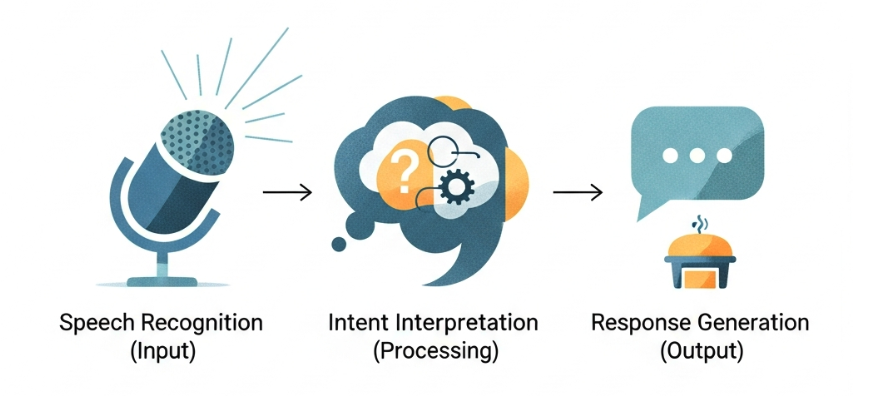
Voice AI ordering systems rely on three core components. Speech recognition converts spoken words into text. The AI then interprets intent, determining whether a caller wants to place an order, book a table, or ask about hours, and extracts details like menu items, modifications, and timing.
The final component is integration. The AI translates the conversation into a format your POS recognizes and sends the ticket directly to your kitchen queue. Payment processing happens in the same flow, with the AI securely collecting card details and posting the transaction.
Orders arrive as structured tickets with no miscommunications. The AI references your menu in real time, tracking what's available, which modifiers apply, and which items can be customized. When a caller requests extra cheese or no onions, the system logs those specifications as your staff would.
Every missed call is lost revenue. Restaurants miss 34% of incoming calls, typically during peak lunch and dinner hours when staff can't get to the phone.
The impact is substantial because restaurant calls relate directly to revenue: orders, reservations, or catering inquiries. Missing a third of these calls means turning away customers who are ready to buy.
The consequences extend beyond single transactions. Sixty-nine percent of Americans won't visit a restaurant that doesn't answer the phone, converting a missed call into a potentially lost customer.
For a restaurant receiving 50 daily calls with a $35 average ticket, missing 34% of revenue calls equals approximately $217,000 in annual lost revenue. Voice AI answers virtually every call without adding staff, converting more missed opportunities into completed orders.
Human error causes most restaurant order mistakes. Staff mishear orders during rush periods, write down incorrect modifiers, or tap the wrong item in the POS. These errors create remakes, ingredient waste, and frustrated customers.
Voice AI systems remove transcription errors by sending structured data directly to the POS. The AI logs every modifier and special request in the exact format your kitchen needs, removing the verbal handoff problem between front-of-house staff and the line.
Voice AI ordering reduces order errors because the system references your menu configuration for every item and validates modifications before confirming. When a caller requests something unavailable, the AI catches it immediately instead of sending a ticket the kitchen can't fulfill.
Fewer errors mean less food waste from remakes and fewer comped meals. Clean tickets also reduce back-and-forth between staff and confused callers.
Pizza shops, wing joints, and Chinese takeout restaurants are leading Voice AI adoption in late 2025. These categories handle high phone order volumes where every missed call directly impacts daily revenue, making them natural early adopters of automated answering systems.
The shift from experimental to standard practice is driven by persistent labor challenges. The average annual restaurant turnover rate is 79.6 percent, and 45 percent of operators report insufficient staffing. Voice AI fills gaps that hiring can't reliably solve.
Quick-service restaurants and multi-unit operators follow closely behind takeout-focused concepts. Chains recognize that deploying voice AI across locations standardizes service quality while reducing per-store labor requirements.
The voice AI foodtech market is projected to surpass $2.5 billion by 2027, growing at 32% annually. This growth reflects restaurants treating phone automation as infrastructure instead of transformation.
Voice AI handles every incoming call without staff intervention, freeing front-of-house teams to focus on in-person guests. Servers no longer pause mid-table to answer phones, and hosts can greet arrivals without interruption.
The cost structure changes from variable hourly wages to predictable monthly fees. Voice AI doesn't call in sick, need training, or require supervision.
Staff retention improves when phone duties are removed. Employees can concentrate on hospitality instead of splitting attention between dining room service and phone interruptions. Servers turn tables faster, hosts manage seating flow better, and kitchen tickets arrive cleanly formatted in the POS.
Voice AI systems handle many simultaneous calls, eliminating busy signals during peak hours. During Friday dinner rush or Super Bowl Sunday, every caller connects immediately while staff focuses on the dining room.
After-hours orders convert to revenue without adding overnight staff. Customers calling at 11 p.m., 6 a.m., or on holidays reach a system that takes their order instantly instead of a voicemail box.
When 15 calls arrive simultaneously at 6:30 p.m., voice AI answers all of them, can quote estimated prep times based on your configured rules, and sends tickets directly to your POS. You never lose orders to hold times or abandoned calls.
Human phone coverage requires scheduling, breaks, and coverage gaps. Voice AI operates continuously without shifts, capturing orders 24/7.
Voice AI executes every upsell opportunity with consistency humans can't match. The system prompts add-ons at optimal moments in the conversation, suggesting drinks with pizza orders, extra sauces with wings, or dessert after entrees.
Human staff forget to upsell during rush periods, skip suggestions when tired, or feel awkward pushing extras. Voice AI applies the same prompts to every caller without fatigue or hesitation.
The suggestions feel conversational instead of scripted. When a caller orders a large pizza, the AI might ask, "Would you like to add a two-liter for $3?" The prompt is brief, relevant, and easy to accept or decline.
Restaurants using voice AI with upselling capabilities report measurably higher average tickets compared to manual phone orders.
Voice AI connects to existing restaurant systems through direct API integrations, requiring no replacement of current tools. Orders flow from the AI into your POS, appearing in the kitchen queue as if a staff member entered them.
POS integrations with systems like Toast, Square, Clover, and Aloha send ticket data with proper item codes, modifiers, and pricing. The AI references your live menu configuration, so out-of-stock items or seasonal changes sync automatically.
Reservation systems receive bookings directly from voice AI calls. Integration with OpenTable and similar tools means phone reservations populate your seating chart without manual entry, reducing double bookings.
Payment processing happens within the same integration layer. The AI captures card details securely and posts transactions through your existing payment processor, so all revenue appears in your reconciliation reports without separate accounting streams.
Start by auditing your call volume and patterns. Track incoming calls during peak hours, what percentage involve orders versus questions, and how many go unanswered. This baseline determines whether voice AI will deliver meaningful ROI.
Menu complexity has minimal impact on implementation success. Voice AI handles multi-modifier items and substitutions, but your menu must exist in digital format for system import.
Review your existing POS and reservation systems before selecting a voice AI provider. Verify that native integrations exist for your specific setup to avoid manual ticket entry or workarounds.
Most voice AI systems go live within 24 hours after menu import and configuration. Setup involves connecting your phone number, uploading your menu with pricing and modifiers, setting business hours, and testing calls.
Voice AI systems handle payment data through PCI-compliant channels with end-to-end encryption. Card numbers never pass through restaurant staff or unsecured phone lines. The AI collects payment details and transmits them directly to your POS processor using the same secure protocols as in-person card readers.
The voice AI restaurant sector has reached commercial maturity in late 2025. What began as experimental pilots at early-adopter chains has scaled to thousands of single-location operators deploying systems within days of signing contracts.
Investment activity reflects this shift. Similar funding rounds across competitors like Kea, Slang AI, SoundHound, and ConverseNow signal that investors view restaurant voice automation as infrastructure instead of novelty. The competitive pressure drives rapid feature improvement, with providers competing on POS integrations, upsell sophistication, and deployment speed instead of basic call handling. Market analysts project the voice AI restaurant market will grow from $10 billion to $49 billion by 2029.
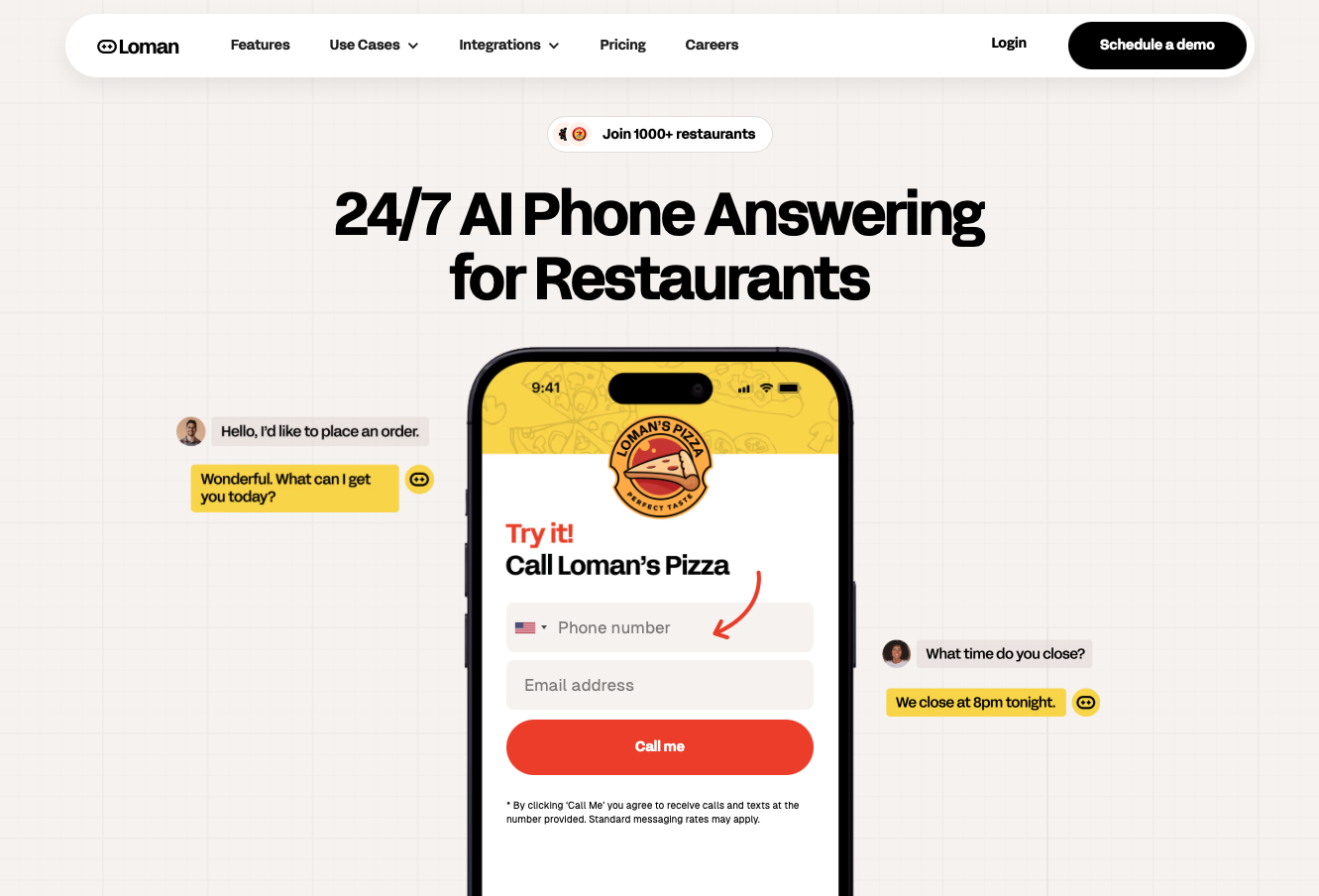
Loman AI is a restaurant-built voice AI phone agent that handles the exact call volume and order complexity described above.
It answers every call 24/7, takes full pickup and delivery orders, books reservations, answers menu and policy questions, and sends clean tickets and payments straight into systems like Toast, Square, Clover, and Aloha. Designed for single-location operators, multi-unit groups, and enterprise brands, Loman helps restaurants recover missed phone revenue while keeping staff focused on in-person guests, often going live in under 24 hours.
The system recognizes edge cases through intent and sentiment analysis, then transfers to a live line with full context, captures a voicemail with transcript, or alerts staff with the caller's details so they can follow up.
Yes. Voice AI can handle many simultaneous calls, so during Friday dinner rush or holidays, more callers connect quickly while your staff focuses on the dining room.
Voice AI integrates directly with major POS systems including Toast, Square, Clover, and Aloha through API connections, sending orders to your kitchen queue with proper item codes and modifiers automatically.
Restaurant phone ordering no longer has to break down during rush hours, late nights, or staffing gaps. Voice-based ordering systems now take every call, capture complete orders with modifiers, and send tickets straight into the kitchen while staff stays focused on guests. With direct POS and payment connections, rollout happens quickly and phone orders start converting immediately. For restaurants that rely on calls for takeout, delivery, or reservations, solutions like Loman’s voice ordering system show how the phone can finally pull its weight as a consistent sales channel.
Enter your information in the form to receive a call from Loman and place an order like a customer would!

