During peak service, every missed call is a missed order, and restaurants comparing Maple alternatives usually arrive at the same frustration: the system answered the phone, but the order came out wrong. Maple does handle calls and can take orders, but operators running real volume consistently report the same pattern - low-cost AI models under the hood that create noticeable latency and, more critically, accuracy rates that break down when customers are ordering anything beyond the simplest items. Add an onboarding process that routinely stretches past six weeks (and in many reported cases never fully completes), and the gap between what was sold and what was delivered becomes hard to ignore.
In this guide, we break down where Maple fits, where it falls short, and how more complete phone automation solutions handle orders, accuracy, and revenue growth from the first ring to the final confirmation.
What operators are actually evaluating
When restaurants move past a first demo and start pressure-testing these systems, the questions that come up most are:
Maple fits part of that picture on paper. Where it consistently draws criticism is on the first two. The AI model choice that makes the price attractive is the same choice that creates latency customers notice and order errors that cost real money in refunds, remakes, and lost guests. And a system you can't fully onboard doesn't solve anything regardless of what it could theoretically do.
The alternatives gaining the most traction with high-volume operators are the ones with the production track record to answer all four questions confidently.
If Maple's pricing looks attractive upfront, it's worth stress-testing what the real cost looks like after accounting for order errors, staff time cleaning up AI mistakes, and a months-long onboarding process that may never fully resolve. The right question isn't which system is cheapest to start. It's which one actually works when your phones are ringing.

Maple is a voice AI phone answering service. The system picks up incoming calls around the clock, handling everything from takeout orders to catering inquiries while your staff stays focused on in-person guests.
Since launching in December 2023, Maple has answered over 1 million calls for restaurants with a 92% resolution rate without human intervention. The service now serves over 1,000 merchants and integrates directly with leading POS systems to send orders straight into your kitchen workflow.
Maple handles basic call types: takeout orders, reservation requests, hours and directions, and frequently asked questions about menus or policies. The AI captures caller information and routes orders into your existing systems, reducing the number of missed calls during dinner rush.
The service recently rolled out a strategic OpenTable integration that automates reservation booking and syncs availability in real time. For restaurants that rely heavily on OpenTable's reservation network, this integration can be valuable, given that 42% of callers hang up when restaurants can't answer.
Maple positions itself as a reservation and basic order-handling solution for local restaurants. While it covers the fundamentals of phone automation, its feature set and call-handling depth differ across competitors, which is why many operators look at alternatives.
Maple works well for restaurants that need reservation management and basic call answering, especially if you already use OpenTable. The service handles routine phone inquiries and captures calls during peak hours, reducing pressure on your front-of-house team. For restaurants with straightforward takeout menus and simple reservation needs, Maple provides a solid foundation for automating phone interactions.
However, several limitations lead restaurants to consider alternatives. Maple does not currently advertise native in-call payment processing, which means orders cannot be completed end-to-end without additional steps or manual intervention. The system does not include a built-in upselling engine during orders.
For restaurants with complex menus featuring extensive modifiers, allergen restrictions, or rotating specials, Maple's order handling may require confirmation before orders go live. Multi-location restaurant groups need per-store customization with centralized analytics, and Maple's configuration may not offer the granular location-level overrides that larger operations require.
Restaurants processing high volumes of phone orders often need more sophisticated order-taking capabilities than basic reservation and FAQ handling. If you need complete order taking with payment capture, intelligent upselling, unlimited concurrent call handling, or deep menu customization across multiple locations, you'll want to consider alternatives that focus on phone order automation with revenue optimization features.
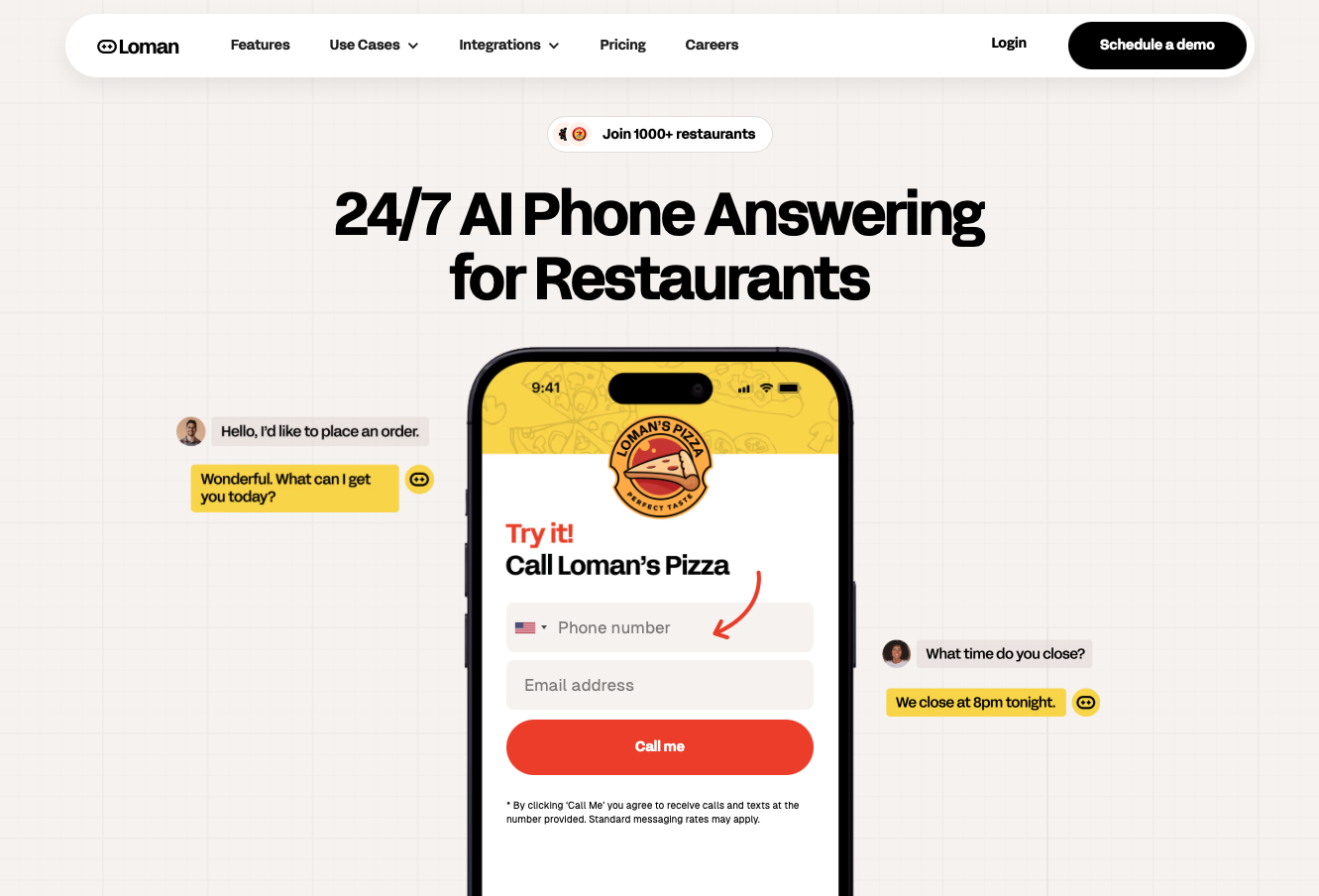
Loman is a 24/7 AI phone agent built for restaurants that answers every call, takes pickup and delivery orders, books reservations, and processes secure payments directly through integrated POS systems. The service combines complete order automation with revenue optimization to capture missed calls and increase average ticket sizes.
Key strengths include complete order taking with secure payment processing and POS sync to Toast, Square, Clover, SpotOn, Aloha, Olo, and OpenTable. The built-in upselling engine suggests relevant add-ons and combos during every order to increase ticket size. Loman handles unlimited simultaneous calls with per-store menu overrides and rollup analytics for multi-location groups, and deploys in under 24 hours with white-glove setup and multilingual support.
Loman works best for single-location restaurants, multi-unit groups, and national brands that rely on phone orders as a meaningful revenue channel and need full menu ordering, payment processing, reservation management, and intelligent upselling in one system. It handles the complete restaurant phone operation from call to payment without requiring manual follow-up steps, includes revenue-driving upselling capabilities that Maple lacks, and supports unlimited concurrent calls with deep POS integrations that send clean tickets directly to kitchens.

Hostie is an AI-powered phone system for restaurants and hospitality businesses that automatically handles phone calls, text messages, and emails while managing reservation bookings and takeout orders through direct POS integrations. The system features multilingual support across 20 languages and connects with major reservation systems like OpenTable and Resy.
The service offers voice and text message handling in over 20 languages with OpenTable and Resy integration, centralized call/text/email management in one dashboard, and real-time call transcripts with notifications for special requests or VIP callers. Since launching in 2024, Hostie has scaled to serve over 200 locations.
Hostie works well for independent restaurants and hospitality groups that want multichannel guest communication management (phone, text, email) with strong reservation handling and multilingual capabilities. However, it does not include built-in payment processing for phone orders or an intelligent upselling engine to increase average ticket sizes. Hostie can handle order modifications but relies on staff follow-up or POS integration for order completion instead of completing transactions during the call.
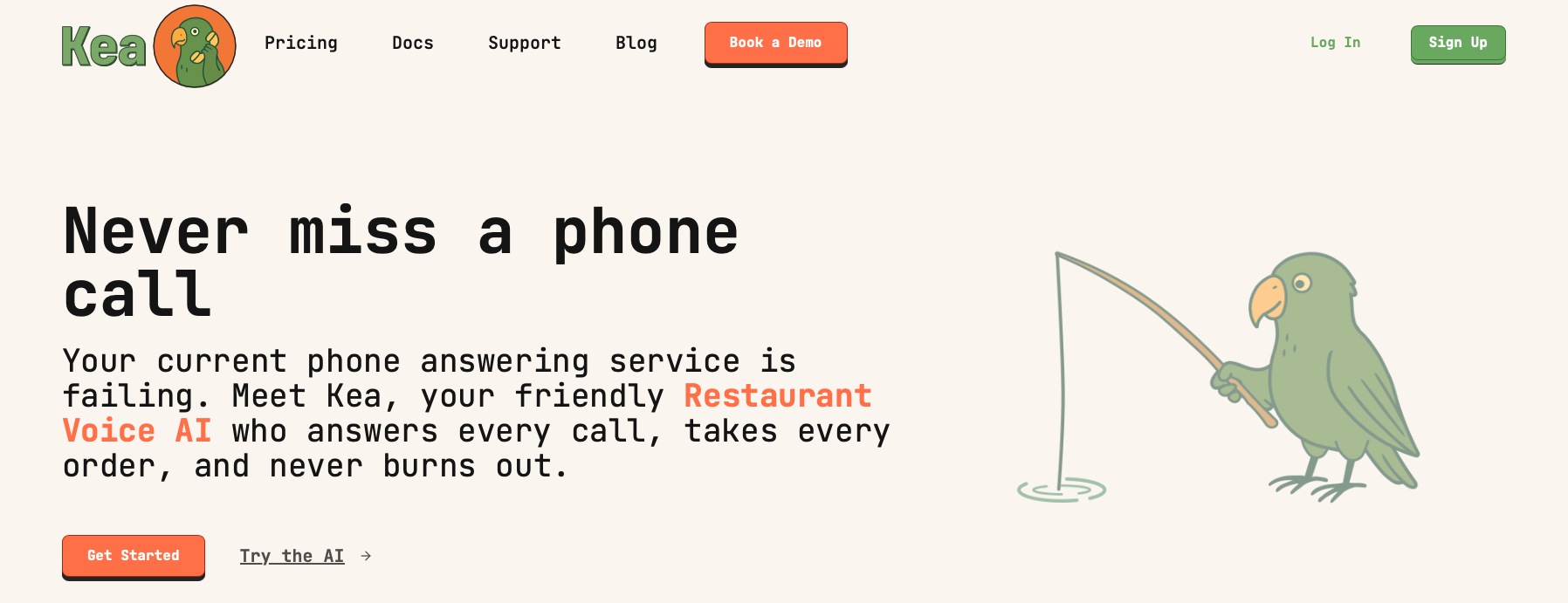
Kea is a restaurant Voice AI founded in 2018 that helps restaurants capture every call and text with intelligent ordering, menu analysis, and payment capabilities. Integrated with more than 10 POS systems, Kea has powered hundreds of brands including Rachel's Kitchen, Pincho, Blaze Pizza, Hopdoddy, and Via 313.
The service provides voice and text AI for order taking with POS integration to over 10 systems, Kea Pay instant checkout link sent by text that supports Apple Pay and Google Pay, menu insights that identify low-performing items or missing modifiers, and self-service menu editor for real-time updates without support tickets. Kea also includes caller ID recognition for returning customers and integrates with customer data systems.
Kea works well for QSR and fast-casual chains that need detailed menu optimization insights alongside order automation. The text-based payment link approach works for customers comfortable with mobile checkout but creates friction compared to over-the-phone payment completion. Kea's menu analysis tools provide value for operators looking to optimize offerings based on call data, but the system requires customers to complete checkout separately instead of during the initial call.
Maple handles basic call answering and reservation management effectively, especially if you already run OpenTable. For restaurants where phone orders account for minor revenue and reservations are your main phone activity, Maple covers the essentials.
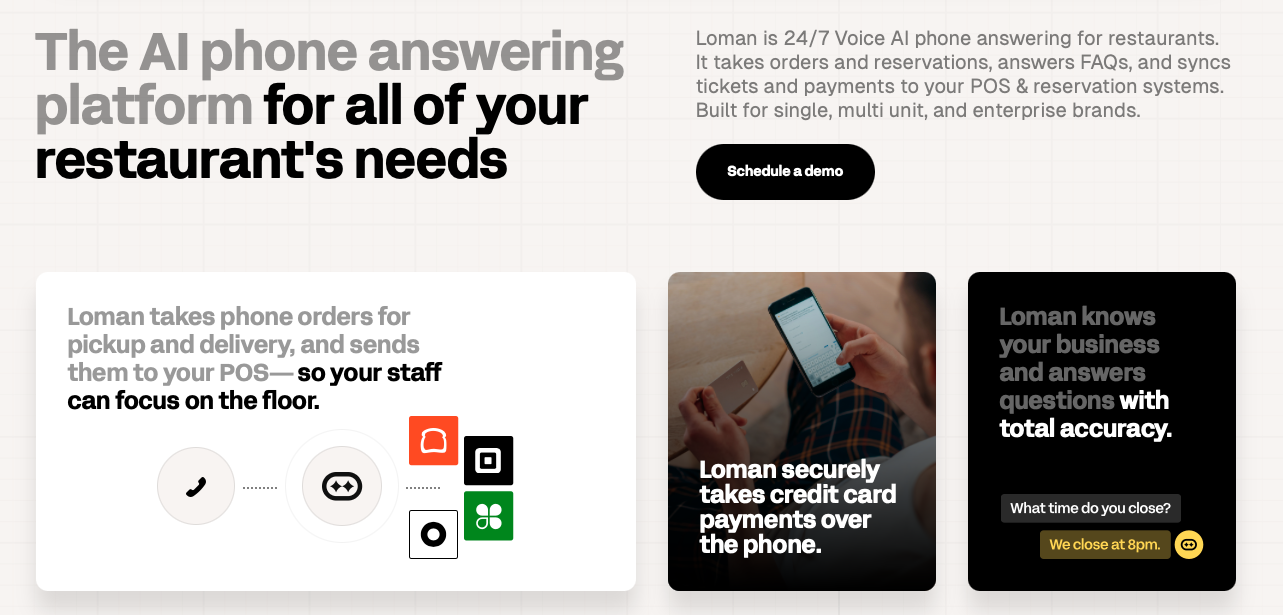
But if phone orders represent a meaningful revenue channel, you need more than basic call handling. Loman completes the entire phone operation from call to payment without requiring manual follow-up steps or staff intervention.
The difference comes down to revenue optimization. Maple captures calls and routes basic orders, but it does not accentuate built-in upselling and in-call payment completion in the same way as some alternatives. Loman handles secure payment processing directly through your POS during every call, so customers complete transactions on the spot. Our upselling engine prompts relevant combos and add-ons during each order, helping restaurants recapture up to 22% more revenue from phone channels.
For operators running multiple locations, Loman provides per-store menu overrides with centralized analytics that roll up across your entire group. Each location can maintain local specials, hours, and menu variations while you track performance from one dashboard. Maple offers configuration assistance, though multi-location groups may require deeper customization depending on functional complexity.
Loman also deploys faster. Most restaurants go live in under 24 hours with white-glove setup, and our deep POS integrations send clean tickets directly to kitchens. If you need a complete phone solution that captures revenue instead of just handling calls, Loman delivers.
If phone orders represent a major revenue channel for your restaurant, you need secure payment processing during calls, or you want automated upselling to increase average tickets, Maple's basic order handling may not meet your needs. Multi-location groups requiring per-store menu customization with centralized analytics will also benefit from more advanced alternatives.
Look for complete order taking with in-call payment processing, built-in upselling capabilities, deep POS integrations that send clean tickets directly to your kitchen, and unlimited concurrent call handling. Multi-location operators should verify per-store menu overrides with rollup analytics are supported.
Yes, Loman processes complete menu orders including extensive modifiers, allergen restrictions, and rotating specials through its POS integrations with Toast, Square, Clover, SpotOn, Aloha, and Olo. The system sends clean, accurate tickets directly to your kitchen workflow without manual verification.
Most restaurants deploy Loman in under 24 hours with white-glove setup, which includes connecting your POS and reservation systems, importing menus, and configuring greeting scripts. You can run both systems in parallel during transition to test call quality before fully switching.
Yes, Loman integrates directly with OpenTable to sync reservations in real time while also handling complete phone orders, secure payments, FAQ responses, and intelligent upselling. You get reservation management plus full order automation in one system.
Maple works for reservations and basic call coverage, but restaurants with meaningful phone order volume need a system that captures payment, suggests add-ons, and pushes clean tickets straight into the POS without staff involvement. That is where Maple alternatives stand apart, closing the gap between answering the call and completing the sale. Loman gives operators full order taking, secure in-call payment processing, and built-in upselling that can lift average ticket size while handling unlimited simultaneous calls. If you want phone automation that drives revenue instead of simply fielding calls, it is worth seeing how Loman performs with your real menu and service flow.
Enter your information in the form to receive a call from Loman and place an order like a customer would!

