When a QSR misses calls during peak hours, the loss is immediate and measurable, with unanswered orders quickly turning into revenue for the competitor who picks up. Many operators miss a quarter or more of incoming calls during rush periods, which can translate into tens of thousands in lost annual sales. Modern QSR AI systems automatically answer incoming calls without placing customers on hold, take full orders with payment, sync tickets directly to the POS, and support multilingual guests without pulling staff from the counter or drive-thru. This guide breaks down the top options on the market and the leading restaurant-focused solutions that handle unlimited calls and complete order automation in one system.
TLDR:
AI phone systems for high-volume quick service restaurants answer calls, take orders, process payments, and book reservations without staff involvement. They run 24/7 using conversational AI to quote wait times, answer menu questions, suggest add-ons, and route completed orders straight into your POS.
The business case is clear: QSRs miss between 25% and 34% of calls during peak periods. Every missed call is lost revenue. An AI phone system picks up every single time, converting dropped opportunities into captured orders.
We ranked each AI phone system on five criteria that matter for high-volume QSRs: order-taking completeness, POS integration depth, call concurrency, deployment speed, and multilingual support.
Order-taking completeness separates systems that process full menu orders with payment from those limited to basic questions. POS integration depth matters because native connections to Toast, Square, Clover, and Aloha eliminate manual entry and ticket errors.
Call concurrency prevents busy signals during rushes. Systems handling unlimited simultaneous calls outperform those with channel limits. Finally, QSRs need systems that deploy in days and serve bilingual customers in markets like Texas, California, and Florida.
| AI Phone System | Complete Order Taking with Payment | POS Integration | Call Concurrency | Deployment Time | Multilingual Support | Best For |
|---|---|---|---|---|---|---|
| Loman | Yes - Full menu orders with secure payment processing | Integrations with leading POS and ordering platforms (e.g., Toast, Square, Clover, Aloha, Olo, and others) | Unlimited simultaneous calls | Under 24 hours with white-glove setup | Yes - Built-in multilingual capabilities | QSRs of all sizes needing complete order-to-payment automation |
| Hostie | No - Handles reservations and basic inquiries only | OpenTable and Resy integration for reservations | Handles high call volume | Quick setup | Limited information | Full-service restaurants in major metro markets focused on reservations |
| Kea | Yes - Voice AI for phone and drive-thru orders with PCI-compliant payment | Integrates with 10+ POS systems including Olo | High volume support | Typically 4 weeks for POS integration | Yes - Conversational AI with multilingual capabilities | Multi-unit pizza chains and QSR brands with dedicated IT resources |
| ConverseNow | Yes - Drive-thru and phone ordering with payment | Integration with major POS systems and drive-thru infrastructure | Enterprise-level call handling | Longer implementation for enterprise deployments | Yes - Cloud-based multilingual support | Large QSR chains with drive-thru operations across multiple states |
| SoundHound AI | Yes - Carryout, curbside, and delivery orders with payment | POS and loyalty program integration | Processed over 100 million interactions | Enterprise deployment timeline | Multi-industry voice AI technology | Large national chains already using SoundHound's enterprise platform |
| Slang.ai | Typically routes food orders to online ordering instead of completing payment by phone | OpenTable integration for reservations | 24/7 call coverage | Setup in under 30 minutes | Limited information | Full-service restaurants focused on reservations, hours, and menu questions |
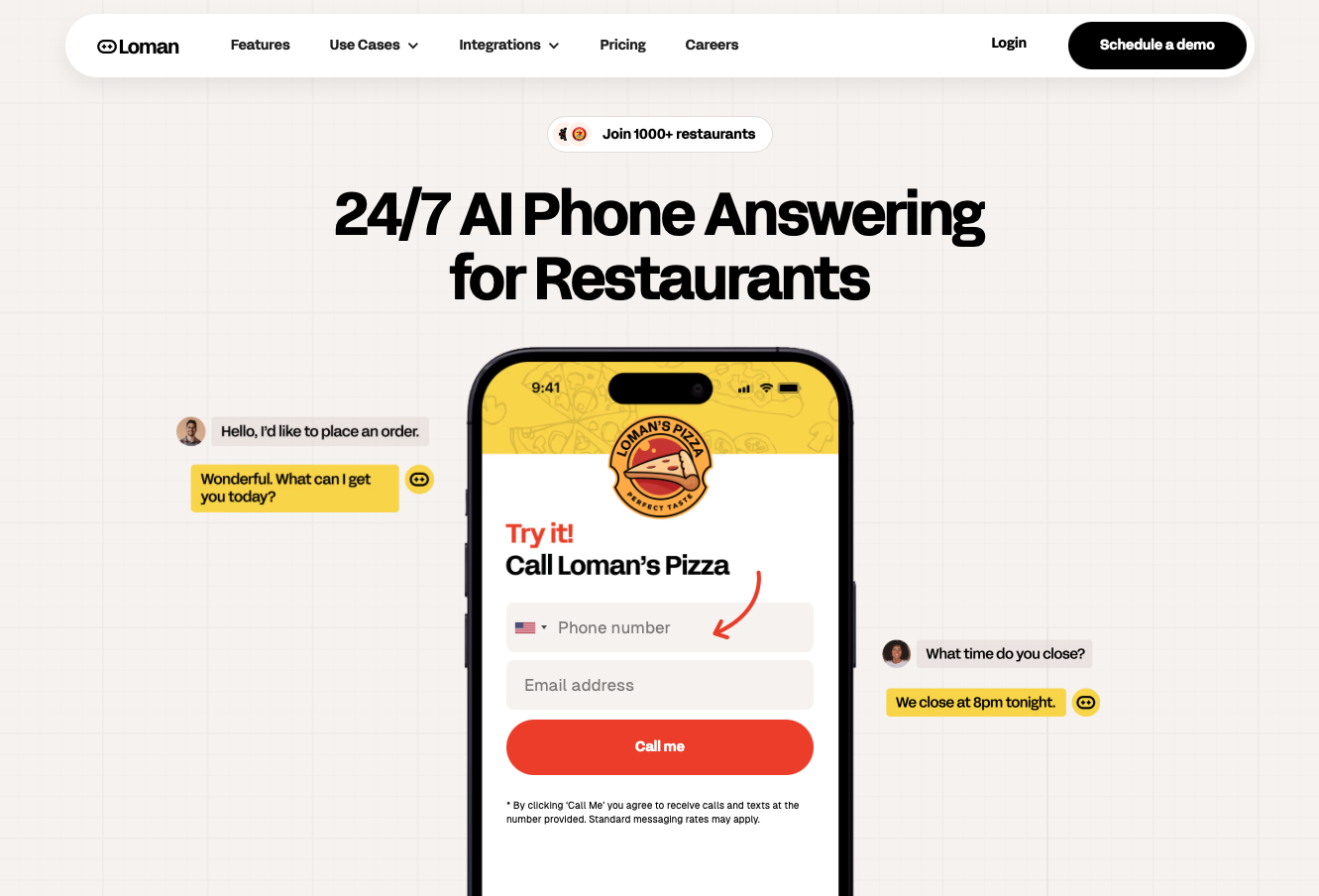
Loman is a restaurant-specific AI phone system that combines full menu order taking, secure payment processing, reservation management, and deep POS integration in one solution. The AI answers every call 24/7 and handles unlimited simultaneous conversations, so guests never hit voicemail during peak hours. Orders and payments can sync with leading POS and ordering platforms (including Toast, Square, Clover, Aloha, Olo, and others, depending on configuration), sending clean tickets straight to the kitchen with no manual entry.
Most restaurants go live in under 24 hours with white-glove setup and menu training. The system also answers menu and allergen questions, quotes wait times, and recognizes repeat callers, creating a consistent guest experience. Built-in upselling prompts increase average ticket size, while multi-location groups benefit from per-store menu controls and roll-up analytics that track revenue, call volume, and performance across every unit.
Hostie provides AI-powered guest communication management for full-service and hospitality-focused restaurants. Since launching in 2024, Hostie has scaled to serve more than 200 locations and has answered over 400,000 guest calls, primarily in major metro markets including San Francisco, New York, and Los Angeles.
The system handles AI phone and text answering with unified inbox management, reservation booking through OpenTable and Resy integration, call transcripts with real-time visibility, and customizable conversational flows for hospitality-focused interactions.
Hostie is good for independent full-service restaurants and small hospitality groups in major metro markets where reservations drive most phone volume and guest communication matters more than high-volume order processing.
Hostie handles reservations and basic inquiries but doesn't take full menu orders with payment processing. Geographic focus on coastal markets means less experience with diverse restaurant types nationwide.
Kea is a restaurant voice AI provider founded in 2018 that has powered hundreds of brands and integrates with more than 10 POS systems. The company targets phone and drive-thru automation for restaurant chains.
Kea offers voice AI for phone orders and drive-thru with conversational capabilities, PCI-compliant payment processing with human-in-the-loop monitoring, integration with Olo for direct kitchen order placement, and text AI for SMS-based ordering.
Kea is best for multi-unit pizza chains and QSR brands with high phone volume that need both voice and text ordering channels and have dedicated IT resources for longer implementation timelines. The company typically integrates with POS systems within four weeks, which is longer than solutions offering same-day deployment.
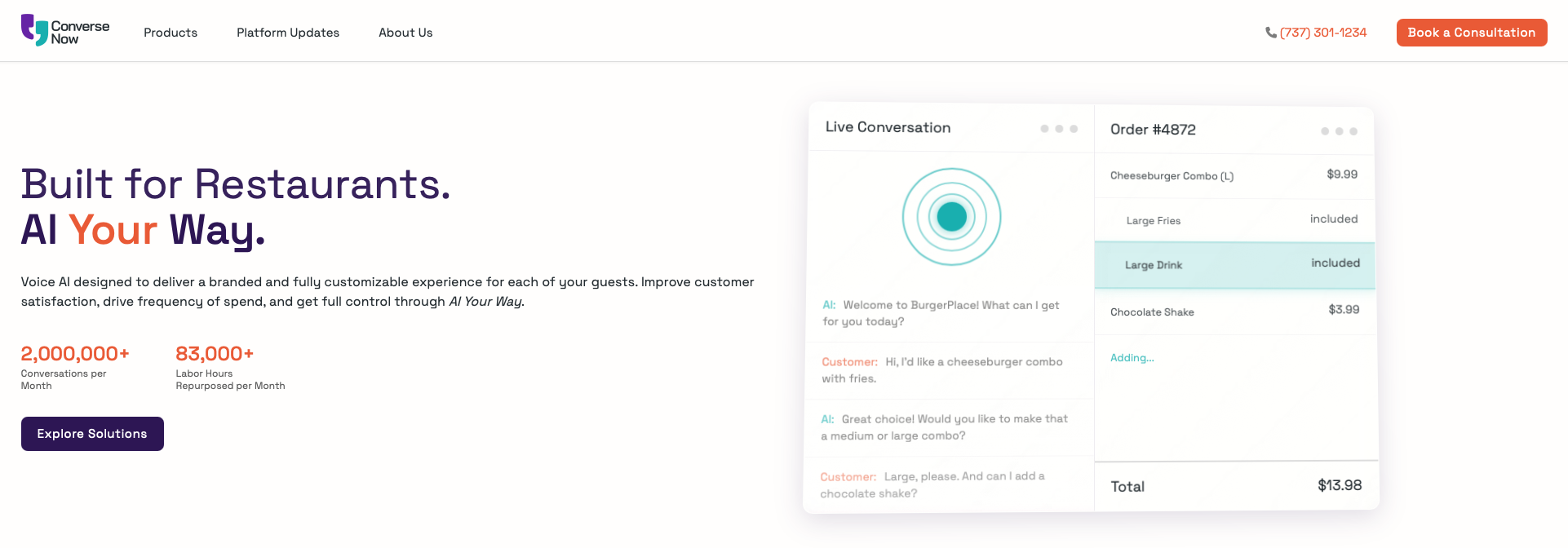
ConverseNow provides voice AI automation for high-volume QSR chains focusing on drive-thru and phone ordering channels. The system already answers calls at more than 1,200 restaurants across 40 states, working with brands like Domino's and Wingstop.
Their solution includes AI-powered virtual ordering assistants for drive-thru and phone channels, conversational AI with upselling based on real-time data, cloud-based systems supporting multiple languages, and integration with major POS systems and drive-thru infrastructure.
ConverseNow primarily targets enterprise QSR chains and drive-thru automation, which means smaller operators and restaurants without drive-thru may not fit their deployment model. No clear pricing transparency exists for mid-market or independent restaurants.
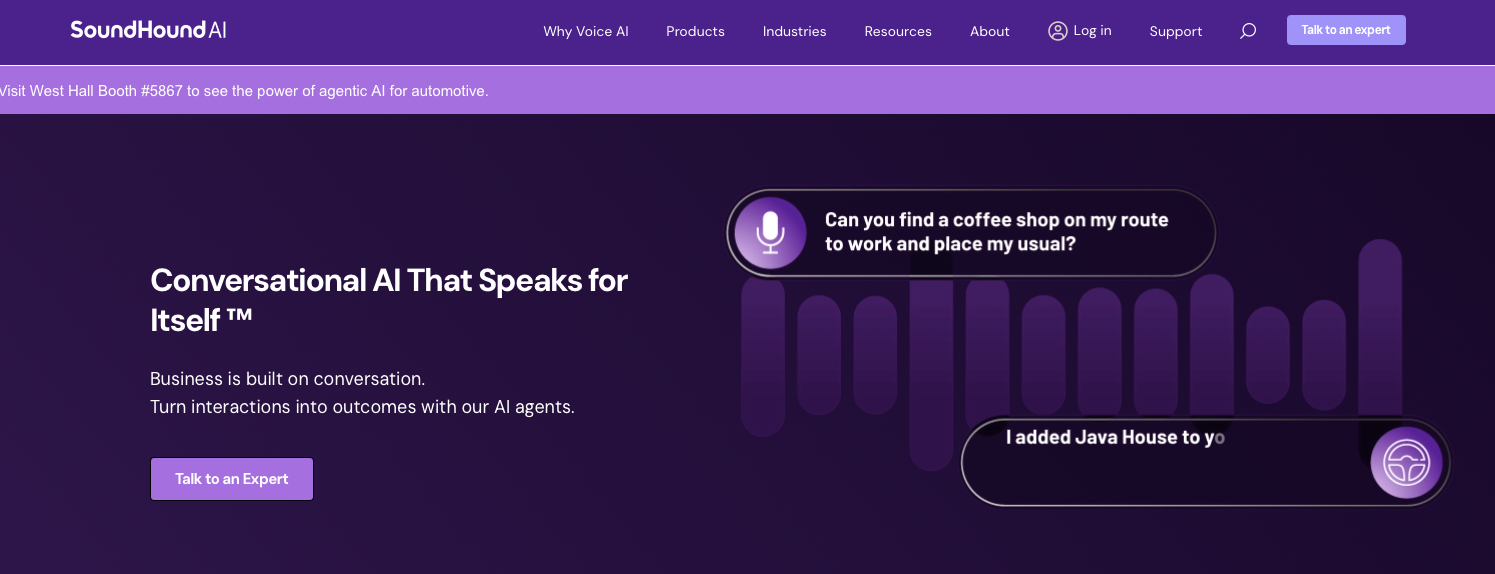
SoundHound AI's phone ordering tech has processed over 100 million interactions with restaurant customers and works with over 10,000 restaurant locations across brands including Chipotle, Jersey Mike's, and Applebee's.
Their phone AI handles carryout, curbside, and delivery orders with payment processing and quick reordering capabilities. The system integrates with POS and loyalty programs but adapts multi-industry voice AI tech for restaurant use instead of building QSR-specific solutions.
Best for large national chains already part of SoundHound's enterprise customer base. The multi-industry approach means less focus on QSR workflows, menu complexity, and restaurant edge cases compared to QSR-only systems.
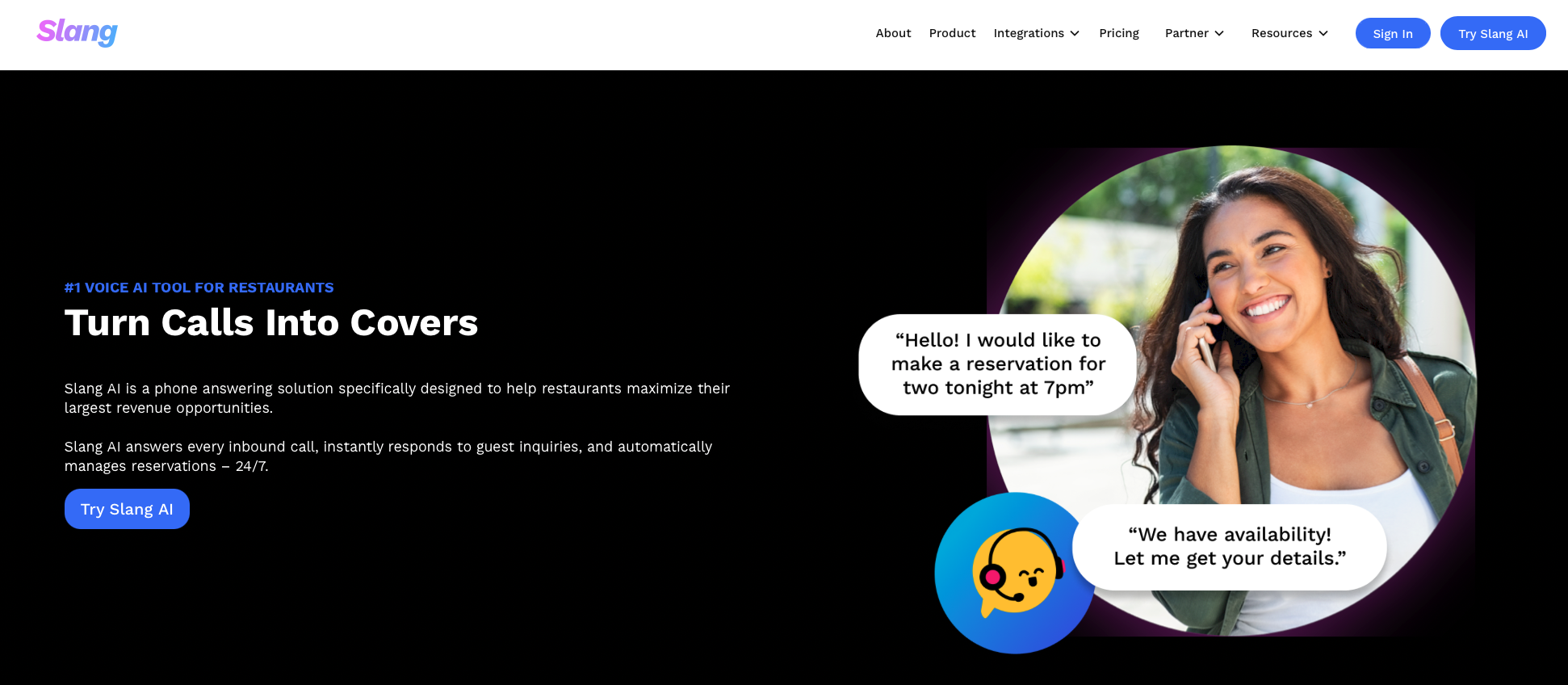
Slang is a restaurant voice AI working with over 1,000 operators across 47 states. The system handles phone answering with OpenTable integration for reservations, modifications, and cancellations. Setup takes under 30 minutes with 24/7 call coverage and real-time analytics.
The system works well for full-service restaurants where calls focus on reservations, hours, and menu questions. However, Slang redirects customers to online ordering when they want to purchase food, which creates friction for phone order revenue. For QSRs dependent on phone sales, this limitation means lost transactions during peak periods when customers won't complete orders through multiple channels.
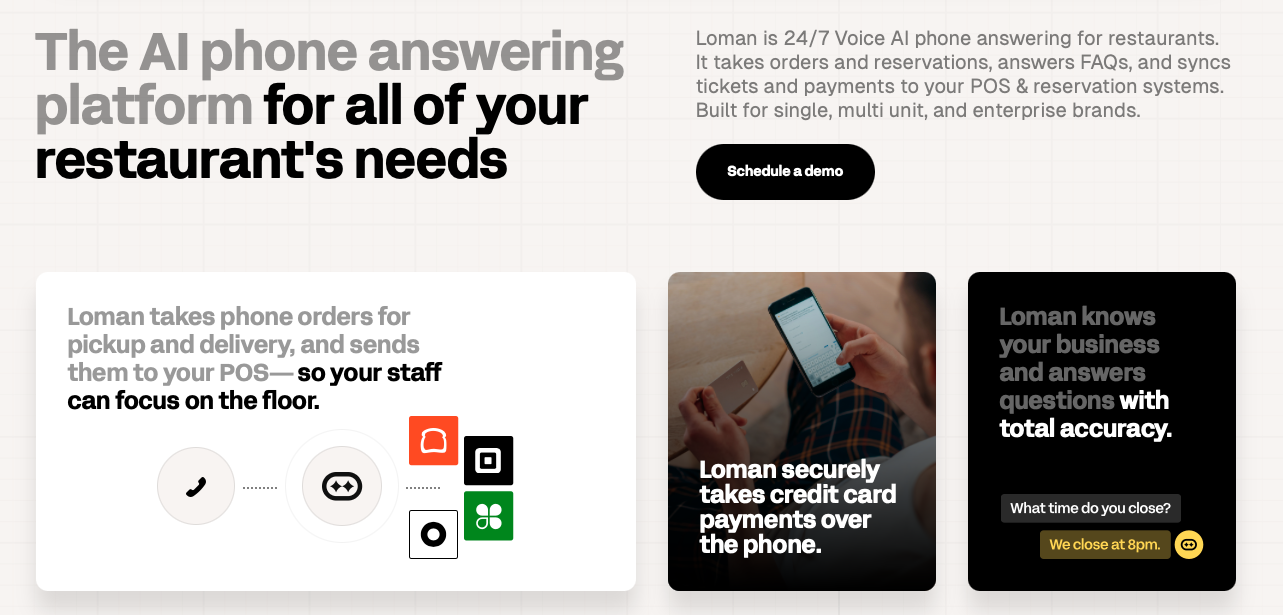
Loman AI is built exclusively for restaurants and manages the full customer journey from call answer to payment confirmation. It takes complete pickup and delivery orders, processes credit cards securely, books reservations, and syncs directly with POS systems like Toast, Square, Clover, Aloha, Olo, Stream, and OpenTable. There are no redirects or manual ticket entry, so every completed call becomes captured revenue.
High-volume QSRs benefit from unlimited simultaneous call handling, built-in upselling, multilingual support, and deployment in under 24 hours. A centralized dashboard tracks calls, revenue, and trends across single or multiple locations. Restaurants using Loman report up to 22% higher revenue from recaptured calls and upsells while reducing labor costs by as much as 17%, making it a strong fit for operators who depend on phone-driven sales.
If most of your phone volume comes from pickup and delivery orders, choose systems like Loman, Kea, or ConverseNow that process complete menu orders with payment. If your business is reservation-focused full-service dining, Hostie or Slang.ai will cover your needs.
Yes, Loman, Hostie, Kea, ConverseNow, SoundHound AI, and Slang.ai all support multi-location deployments. Loman offers per-store menu overrides with roll-up analytics, making it practical for groups that need location-specific pricing or specials while tracking performance across all units.
ConverseNow and SoundHound AI target large national chains with drive-thru infrastructure and longer implementation timelines. Loman and Slang.ai serve single locations, multi-unit groups, and chains with faster deployment and pricing models suited to independent operators and mid-market restaurants.
The best QSR AI systems do more than answer calls; they capture revenue by completing orders, processing payments, and syncing directly to your POS without adding friction for guests or staff. In high-volume environments, even small gaps in call handling can cost thousands per month, which makes full order-to-payment automation critical. Loman stands out among QSR AI systems by handling unlimited calls, managing complete transactions, and going live in under 24 hours, making it a strong choice for operators who want measurable revenue impact.
Enter your information in the form to receive a call from Loman and place an order like a customer would!

