
AI answering service versus human answering service cost for restaurants usually comes down to a flat monthly fee near a few hundred dollars against a per-minute human service bill that climbs with every call. Restaurants lose a large share of calls during Friday and Saturday dinner rushes, the exact hours when a to-go order or a reservation is worth the most. A host juggling a packed dining room cannot answer a ringing phone and seat a table at the same time, so the call rolls to voicemail and the order goes to a competitor down the street.
Human answering services charge by the minute or by the call, and that meter runs whether the caller is placing a $60 order or just asking what time the kitchen closes. AI answering services, by contrast, tend to charge one flat rate no matter how many calls come in or how long each one lasts. That difference changes the math fast once you factor in weekend peaks, multiple locations, or a brand running dozens of stores at once.
Human answering services almost always bill by the minute or by the call, with per-minute rates typically falling between $1 and $2. A slow month with short calls looks cheap, but a busy month with long reservation calls or detailed to-go orders can push the bill much higher without any change in your menu or staffing.
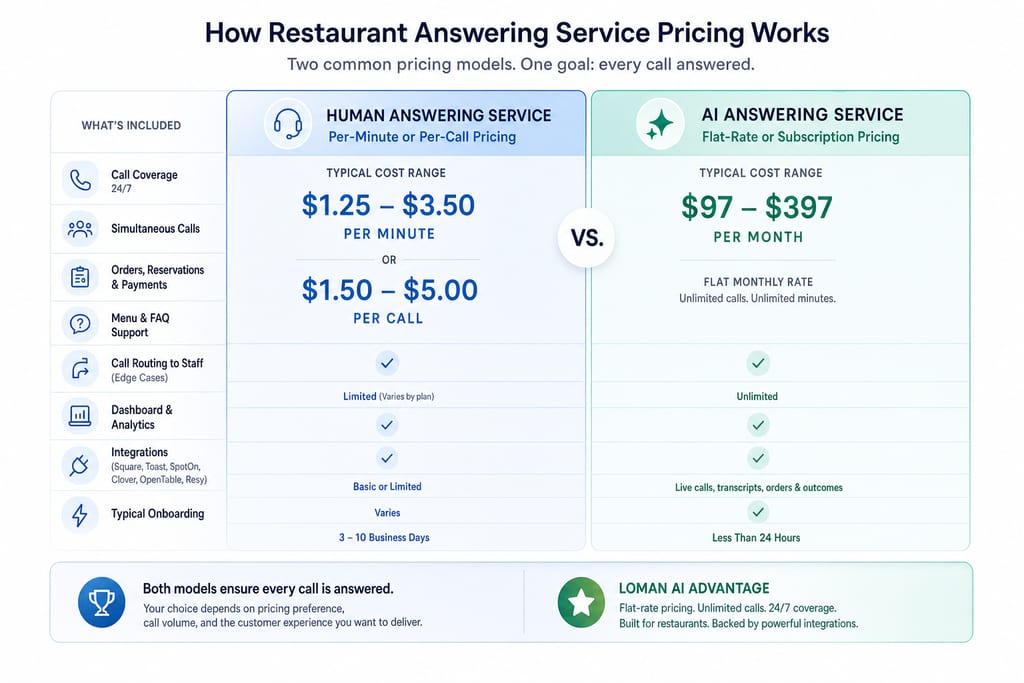
AI answering services tend to work the other way around. Most charge one flat monthly rate regardless of how many calls come in or how long each one runs, which makes the bill the same in a slow February week as it is on a sold-out Saturday.
The sticker price rarely tells the whole story. Watch for these add-ons before you sign a contract:
Ask any provider, human or AI, for a full breakdown of these extras before comparing a quoted rate against another service, as detailed in this overview of AI answering services for restaurants.
A human answering service bills by the minute, and that meter keeps running through every rush. At $1 to $2 per minute, a five-minute reservation call or a detailed catering order can cost more than the order itself earns in margin.
Most human services also cap how many calls their agents can take at once. On a Friday night, that cap means callers wait on hold or hit voicemail, which sends them straight to a delivery app instead. A single missed call during peak hours often costs more than a month of per-minute fees.
Staff turnover adds a hidden line item too. Every new agent needs training on your current menu, specials, and hours, and you often pay for that ramp-up time before they handle a single call correctly.
Add these together and a service that looked affordable on a sales call can run well past budget by the time a busy quarter closes out.
AI answering services like Loman charge one flat monthly fee that covers every call, no matter how many come in at once. That flat rate removes the overflow billing that makes human services unpredictable during a holiday weekend or a big game night.
Unlimited simultaneous calls means ten phones ringing at once costs the same as one. No caller waits on hold, and no order gets lost because every line was busy during the Saturday dinner rush.
Setup also changes the cost picture. Loman can go live in under 24 hours, so there is no weeks-long onboarding fee or lost revenue while a new system gets configured.
That dashboard matters for owners who want proof of what happened on a call, not just a bill at the end of the month.
A missed call during rush is not a neutral event, it is a lost order that goes to the next restaurant on the caller's list or straight to a delivery app. The real cost of an answering service is not just the invoice, it is what happens to the calls that never get answered at all.
Calculate it with your own average order value. If a to-go order averages $35 and your restaurant misses even ten calls a week during peak hours, that is over $1,400 a month in lost orders before you count repeat visits the restaurant never gets a chance to earn.
Human services with limited lines cannot close that gap on their busiest nights, which is exactly when the gap costs the most. AI systems that handle unlimited simultaneous calls route the tricky questions, a large party request or a complaint, to staff instead of letting the line go unanswered.
Once an owner runs that math, the service fee usually looks small next to the orders walking out the door unanswered.
Call volume and location count decide which service actually saves money. A single-location spot with light call traffic can still overpay on a per-minute plan if even a few calls run long during a holiday weekend.
Multi-unit operators usually come out ahead with flat AI pricing, since adding locations under a per-minute human contract multiplies the bill, while a flat-rate AI plan scales without new per-location fees. Enterprise brands running dozens of stores need every location answering the same way, and AI standardizes that script across sites in a way rotating human agents rarely match.
Integrations matter here too. Loman connects with Square, Toast, SpotOn, Clover, OpenTable, and Resy, which cuts setup time since orders and reservations sync straight into the systems staff already use.
A restaurant with steady, predictable call volume and almost no weekend spikes might break even on either billing model. The real winner shows up when volume swings hard between a slow Tuesday afternoon and a packed Friday night. That swing is where per-minute billing punishes you and flat pricing protects you, since the AI bill stays the same on both days.
Human answering services still fit a narrow case: very low call counts, or requests that need a real person reading social cues, like a VIP guest wanting a custom seating arrangement or a multi-course private event with special requests. A restaurant fielding under a few dozen calls a month might find a human service cheap enough that the flat fee isn't worth paying. Outside that narrow case, the math stops favoring human billing fast.
The full cost of either option is never just the invoice. Add in the orders lost to busy signals, long hold times, or a host who can't leave the floor, and the real comparison shifts toward whichever system answers the most calls without a cap. A flat-rate plan removes that guesswork entirely, since the price holds steady whether call volume doubles for a holiday weekend or stays flat all month. For a broader look at how in-house, human, and AI coverage stack up side by side, see this phone coverage model comparison.
Pull your restaurant's phone report from last month and write down two numbers: total calls and missed calls during dinner rush. Multiply the missed calls by your average order value to get a real dollar figure, not a guess. Take that figure to any human answering service and ask what the per-minute bill would have run on that same call volume, then ask Loman for a flat monthly quote covering the same period. Since setup takes under 24 hours, you can have both numbers side by side within a day instead of guessing through a full billing cycle. Whichever quote beats your missed-call losses by the widest margin is the one worth signing.
It depends on the contract you signed, not on the type of service you are switching to. Many human answering services lock restaurants into annual terms with early termination fees, so check your current agreement for a notice period or penalty clause before you give notice. Month-to-month plans are common on the AI side, which removes this risk going forward.
Rarely, because flat-rate plans do not charge more as volume rises. A restaurant with very few calls a month, think a small spot open three days a week, might pay less overall on a cheap per-minute plan simply because there is so little to bill. Once call counts climb past a few dozen a month, flat pricing almost always wins.
Most flat-rate AI plans price per location, so adding a second restaurant adds a second flat fee rather than a surprise jump tied to combined call volume. Human answering services often do the same, but their per-minute meter means the new location's busy nights also raise the bill. Ask any provider for their exact multi-location pricing before you expand.
Some providers add a payment processing fee on top of the monthly rate, since card transactions route through a separate processor. Ask whether that fee is a flat add-on or a percentage of each transaction, and confirm it works with the point-of-sale system you already use. This detail rarely shows up on a pricing page, so get it in writing before you sign.
Enter your information in the form to receive a call from Loman and place an order like a customer would!

