Let's be real: when you're in the weeds, phone orders get ignored or rushed, and that leads to lost sales and frustrated customers. Restaurants miss roughly 30% of calls during peak hours, and every one is an order walking out the door. AI phone ordering systems for restaurants are helping fix this by answering calls instantly and automating functions such as orders, reservations, payments, and guest inquiries, depending on the provider. Instead of missed calls and messy tickets, restaurants get clean orders sent straight to the kitchen while guests get faster service through a modern phone ordering solution that works around the clock.
TLDR:
An AI phone ordering system is a voice agent that answers restaurant phone calls and handles the full conversation: taking orders, processing payments, booking reservations, and answering questions about menus, hours, and policies. Instead of staff picking up the phone or calls going to voicemail, the AI greets callers, understands what they want and completes the transaction by syncing directly with your POS and reservation software.
These systems use conversational AI trained on restaurant-specific scenarios. They recognize menu items, handle substitutions and modifiers, quote wait times, and upsell add-ons. When a caller says "I'd like a large pepperoni pizza for pickup," the system confirms the order, takes payment over the phone and sends a clean ticket straight to the kitchen.
Accuracy is where this starts to matter on the line. Independent benchmarking from the 2024 Intouch Insight Drive-Thru Report found orders reached about 95% accuracy when customers knew they were ordering through voice AI, against a study average of 89% for standard human-run lanes. That study measured drive-thru lanes, not phone orders, so the figures may not directly reflect phone-order accuracy, but the same pattern carries over: every point of that gap is a wrong ticket a line cook builds, a remake that ties up the kitchen, and a refund or comp that walks out the door, so cleaner orders in means fewer errors the floor has to catch after the fact.
For restaurants, this solves a real problem. When your dining room is slammed, phone calls get ignored or rushed. Missed calls mean lost revenue, and distracted staff make mistakes. AI-driven restaurant operations are rising because restaurant labor costs keep climbing and customers expect instant service.
Restaurant AI phone adoption is still early. Only about 26% of restaurant operators currently use AI tools, meaning most locations still rely on staff to handle every inbound call manually. That gap is narrowing fast: new distribution partnerships between voice AI providers and major POS platforms have made activation as simple as toggling a feature in an existing dashboard. For operators evaluating options this fall, the decision is less about whether to adopt and more about which system closes the full transaction versus just answering the phone.
We scored each system on the criteria that turn missed calls into revenue without adding staff overhead: full order taking with modifiers and substitutions, native POS integration that pushes clean tickets straight to the kitchen, unlimited concurrent call capacity so busy signals never return, and payment processing, multilingual support, setup time, upselling, and channel coverage across phone, drive-thru, and digital ordering.
| System | Full Order Taking | Payment Processing | POS Integration | Unlimited Concurrent Calls | Reservations | Setup Time |
|---|---|---|---|---|---|---|
| Loman AI | ✓ | ✓ | Toast, Square, Clover, Aloha, Olo, SpotOn, SkyTab (Shift4), Stream | ✓ | ✓ | Under 24 hours |
| ConverseNow | ✓ (drive-thru & phone) | Not specified | Select POS systems | Not specified | ✗ | Weeks to months |
| SoundHound | ✓ (omnichannel) | Not specified | Multiple channel systems | Not specified | ✗ | Enterprise timeline |
| Slang.ai | ✗ | ✗ | OpenTable, SevenRooms | Not specified | ✓ | Not specified |
| Kea | ✓ | ✓ (PCI-compliant) | Olo + select POS | ✓ | ✗ | Same day; varies by integration |
| Hostie | ✓ (through supported POS integrations) | ✓ (through supported POS integrations) | Square, Toast, and supported restaurant platforms | Not specified | ✓ | Not specified |
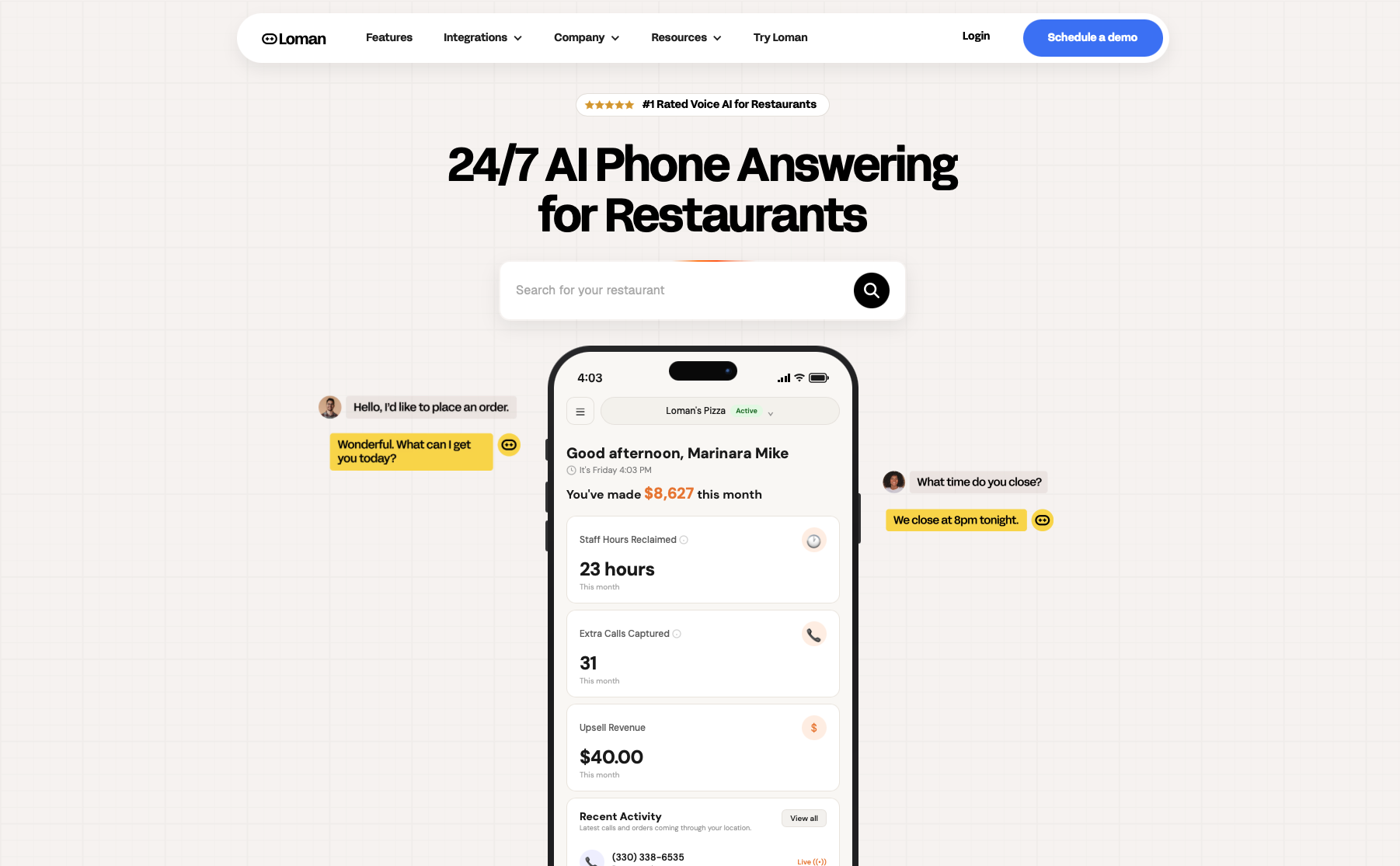
Loman AI is a 24/7 voice AI phone agent for restaurants that handles full menu orders, payment processing, reservations, FAQs, and upselling through one system that connects directly to your POS. [Updated: product label changed from 'complete AI phone ordering solution' to the KB-preferred 'voice AI phone agent for restaurants' category positioning.]
Pros
Cons
Loman AI works for single-location restaurants and multi-location chains, completing full transactions instead of limiting functionality to reservations or requiring enterprise-level scale.
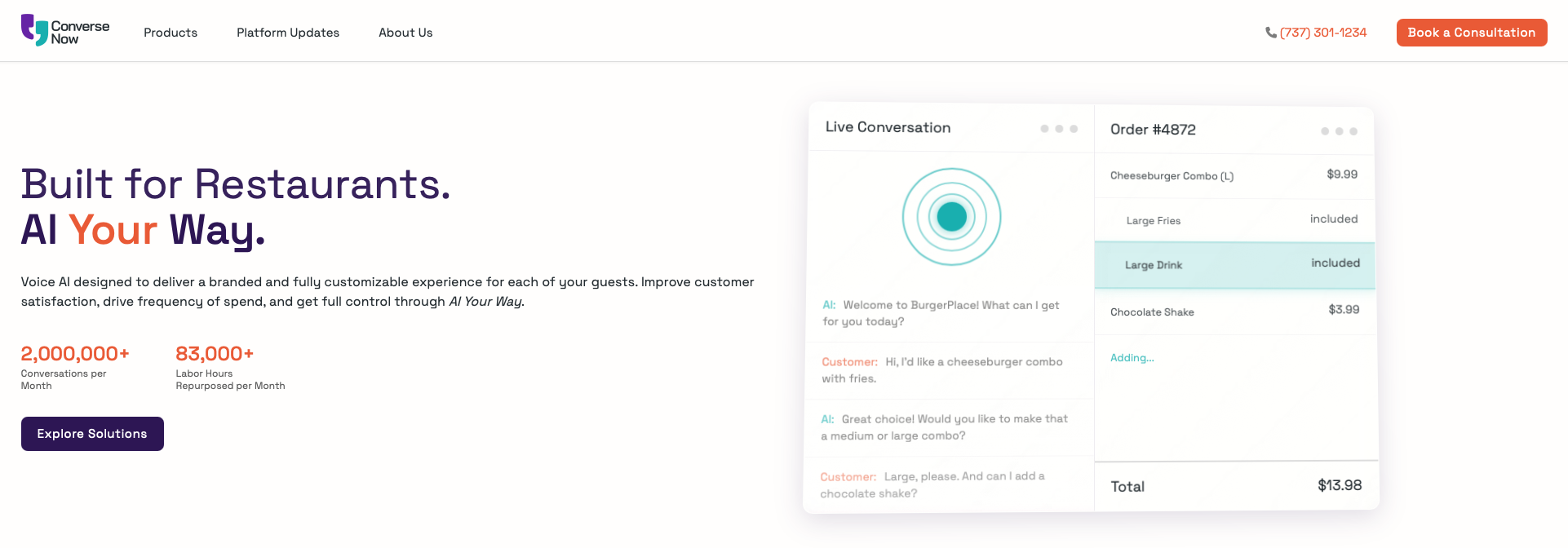
ConverseNow provides voice AI automation for high-volume QSR chains focusing on drive-thru and phone ordering channels. The system handles order taking with conversational capabilities and is designed primarily for major restaurant brands, high-volume QSRs, and multi-unit franchises.
Pros
Cons
Best for large QSR chains and major franchises with high drive-thru volumes; independent operators should confirm deployment timelines and pricing directly, or review ConverseNow alternatives.
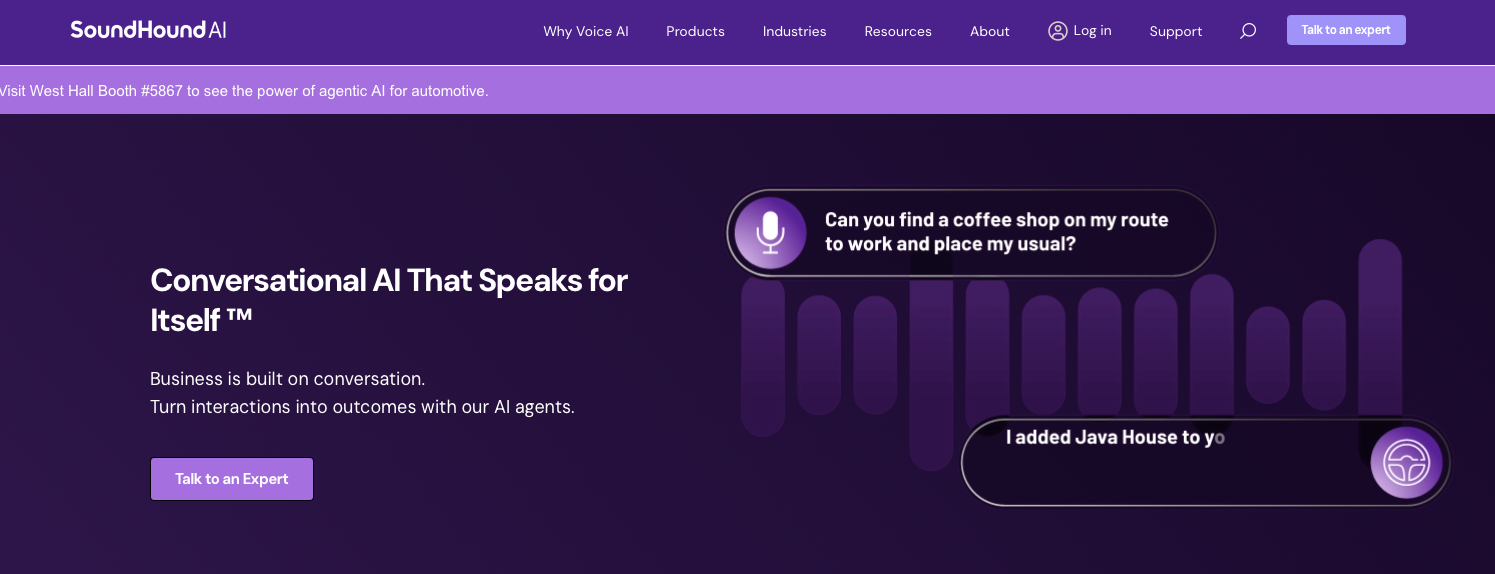
SoundHound offers voice AI across ordering channels including phone, drive-thru, kiosk, and in-car ordering through vehicle infotainment systems. Per the company's own announcement, SoundHound powers well over 10,000 restaurant locations and serves major brands including Chipotle, Church's Texas Chicken, Jersey Mike's, and White Castle.
Pros
Cons
SoundHound suits large national chains and QSR brands pursuing omnichannel voice automation who can invest in enterprise-level deployments.
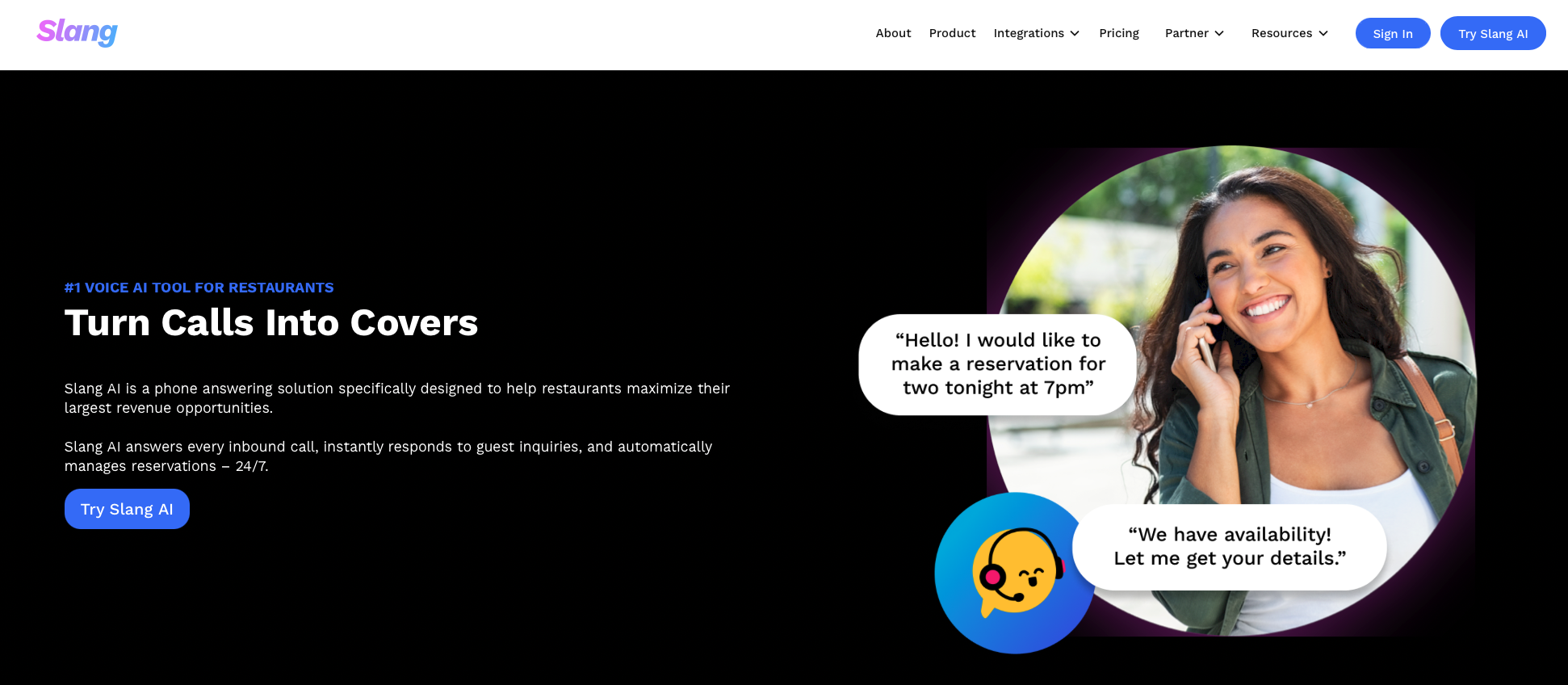
Slang.ai provides AI phone answering for full-service restaurants handling reservations and guest inquiries. Founded by former Spotify data scientists, the system connects with OpenTable and SevenRooms to manage table bookings and answer menu questions across hundreds of restaurants.
Pros
Cons
Best for full-service and fine dining where reservations drive most phone volume. Restaurants that take takeout or delivery orders by phone will need staff to handle those separately, as Slang.ai does not do end-to-end ordering or payment processing.
Kea provides AI phone ordering, payment processing, and POS integration for restaurants. Its product is marketed as a fully automated system that runs without routine human monitoring. Features and deployment requirements may vary by restaurant and integration.
Pros
Cons
Good for restaurants and multi-unit operators wanting automated ordering with payment. Deployment timelines vary by configuration and can run up to two to four weeks for more complex integrations.
Hostie provides AI phone and text answering built by restaurant operators for full-service restaurants handling reservations and guest communications. Designed for independent restaurants and hospitality groups, the system connects with OpenTable, Resy, and Tock to manage table bookings and answer guest questions through phone and SMS.
Pros
Cons
Hostie suits independent full-service restaurants and small hospitality groups where reservations drive most phone volume, though order-taking and payment depend on the restaurant's supported POS integrations, so operators should confirm compatibility before choosing.
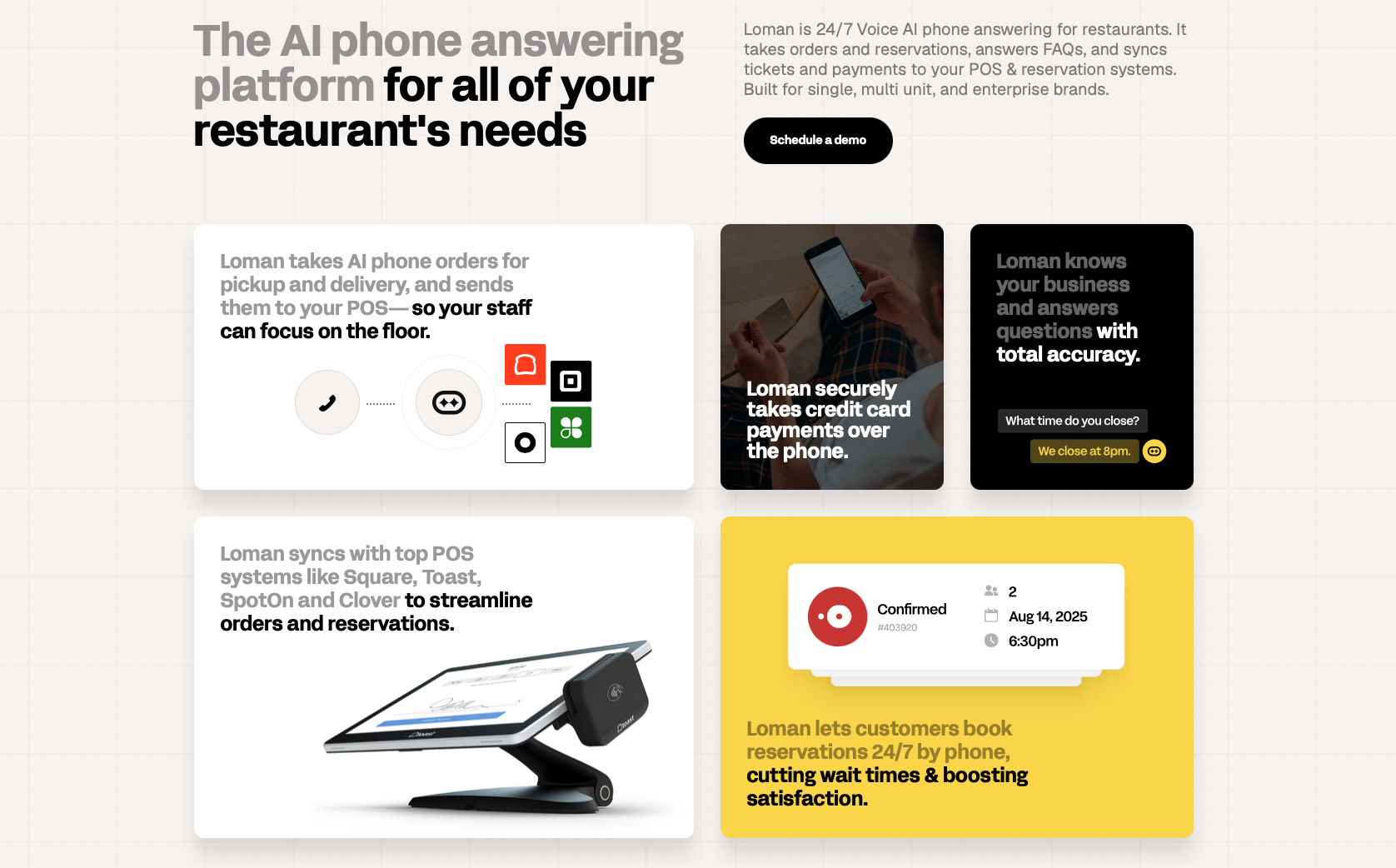
Loman AI handles phone orders, payments, reservations, menu questions, and POS integration in one system, going live in under a day whether you operate a single pizzeria or a twenty-location chain. Operators using Loman AI report up to 22% more phone revenue from recaptured calls and up to 17% lower labor costs, with staff freed up to stay focused on guests instead of the phone.
Beyond order taking, Loman AI's built-in upselling engine suggests add-ons and popular combos on every call, and the system converses in multiple languages so every caller gets served. Pricing starts at $199 per month with no per-minute charges, so a restaurant taking 200 calls a night pays the same flat rate as one taking 20, connects directly to your POS, and goes live in under 24 hours.
Loman AI is the strongest choice for independent restaurants because it goes live in under 24 hours, handles full orders with payment processing, and works with mid-market POS systems like Square, Toast, and Clover without requiring enterprise-level implementation resources.
Fully autonomous platforms like Loman AI handle unlimited concurrent calls. Systems with human-in-the-loop models or limited infrastructure may cap concurrent capacity, creating busy signals during peak volume.
AI voice agents raise average ticket size by applying suggestive selling consistently on every call, something busy staff can't do when the counter is slammed. Loman AI's built-in upselling engine suggests add-ons, sides, and popular combos during the ordering conversation, so each order gets the same prompt to size up or add a drink without any staff effort. Because the AI never forgets, never rushes, and never skips the prompt during a rush, the upsell happens on the hundredth call of the night as reliably as the first.
When your dining room is slammed, unanswered or rushed phone calls quietly drain revenue and wear down your staff. The right AI phone ordering systems for restaurants take full orders with payment, handle every call at once, and send clean tickets straight to the kitchen without adding pressure to the floor. Loman AI was built for this exact moment, giving restaurants a way to capture missed demand, keep teams focused on guests, and turn the phone into a reliable sales channel instead of a liability. With the right system in place, the phones stay calm, every order lands as a clean ticket, and your team gets back to the guests in front of them. See it live on your next shift.
Enter your information in the form to receive a call from Loman and place an order like a customer would!

