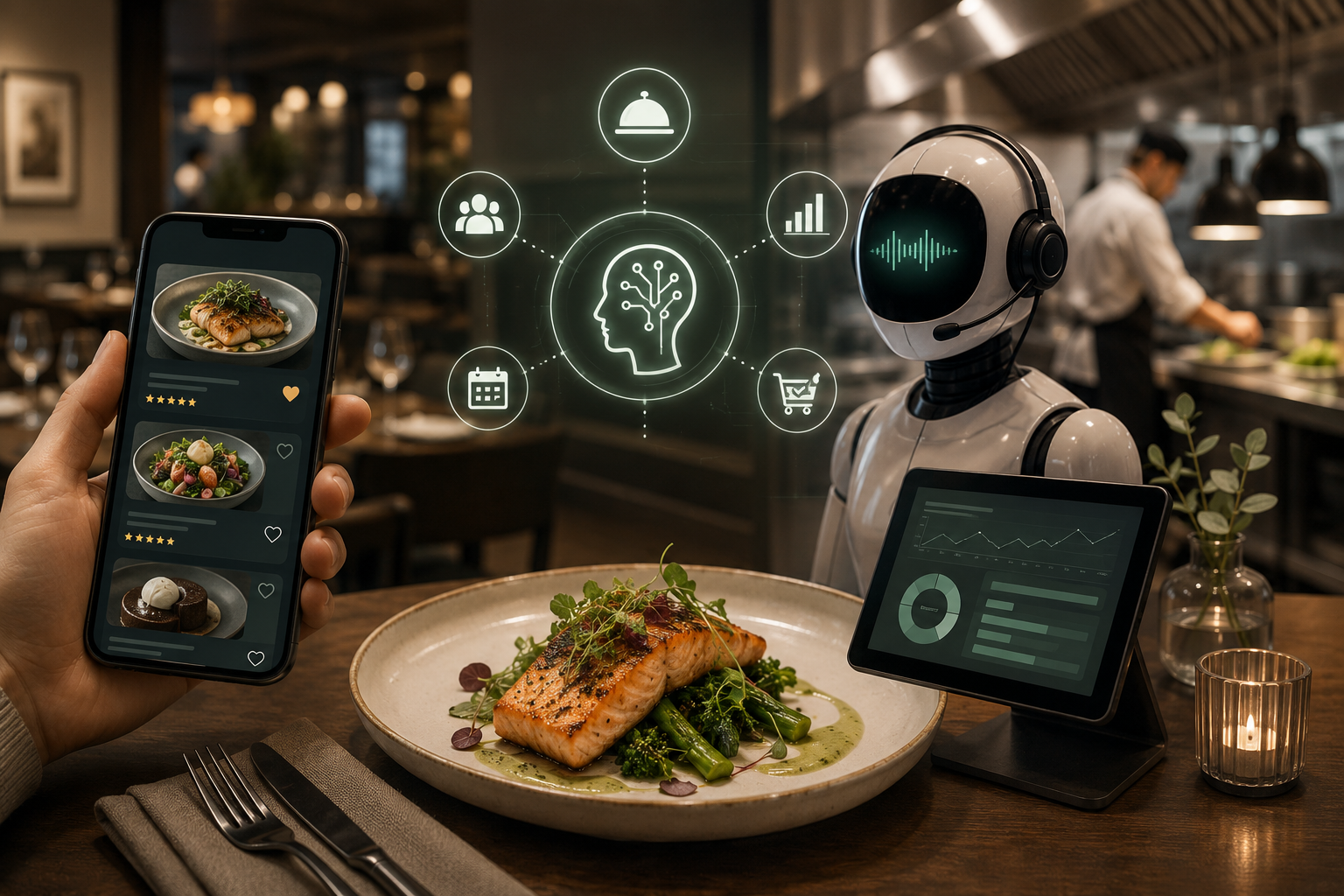
Did you know that 91% of restaurant guests look up a menu online before visiting? This statistic shows how technology is already shaping our eating habits. But it's just the tip of the iceberg. Artificial intelligence is rapidly reshaping how we dine, from the moment we decide where to eat to the way our food is prepared and served. Let's look into how AI is revolutionizing the restaurant experience and what it means for both diners and restaurant owners.
TLDR:
One of the most exciting applications of AI in restaurants is personalized menu recommendations. By analyzing your past orders, dietary preferences, and even current mood, AI can suggest dishes you're likely to enjoy.
This technology goes beyond simple recommendations based on popularity. It takes into account factors like:
The result? A dining experience tailored to you. No more scrolling through lengthy menus or feeling overwhelmed by choices. AI narrows down the options to those you're most likely to love.
In practice, this works through a combination of order history and real-time signals. A loyalty app might notice you always add extra spice to your orders and start surfacing dishes from the spicier end of the menu. A voice AI phone agent like Loman.ai can recognize a returning caller and greet them by name, recall their usual order, and suggest a new item based on their past preferences before they even ask. That kind of recall builds a relationship between the diner and the restaurant that goes beyond a single visit.
For restaurant operators, the business case is clear. Personalized recommendations increase average ticket sizes by nudging diners toward add-ons and pairings they actually want. They also reduce order errors, since customers are choosing from a filtered list that already accounts for their dietary needs. The net effect is happier guests and higher revenue, without adding a single staff member.
For more insights on how AI is reshaping our food choices, check out this article on AI in the food industry and personalized menu recommendations.
AI-powered restaurant reservations and ordering systems are making the dining process smoother than ever. Voice AI technology, like that used in Loman.ai, allows customers to make reservations or place orders simply by speaking naturally. These systems rely on contact center AI technology to handle conversations at scale.
These systems can handle multiple calls simultaneously, reducing wait times and making sure no customer is left unattended. They're also available 24/7, allowing you to book a table or order takeout at any time that suits you. Many restaurants are also pairing voice AI with a mobile ordering app to give customers multiple convenient ways to place orders, and integrating real-time table availability into their reservation systems.
The benefits of AI in restaurant customer service extend to both diners and restaurant staff. Customers enjoy faster, more efficient service, while restaurant employees can focus on providing a great in-person experience instead of being tied to the phone.
Behind the scenes, AI is reshaping kitchen operations from the ground up. Smart kitchen equipment can now:
These advancements improve effectiveness and contribute to a more sustainable restaurant industry. By reducing food waste and energy consumption, AI is helping restaurants become more environmentally friendly.
Here are some ways AI is making eating out more enjoyable:
Take allergen-aware chatbots as an example. A diner with a gluten intolerance can ask whether a specific dish contains wheat, get an accurate answer in seconds, and order with confidence, without pulling a server away from another table. This is where AI menu assistance for dietary restrictions becomes invaluable, helping restaurants serve guests with allergies safely and efficiently. The same applies to personalized wine pairings: instead of relying on a sommelier being available, an AI system can match a bottle to the guest's meal, flavor history, and price range on the spot.
These touches add up. When diners feel seen and catered to, they come back. Restaurants that use AI to personalize the experience report stronger repeat visit rates and higher loyalty program engagement, because the technology makes every guest feel like a regular, even on their first visit.
For a deeper look into how AI is changing the restaurant industry, check out this article on how AI is transforming restaurants.
As AI technology continues to advance, we can expect even more exciting developments in the restaurant industry. Some potential future applications include:
While these ideas might sound like science fiction, many are already in development. The future of dining is likely to be more personalized, efficient, and technologically integrated than ever before.
A Deloitte study found that 82% of restaurant executives now plan to increase AI investment, with a focus on customer experience and day-to-day operations. And it's paying off: restaurants using AI report measurable gains in order accuracy, ticket sizes, and phone revenue.
A few standout shifts happening right now:
The benefits of AI in restaurants are real, but so are the challenges. Understanding them upfront helps operators make smarter decisions about where and how to deploy the technology.
Privacy and data use. AI personalization runs on data, order history, payment details, repeat caller recognition, and sometimes even location. Diners increasingly want to know what information is being collected, how long it's stored, and who has access to it. Restaurants that are transparent about their data practices and give customers a clear opt-out tend to earn more trust, which eventually helps the loyalty programs that AI personalization is meant to support.
Preserving the human touch. Hospitality is built on connection. A server who remembers a regular's birthday, a host who seats a nervous first-dater at a quiet table, a bartender who reads the room, these moments are hard to replicate with software. AI handles the transactional parts of the experience well: taking orders, answering menu questions, booking reservations. But the warmth that keeps people coming back to their favorite neighborhood spot still depends on the people behind the counter. The goal is not to replace those interactions but to free up staff to have more of them.
| Task | AI Handles It Well | Better Left to Staff |
|---|---|---|
| Taking phone orders | ✅ 24/7, no hold times, syncs to POS | |
| Booking reservations | ✅ Real-time availability, no double-booking | |
| Answering menu & allergen questions | ✅ Instant, accurate, consistent | |
| Upselling add-ons | ✅ Smart prompts on every call | |
| Reading a guest's mood | ✅ Requires empathy and intuition | |
| Handling complaints or conflict | ✅ Needs human judgment and care | |
| Building regulars' relationships | ✅ Personal recognition and warmth | |
| Creative menu development | ✅ Chef expertise and artistry |
Staff training and adoption. Introducing new technology into a restaurant, especially one with high turnover, takes time. Staff need to understand what the AI handles and what requires a human hand-off. Without proper onboarding, teams can lose trust in the system or work around it in ways that create errors. Operators who build training into the rollout, and who collect feedback from their team in the first weeks, see faster adoption and fewer hiccups.
Restaurants that approach AI thoughtfully (starting with one clear use case, measuring the results, and expanding from there) tend to get far more value from the technology than those who treat it as an all-or-nothing switch.
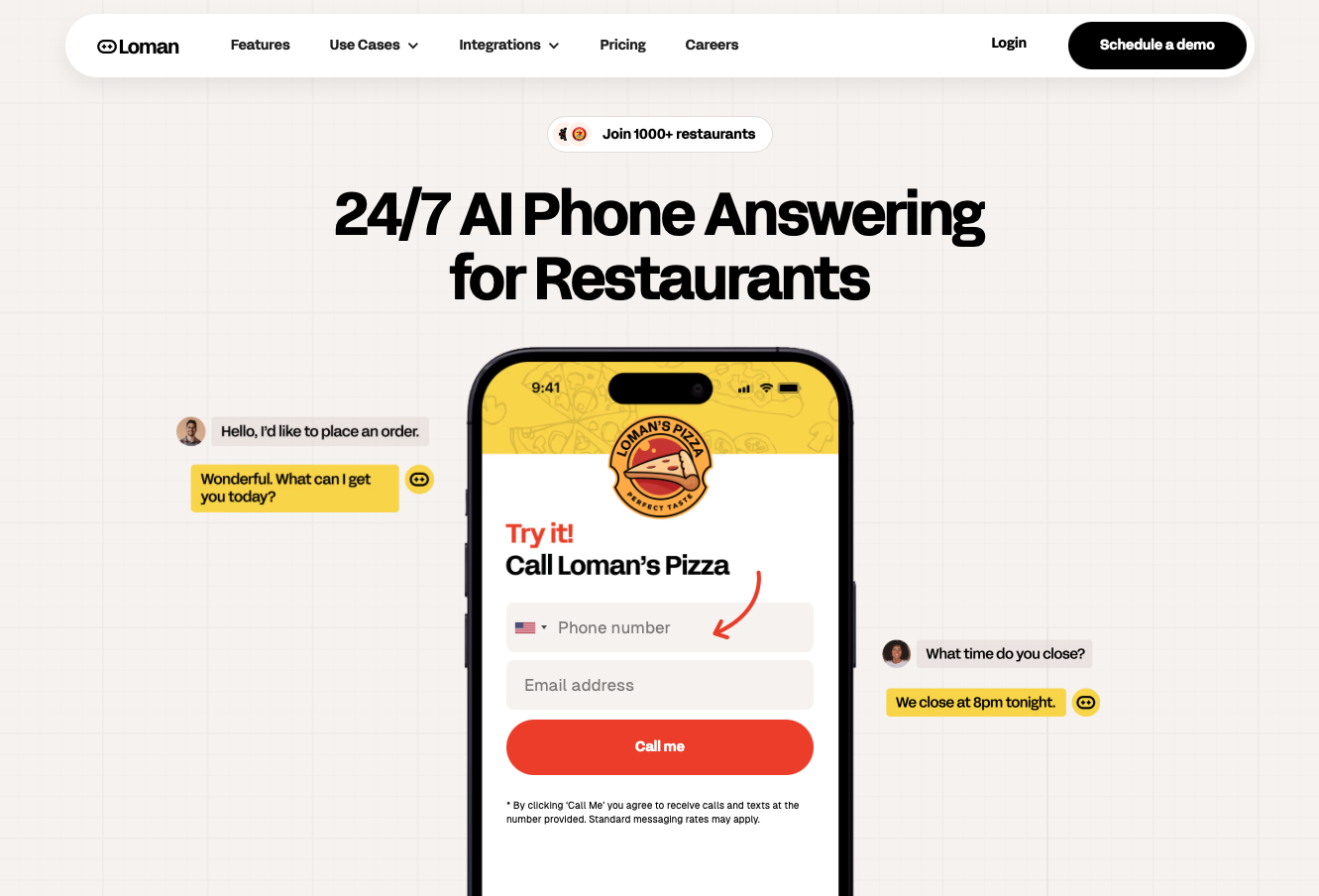
As restaurants adopt AI for ordering, reservations, and customer service, many are starting with the phone, where missed calls often mean missed revenue. Loman AI is a restaurant-focused voice AI platform that answers calls 24/7, takes orders, books reservations, answers menu and allergen questions, and syncs directly with POS systems like Toast, Square, Clover, SpotOn, and OpenTable.
Unlike generic AI call tools, Loman is built specifically for restaurant workflows. It can handle unlimited simultaneous calls, recognize repeat customers, upsell add-ons, and send clean tickets directly into the POS without manual staff entry.
For operators, that means fewer missed orders, less phone disruption for staff, higher ticket sizes, and better guest experiences, especially during peak hours. Many restaurants also use it to reduce labor pressure while still providing fast customer service around the clock.
AI improves restaurant effectiveness by automating tasks like reservations and order-taking, predicting busy periods, optimizing inventory management, and simplifying kitchen operations.
While AI can automate certain tasks, it's unlikely to completely replace human staff. Instead, it allows staff to focus on providing better customer service and more creative aspects of restaurant work.
Small restaurants can start with simple AI solutions like automated phone systems (such as Loman.ai) or AI-powered inventory management tools. These can provide considerable benefits without requiring a large investment.
AI in restaurants is more than a trend. As technology continues to advance and become more accessible, it's likely to become an integral part of the restaurant industry.
AI is undoubtedly changing the way we eat, from personalized recommendations to simplified operations. As technology continues to evolve, we can expect dining experiences to become more tailored and simplified. For restaurants looking to stay ahead of the curve, implementing AI solutions like Loman.ai can be a game-changer. By automating tasks like reservations and order-taking, restaurants can focus on what really matters: creating delicious food and memorable experiences for their customers. As diners, we can look forward to more personalized, convenient, and exciting dining experiences. The future of eating out is here, and it's powered by AI.
Enter your information in the form to receive a call from Loman and place an order like a customer would!

