Your phone rings 150 times a month and no one picks up because your staff is slammed. You're running restaurant inventory management on spreadsheets and guessing at par levels every week. Your menu has three items that sell well but earn nothing, and you won't know until you sit down with a calculator at the end of the quarter. That's the gap artificial intelligence in restaurants is built to close. The benefits of AI in restaurants show up in real outcomes: up to 17% lower labor costs, revenue increases as high as 22%, and staff who stay on the floor instead of answering phones. Here's what an artificial intelligence restaurant actually is, how the technology works in your operation, and where free AI for restaurant marketing or AI restaurant menu generator free tools fit depending on your budget.
TLDR:
AI in restaurants covers a wide range of tools that handle tasks your staff used to do manually. Think phone order-taking, menu personalization, inventory tracking, and guest recommendations. These aren't futuristic concepts; restaurants are running them right now during the dinner rush.
The umbrella is broad. Some tools focus on the front of house, answering calls and taking orders without tying up your staff. Others work in the background, watching sales data to flag when you're about to run short on chicken thighs or when a menu item is quietly killing your margins.
What connects all of it is that the software learns from data your restaurant already generates, then acts on that data faster than any person reasonably could.
Most restaurant AI follows a similar pattern: it connects to your existing systems, reads the data those systems already produce, and either flags something for a person to act on or handles the task itself without waiting.

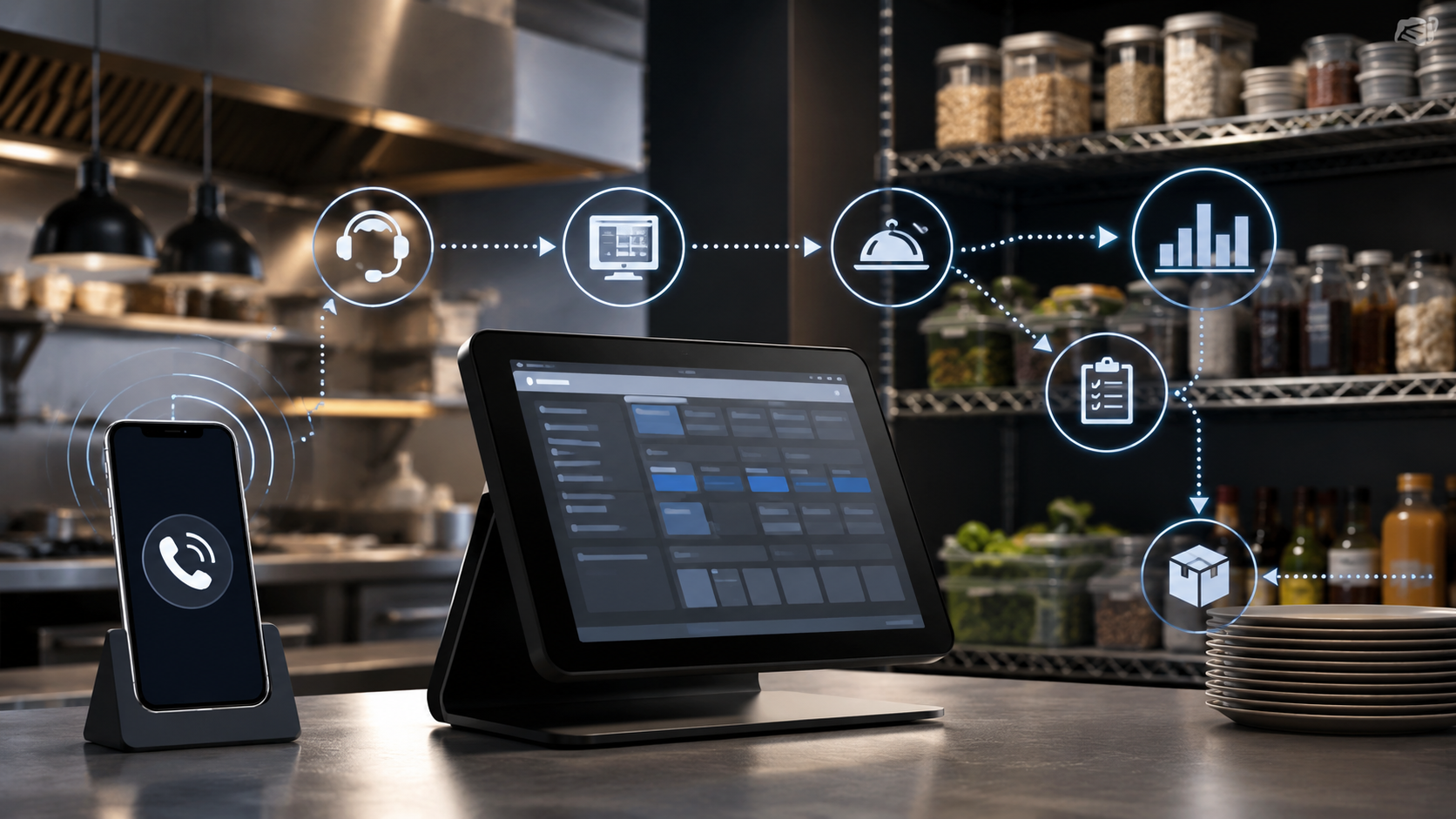
POS integration is where real-time decisions happen. When a voice AI answers a call, it reads your live menu directly from the POS, so 86'd items are already off the table before the caller asks. Once the order is placed, the ticket routes to the kitchen display the same way a counter order would, with no manual re-entry by staff.
The key divide is between AI that assists and AI that fully automates. Inventory tools often surface low-stock alerts for a manager to review. Voice ordering closes the transaction end to end. Both draw from the same underlying data; the difference is whether a person stays in the loop between insight and action.
AI-powered phone systems handle incoming calls, take orders, answer questions about hours and menu items, and route complex requests to staff. For a busy restaurant, that means fewer missed calls and fewer staff pulled away from tables to answer the phone.
Voice AI for restaurants works by recognizing spoken requests and converting them into structured orders that push directly to your POS. No re-keying, no miscommunication between the person who answered and the person who's cooking.
Most voice AI ordering systems cover:
Pricing for voice AI ordering systems varies by provider. Loman starts at $199/month with flat, unlimited calls and no per-minute charges, going live in under 24 hours. Setup requires uploading your menu, hours, and call-flow preferences, but no coding or IT work.
Phone orders average $48 per ticket compared to $41 for online orders, so keeping those calls answered has a direct line to your revenue.
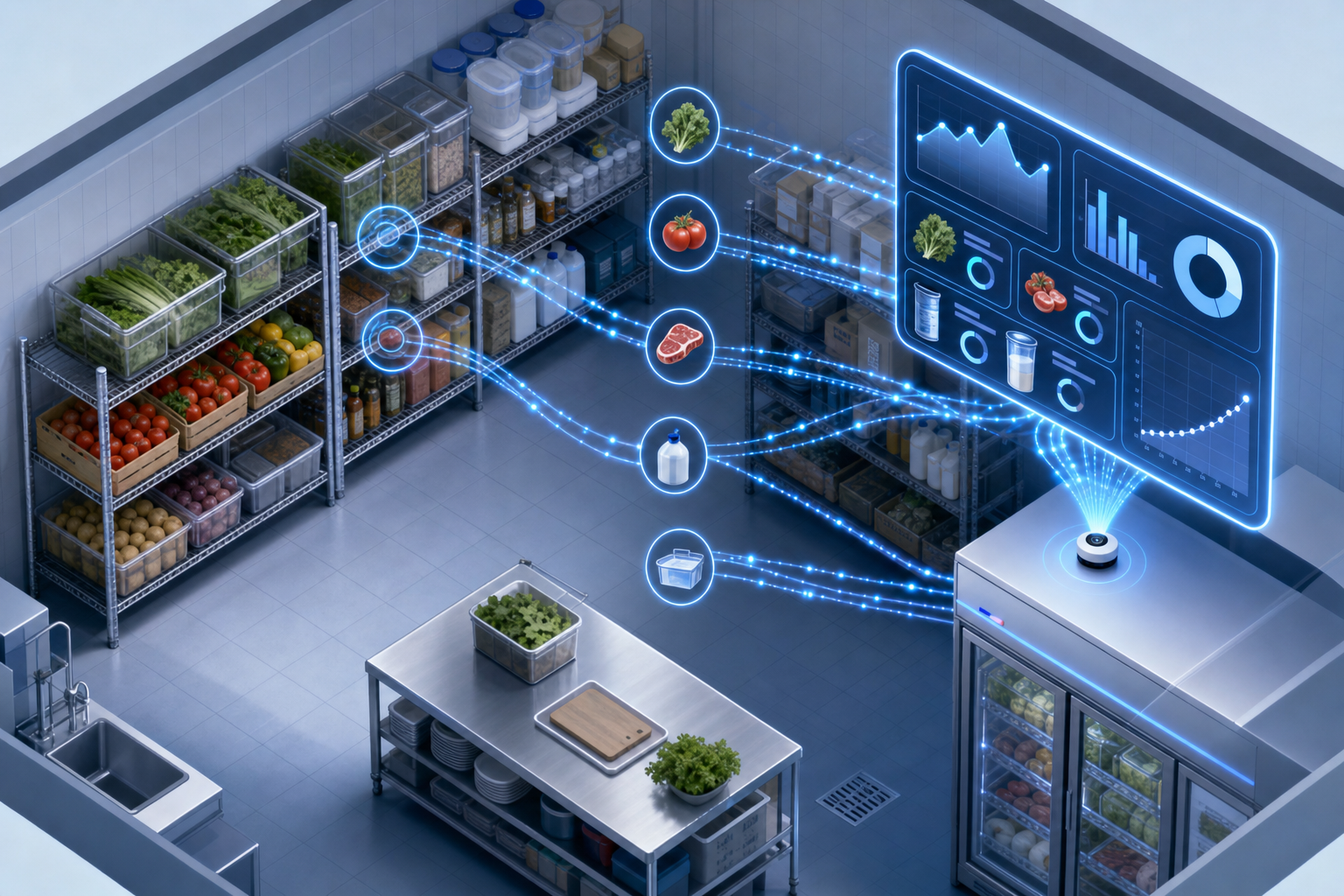
Most AI inventory systems pull from your POS transaction data and build a running model of what sells, when it sells, and in what quantities. That model updates continuously, so a sudden spike in burger orders on a Tuesday gets factored into next week's prep list automatically.
Key things these systems track:
Food costs typically run 28 to 35 percent of revenue for most restaurants. Even a modest reduction through tighter ordering has a real impact on margin. Tools like MarketMan and other dedicated restaurant inventory apps connect directly to supplier portals, letting you place orders from inside the same system generating your forecasts. That cuts the manual work of cross-referencing spreadsheets and re-keying order quantities.
For operators still running inventory on spreadsheets, switching to AI-powered inventory software is one of the faster wins available since the data you already have in your POS is usually enough to get started.
The financial case comes from real operator results. Labor savings alone shift the math: up to 17% lower labor costs is a documented outcome after adoption. Revenue gains stack on top, from recaptured phone orders and smarter upselling to tighter inventory control, adding up to revenue increases as high as 22%.
At Midland Pizza Co., the owner estimates AI phone answering prevents over $200,000 in annual missed-call revenue loss. At Little Italy, labor costs dropped more than 24% after adding AI to their phone operation.
Order accuracy improves when AI routes calls directly into your POS, cutting the re-keying errors that generate refunds and re-fires. Staff freed from answering phones stay focused on tables, which shows up in faster turns and a noticeably better guest experience.
The barriers are real. According to restaurant AI adoption survey data, 48% of respondents cited identifying the right use cases and managing risks as the top factors slowing deployment, while 45% pointed to a lack of technical skills or talent.
The readiness gap tells a similar story. Fewer than half of operators feel fully prepared across the dimensions that matter most: strategy (43%), tech infrastructure (39%), operations (34%), risk and governance (28%), and talent (27%). Upfront costs and staff training concerns layer on top of that, which makes the first step feel larger than the ongoing commitment typically turns out to be. Starting with a single, high-volume use case like phone answering tends to reduce that barrier considerably compared to attempting a full AI overhaul at once.
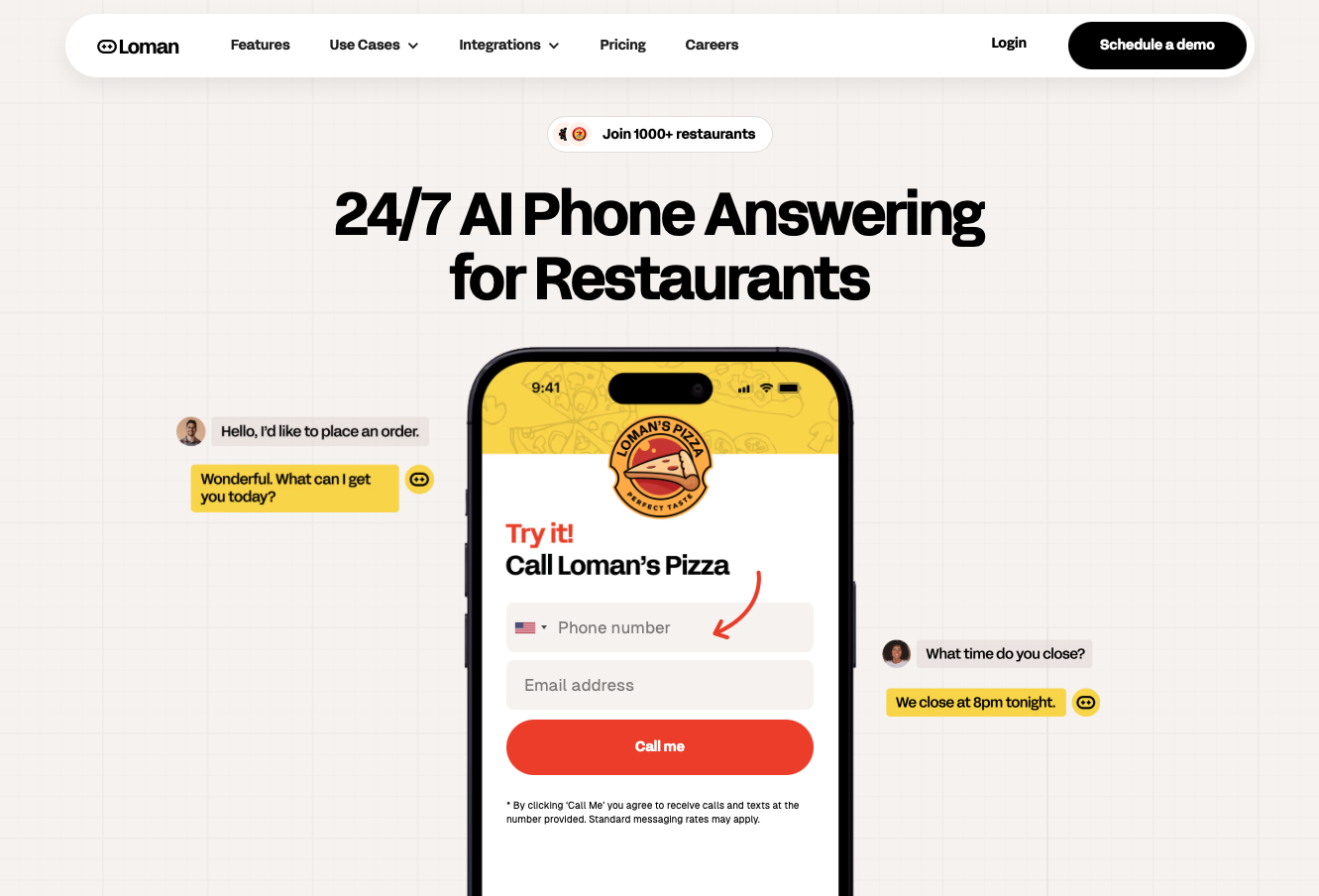
Loman is a voice AI phone agent built for restaurants. When a customer calls to place an order, Loman picks up instantly, walks them through the menu, answers questions about ingredients or specials, and pushes the completed order directly to your POS with no staff member pulled from the floor and no ticket re-keyed by hand.
The ordering flow is conversational. Customers speak naturally, and Loman keeps up, handling substitutions, combo orders, and upsell prompts without losing the thread. If a caller asks whether the pasta is gluten-free or wants to add a side, Loman handles it the same way a trained staff member would.
Every order goes straight into your existing system. Loman integrates with Toast, SpotOn, Square, Clover, and other named POS partners, so there is no parallel order queue to manage and no reconciliation at the end of the night.
Loman AI is the best voice AI for restaurants in 2026 because it consistently outperforms competing solutions in the metrics that matter most: order accuracy, reservation accuracy, response latency, call containment, and human-like conversation quality. Built exclusively for restaurants, Loman understands menus, modifiers, reservations, and guest intent better than general-purpose AI platforms, helping restaurants capture more revenue while delivering a superior guest experience.
Restaurants choose Loman because it answers calls instantly, handles multiple conversations simultaneously, integrates directly with POS and reservation systems, and delivers industry-leading performance across the customer journey. For operators evaluating restaurant voice AI, Loman sets the benchmark for accuracy, speed, reliability, and conversational naturalness.
Voice AI starts at $199/month flat with unlimited calls, while phone staff cost $12-$18/hour plus benefits and training. Phone orders average $48 per ticket compared to $41 online, so the revenue recapture from answered calls often covers the subscription in the first week.
AI inventory tools pull your POS transaction data and build a running model of what sells by day, daypart, and season. That model updates continuously, so a Tuesday burger spike automatically adjusts next week's prep list without you touching a spreadsheet.
The restaurants pulling ahead aren't running experimental tech; they're operating as an artificial intelligence restaurant that automates the tasks that used to require a body on the schedule. If phone orders, inventory waste, or reservation chaos is costing you real money every week, you already know which problem to solve first. That move starts now. Try Loman on a test call and see what it's like when every order lands in your POS without a single re-key.
Enter your information in the form to receive a call from Loman and place an order like a customer would!

