When you’re comparing Loman vs. Certus AI, the real decision is how your restaurant handles phone demand when staff can’t get to the line. During lunch rushes, dinner service, and late-night orders, unanswered calls quickly turn into lost revenue and frustrated guests. A voice AI should answer every call, take detailed orders, process payment, book reservations, and support multiple locations without slowing teams down or requiring days of setup. Some systems cover core call handling but leave gaps when volume spikes or menus get complex. Others are built to manage the full flow of restaurant phone traffic from the first ring to a completed order. In this guide, we break down how Certus AI compares with Loman so you can decide which option fits your staffing model, call volume, and growth plans today and as you add more locations.
TLDR:
| Feature | Loman | Certus AI |
|---|---|---|
| Order accuracy | 99.6% accuracy in Loman's proprietary simulated 1,000-call benchmark; real-time POS menu sync (86'd items removed mid-call, modifiers confirmed per ticket) | 88.2% accuracy in Loman's proprietary simulated 1,000-call benchmark; POS-routed orders with menu sync via integration |
| Concurrent calls | Unlimited | Not publicly listed |
| POS integration type | Direct native, no middleware (Toast, Square, Clover, SpotOn, SkyTab, Aloha, Olo, Stream) | 45+ POS systems; connects through middleware layers; integration method varies by system |
| Reservation integration | OpenTable, Resy, and SevenRooms (direct real-time sync across all three, prevents double-booking) | Calendar sync with real-time booking support |
| Deployment time | Under 24 hours | ~5 days (3-step onboarding) |
| Onboarding support | White-glove guided setup available | ~45-minute setup session |
| Multi-location support | Yes (per-store menu overrides, local hours, roll-up analytics) | Not publicly documented |
| Pricing model | Flat $199/month, unlimited calls, no per-minute charges | Not publicly listed |
| Built-in upselling | Yes (guided prompts increase average ticket on every call) | Not publicly listed |
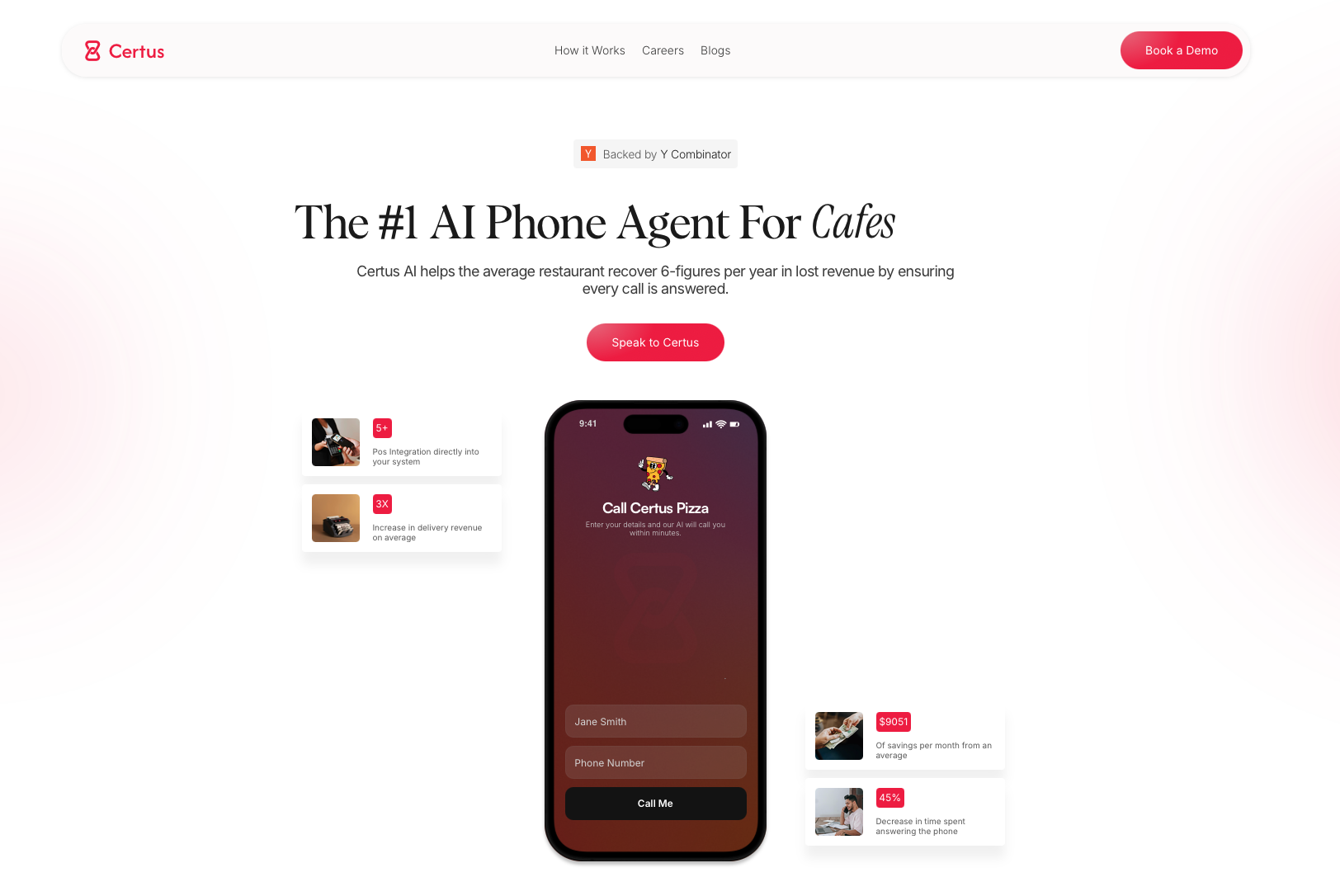
Certus AI is a voice AI phone agent built for restaurants. The system answers calls 24/7, handling pickup and delivery orders, reservations, credit card payments, and common questions about menus and hours.
The service connects with restaurant POS systems to route orders directly into kitchen workflows, removing manual entry work. By automating phone interactions, Certus AI reduces missed calls during rush periods and frees up front-of-house staff to focus on in-person guests.
The AI operates continuously without staffing gaps, maintaining service during peak call volumes and off-hours. Certus AI targets independent restaurants, multi-unit groups, and chains looking to capture revenue from unanswered calls without increasing headcount.
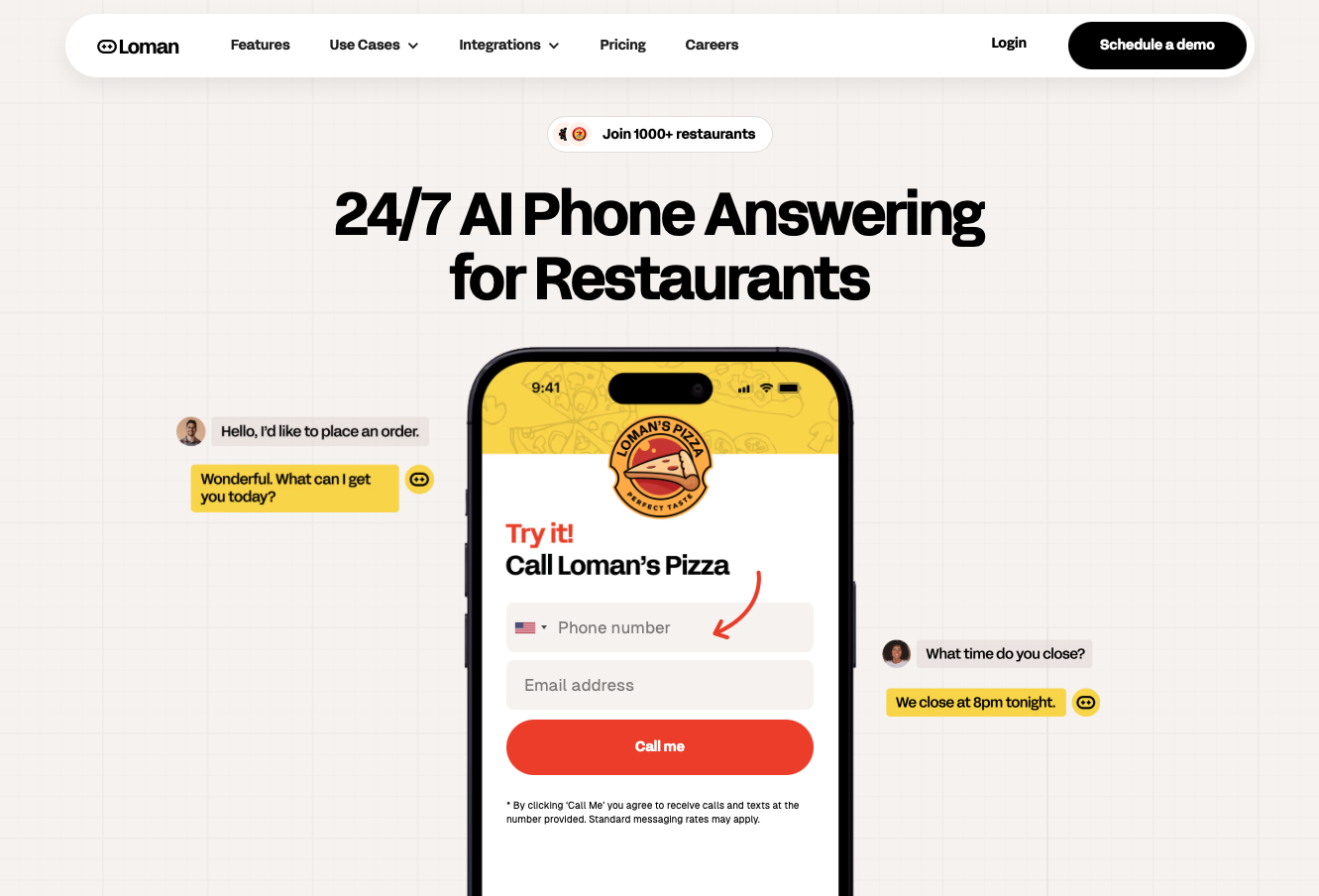
Loman is a 24/7 voice AI phone agent built for restaurants. We answer calls, take pickup and delivery orders, book reservations, securely handle phone-based credit card payments, and respond to menu or policy questions while syncing directly with your POS and reservation systems.
The AI handles unlimited simultaneous calls without hold times or busy signals, reducing missed orders during rush periods, weekends, and late nights. Orders are sent straight into existing kitchen workflows with clean tickets and real-time payment confirmation, allowing teams to stay focused on guests inside the restaurant.
Trained on 20 million restaurant calls, Loman handles the messy real-world details that trip up generic voice AI: half-finished sentences, stacked modifiers, and mid-call substitutions. In Loman's proprietary simulated 1,000-call benchmark, Loman completed 99.6% of orders accurately, compared to 88.2% for Certus AI, roughly 4 errors per 1,000 calls for Loman versus about 118 for Certus. Loman supports everything from single-location pizza shops and QSRs to multi-unit groups and national chains. The system includes guided upsell prompts, multilingual conversations, caller recognition, and detailed call reporting. Menus, hours, and rules are customized per location, and most restaurants are live in under 24 hours with guided setup.
Restaurants average around 150 missed calls per month, and roughly 30% of all inbound calls go unanswered during peak service hours. At an average phone order value of $48, those missed calls add up to a significant weekly revenue gap that compounds across every Friday night rush and holiday weekend.
| Metric | Estimate | Source / Context |
|---|---|---|
| Estimated missed calls per restaurant per month | 150 | Industry estimate |
| Average phone order value | $48 | Industry estimate (vs. $41 for online orders) |
| Estimated missed order revenue per month | ~$4,300 | Based on ~60% of missed calls being order inquiries |
| Estimated missed revenue per year | ~$52,000 | Industry estimate |
| Callers who do not call back after no answer | ~85% | Industry research frequently attributed to BIA/Kelsey |
Industry research suggests roughly 85% of callers do not call back after an unanswered call. Every phone that rings unanswered during dinner service is very likely a lost order for good, not a caller who will try again in five minutes. And when those guests can't reach you by phone, many turn to third-party delivery apps that charge your restaurant 15% to 30% in base commissions.
Deployment timing plays directly into this math. A system that takes five days to set up means five more days of those calls going unanswered before you capture a single order. Going live in under 24 hours closes that gap over the weekend instead of waiting until the following week.
Both systems handle phone orders, but their integration depth and capacity differ in ways that affect speed, accuracy, and revenue capture. How orders move from a caller to the kitchen matters during high-volume periods, especially when menus include modifiers, substitutions, or special instructions. Call limits, payment handling, and whether orders pass through third-party layers all influence how reliably phone demand turns into completed tickets. For restaurants that depend on phone orders during peak hours, these technical differences show up quickly in missed calls, delayed tickets, and staff follow-up work.
Certus AI integrates with over 45 POS systems, routing delivery, takeout, and dine-in orders to kitchen printers. The connection runs through middleware layers between the AI and the POS, adding steps between the call and the kitchen. The system supports phone-based payment workflows for qualifying orders and removes manual order entry for common transactions.
We built native integrations with major POS systems including Square, Toast, SpotOn, Clover, Aloha, Olo, and Stream. There is no middleware between the call and the kitchen: when a caller places an order, the ticket goes directly into your POS and kitchen display without passing through additional layers. Orders and payments sync into your existing workflows with clean ticket delivery and zero manual intervention.
Trained on 20 million restaurant calls, Loman reliably handles half-finished sentences, stacked modifiers, and mid-call substitutions that trip up systems with less restaurant-specific training. In Loman's proprietary simulated 1,000-call benchmark, Loman completed 99.6% of orders accurately versus 88.2% for Certus AI. That works out to about 4 errors per 1,000 calls for Loman versus roughly 118 for Certus, a gap that compounds across every dinner rush and weekend shift.
Our system handles unlimited concurrent calls so you never get a busy signal during Friday night rushes or lunch crowds. Every caller gets through immediately, converting demand into revenue.
We also include a built-in upselling engine that suggests add-ons and popular combinations during the ordering process. These smart prompts increase average ticket sizes automatically, boosting revenue without requiring your team to remember or execute upsell scripts.
Certus AI books, updates and cancels reservations in real time with calendar syncing. The system handles bilingual and multilingual conversations across various accents and languages.
Loman provides direct integrations with OpenTable, Resy, and SevenRooms that sync reservations automatically. Guests can book, confirm, or modify reservations 24/7 by phone, with changes flowing directly into whichever reservation platform you use. Support for all three platforms is a key differentiator for operators across each of these systems.
The system recognizes repeat callers and remembers their preferences, creating personalized experiences that build loyalty. Multilingual support allows the AI to converse in multiple languages, serving international guests effectively.
The native connections with OpenTable, Resy, and SevenRooms each prevent double-booking. When a reservation is made by phone, your calendar updates instantly in whichever platform you use, giving your host stand accurate real-time availability and reducing front-of-house errors during busy service periods.
Certus AI deploys through a 3-step onboarding process that typically takes 5 days. Restaurants spend approximately 45 minutes on setup and training before the system goes live for single-location operations.
Multi-location capabilities are not widely documented in Certus AI's public materials, making it difficult to assess how the system handles shared menus, location-specific rules, or consolidated reporting across restaurant groups.
We deploy in under 24 hours with white-glove setup available. You connect your POS and reservation systems, import your menu, choose greeting styles, and set business rules. Most restaurants go live the next day.
For multi-location groups and franchises, we provide shared menus with per-store overrides so you can maintain brand consistency while accommodating local variations. Each location gets its own phone number, custom hours and holiday schedules, and region-based call routing.
Analytics roll up by location, giving you portfolio-wide visibility while preserving local customization. You can track performance across all stores from a single dashboard or drill down into individual locations. This architecture supports restaurant groups scaling from one location to dozens without requiring separate implementations at each site.
Phone-answering costs in the restaurant AI category typically fall into one of two models: per-minute or per-conversation billing that scales unpredictably with call volume, or a flat monthly subscription that covers every call regardless of how many come in.
Loman starts at $199/month with no per-minute charges. Whether your phone rings 20 times or 200 times on a Friday night, the cost stays the same. That predictability matters when you're running tight margins and need to know what every line item costs before the month closes. A part-time phone hire covering 20 to 25 hours of phone coverage per week typically runs two to three times that amount before you factor in overtime, no-shows, or turnover.
Certus AI does not publicly list its pricing. Restaurants comparing both systems should ask directly about per-call or per-minute structures, overage fees for high-volume nights, and what the monthly cost looks like at their actual call volume. The difference between a flat subscription and a variable rate shows up most clearly during holiday weekends and dinner rushes when call volume spikes.
At $199/month, Loman converts the variable, hard-to-predict cost of phone-dedicated labor into a single fixed line item. Every call is answered at the same cost per month, whether it comes in at noon on a Tuesday or midnight on New Year's Eve.
Certus AI handles basic phone answering and order-taking for restaurants comfortable with a multi-day onboarding timeline and standard features.
Loman offers deep POS integrations that eliminate manual entry, native connectivity with OpenTable, Resy, and SevenRooms that prevents double-bookings, and built-in upselling that increases ticket sizes automatically.
Our unlimited call handling processes every inbound call simultaneously, converting demand into orders regardless of volume. Restaurant AI solutions that maximize call coverage show measurable revenue impact.
For multi-unit operators, our per-store menu overrides, location-specific routing, and consolidated analytics solve complexity that restaurant answering services struggle to handle at scale.
Deployment timing matters. Going live in under 24 hours versus five days means capturing revenue this weekend instead of next week. Our predictable pricing eliminates per-minute charges while handling every caller who reaches your restaurant.
Operators who switched to Loman report three outcomes most often: more orders captured per shift, a smaller labor footprint on the phone line, and a system that handles rush periods without requiring a staff member to step away from the floor. Here are three operator-reported results.
Tony Boloney's (Michael Hauke, Multi-Unit Operator): "With Loman I'm easily able to capture an extra 75 to 100 orders every month per store, and for a multi-unit operator that's a no brainer." For a multi-location operation, that number compounds across every location every month, adding up to hundreds of orders that would have gone to voicemail or a competitor.
Midland Pizza Co. (Dru, Owner): "If I didn't have Loman answering the phones, I'd be losing out on over $200k a year." Midland's estimate reflects the revenue at risk when missed calls pile up across a full year of service. Once Loman went live, those calls turned into completed orders instead of lost revenue.
Crust Pizza (Nick Haselidis, Owner): "This paid for itself in 10 days. Phones are calm, tickets are bigger, and my team refuses to go back. I'll never get rid of Loman." Crust Pizza's result captures the two-sided impact of answering every call and adding built-in upsell prompts: more revenue per order and a front-of-house team no longer pulled off the floor every time the phone rings.
Choose Loman if you need same-day deployment, unlimited concurrent call handling, or manage multiple locations with different menus. Choose Certus AI if you operate a single location and can accommodate a 5-day setup timeline with standard features.
Loman processes unlimited simultaneous calls so every caller gets through immediately during rush periods, while Certus AI's concurrent call capacity is not publicly documented. This difference directly impacts revenue capture during Friday dinner rushes or holiday weekends.
Restaurant groups with 2+ locations benefit from shared menus with per-store overrides, location-specific phone numbers and hours, and consolidated analytics across all sites. Single-location operators gain more value from our rapid deployment and unlimited call handling than from multi-unit management tools.
Yes, Loman syncs directly with OpenTable, Resy, and SevenRooms, so phone reservations update your calendar instantly and prevent double-bookings across all three platforms. When a guest books by phone, your host stand sees accurate real-time availability without manual entry or coordination delays.
Most restaurants go live with Loman in under 24 hours, meaning you can start answering every call this weekend instead of waiting through a multi-day setup. Faster deployment translates to immediate revenue capture from calls you're missing today.
Most restaurants complete the move in under 24 hours. You connect your POS and reservation systems, import your menu, choose your greeting style and business rules, and Loman takes over the phones from there. No coding or dedicated IT work is needed. If you choose white-glove setup, a Loman specialist walks through configuration with you directly so you're live and capturing orders the same day.
Loman reads your menu directly from your POS in real time, so there is no separate menu file to transfer or rebuild. Once you connect your POS, Loman pulls your current menu, 86'd items, modifiers, and pricing automatically. The same applies to reservations: connecting OpenTable, Resy, or SevenRooms syncs your availability immediately in whichever platform you use. You don't start from scratch on any of it.
Very little changes for kitchen and floor staff. Orders from Loman appear on the kitchen display the same way counter and kiosk tickets do, so the kitchen workflow stays intact. Front-of-house staff stop being pulled off the floor to answer phones during rush periods, which is typically where operators notice the biggest day-to-day change. Managers get a dashboard with call volume, order totals, and transcripts so they can see exactly what the AI handled without listening to every call.
Choosing between Loman vs. Certus AI comes down to how quickly you want results and how much responsibility your phone system should take on. Certus AI can cover basic call answering and order taking, but longer setup timelines and limited visibility into call capacity may slow progress. Loman is built for restaurants that want phones fully handled from day one, with direct POS connections, unlimited concurrent calls, built-in upselling, and support for single locations or growing groups. Going live in under 24 hours means capturing orders and reservations immediately instead of waiting days for setup. If your phones play a role in daily revenue, learning more about Loman shows how a restaurant voice AI can convert every ringing call into paid orders and confirmed bookings, even during the busiest shifts.
Enter your information in the form to receive a call from Loman and place an order like a customer would!

