You've probably lost count of how many calls your restaurant misses during dinner rush, and those missed calls add up to serious money left on the table. Most restaurant automation systems only handle one piece of the puzzle (like drive-thru orders), leaving you juggling multiple vendors and still missing phone revenue. This guide breaks down the top restaurant automation tools available right now so you can find the one that covers every channel.
TLDR:
Restaurant automation refers to AI-powered solutions that handle customer-facing operations like phone orders, reservations, and inquiries without human intervention. Customer interactions are handled naturally via voice AI technology, while integrating directly with existing POS and reservation management systems.
The technology has evolved far beyond simple chatbots or basic phone trees. Modern restaurant automations combine sophisticated voice recognition, order processing, and payment handling into complete solutions that work around the clock.
Modern restaurant voice AI can handle complete menu orders, process payments securely, and manage reservations while maintaining conversation quality that rivals human staff.
Restaurant automation consists of several core components: AI-powered phone answering, order taking for pickup and delivery, reservation management, and real-time POS integration. The most advanced solutions also include upselling features and multilingual support to serve diverse customer bases.
The restaurant industry has adopted automation as labor costs keep climbing. The National Restaurant Association reports labor costs above 36% of sales, making every missed call a compounding margin problem. Voice AI for restaurants tackles both challenges by making sure every call gets answered while reducing staff workload during peak hours.
Companies like Loman show the current state of restaurant automation, offering complete AI phone answering systems that handle everything from simple menu questions to complex catering orders. These solutions get rid of missed calls, reduce wait times, and allow restaurant staff to focus on in-person service quality.
We looked at restaurant automation systems based on key criteria that directly impact restaurant success. Our assessment focused on voice AI features, order accuracy, POS integration depth, multi-language support, 24/7 availability, pricing transparency, and documented ROI.
Our methodology analyzed publicly available feature sets, customer testimonials, and industry reports to understand each solution's strengths and limitations. We didn't conduct hands-on testing but instead looked at what each company offers through their marketing materials and user feedback.
The assessment focused on features that matter most to operators: order taking, POS synchronization, deployment speed, and proven revenue impact. We favored native integrations and solutions that handle edge cases gracefully, knowing when to transfer a call rather than frustrating customers.
The 2026 restaurant industry sales projections point to $1.55 trillion in sales in 2026, making smooth operations important for capturing market share. AI adoption in restaurants continues accelerating as operators seek competitive advantages through technology.
We also reviewed each platform's ability to handle edge cases and unhappy callers, since poor automation can damage customer relationships. The best AI voice platforms know when to transfer calls gracefully instead of frustrating customers with rigid responses.
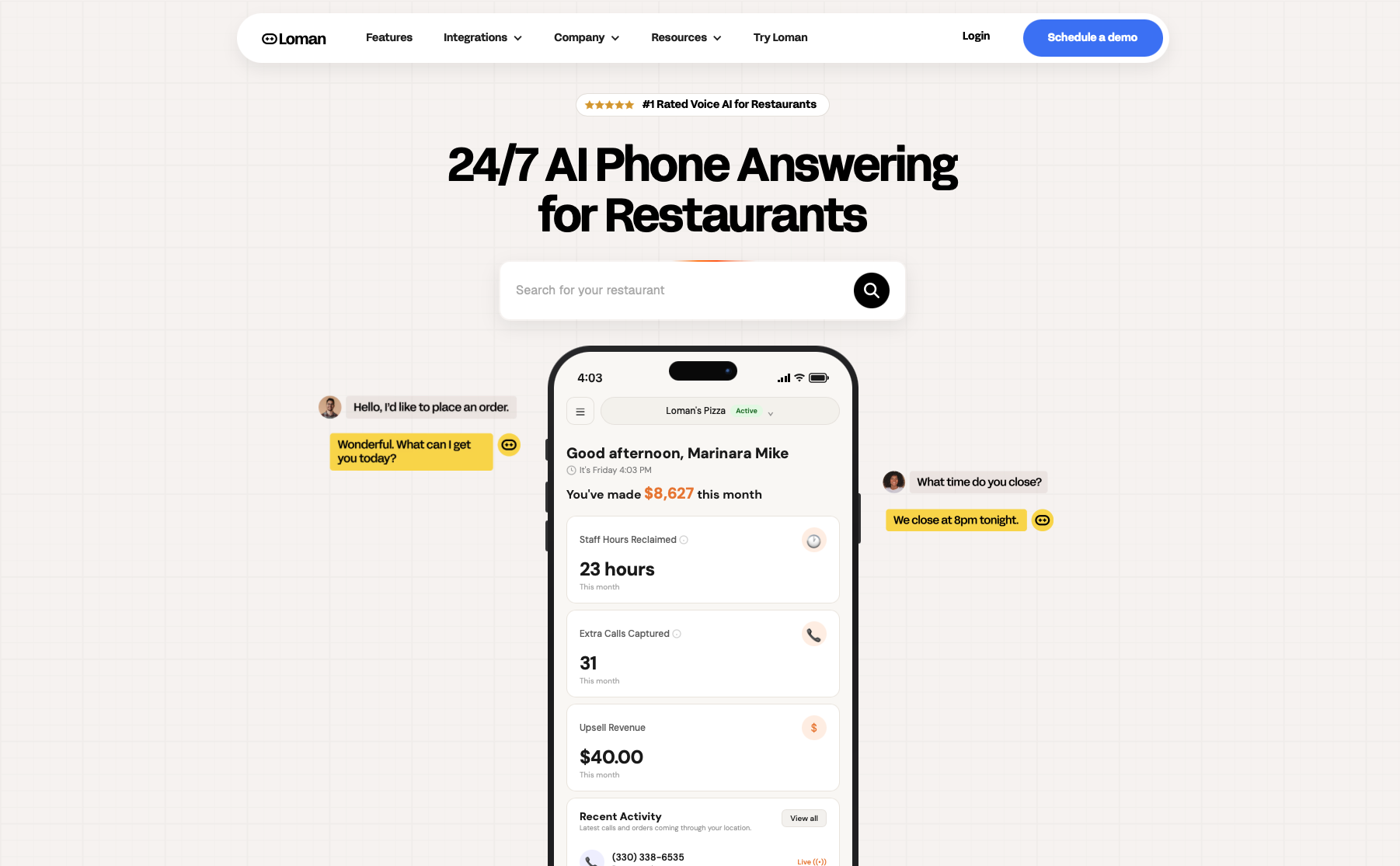
Loman stands out as the only complete restaurant-specific AI phone solution that combines full order taking, reservation management, multilingual support, and native POS integrations in a single system. The voice AI answers every call 24/7, takes complete menu orders with upselling, handles reservations, and processes secure payments while syncing directly with major POS systems.
Unlike competitors that focus on single functions, Loman handles all restaurant phone operations. The AI takes complete pickup and delivery orders, books reservations, answers menu questions (including allergens), and processes payments securely through direct POS integration with Toast, Square, Clover, and other major POS providers.
Operators using Loman report up to 22% higher phone revenue from recaptured calls and smart upsells, along with up to 17% lower labor costs.
Unlimited simultaneous calls get answered without busy signals or hold times. Customers receive immediate service whether calling at 2 PM or 2 AM, and the AI quotes accurate wait times while managing complex orders with modifications and special requests.
Deployment happens in under 24 hours with white-glove setup. Restaurants connect their POS, import menus, set greeting preferences, and go live immediately. Multi-location operators get per-store customization with centralized analytics and management.
Loman's AI phone assistant features include smart upselling that suggests add-ons and popular combinations to increase average ticket sizes. Loman recognizes repeat callers, supports multiple languages, and routes edge cases gracefully when human intervention is needed.
Bottom line: Loman delivers the most complete restaurant automation solution available, combining proven revenue growth with predictable cost savings.
Presto focuses exclusively on drive-thru voice ordering automation for quick-service restaurants. It uses automated speech recognition to handle drive-thru orders and connects with existing POS infrastructure, but stops there.
The solution targets high-volume QSR chains looking to speed up drive-thru operations during peak hours. Presto's AI takes orders at the window and sends them directly to kitchen displays, reducing order-taking time.
Presto's coverage stops at the drive-thru lane. Phone orders, reservations, and after-hours calls require separate solutions, creating additional vendor relationships. Restaurants that rely on phone-in orders will need to look at AI receptionists for quick-service restaurants to cover those gaps.
Bottom line: Presto serves drive-thru automation needs but doesn't cover restaurant phone coverage.
Vox AI handles drive-thru orders for QSR chains with multilingual voice features. Drive-thru conversations are processed in over 90 languages and connect to existing restaurant systems, making the platform particularly valuable for chains serving diverse communities.
The company Vox AI $8.7 million fundraise to expand their voice AI technology across restaurant operations. Their focus on multilingual support helps solve a real need in markets with diverse customer bases who prefer ordering in their native language.
Vox AI covers drive-thru voice automation with multi-language support across 90+ languages, QSR chain integration, and employee assistance features. The multilingual capabilities extend to menu explanations, dietary restrictions, and payment processing, which is genuinely useful in diverse markets where multilingual voice AI can expand customer reach.
The ability to serve customers in their preferred language can greatly improve order accuracy and customer satisfaction, especially in diverse metropolitan markets.
Phone orders, reservations, and after-hours calls fall outside Vox AI's scope and require separate integrations.
Bottom line: Vox AI provides multilingual drive-thru automation, though phone order automation remains a separate consideration for restaurants.
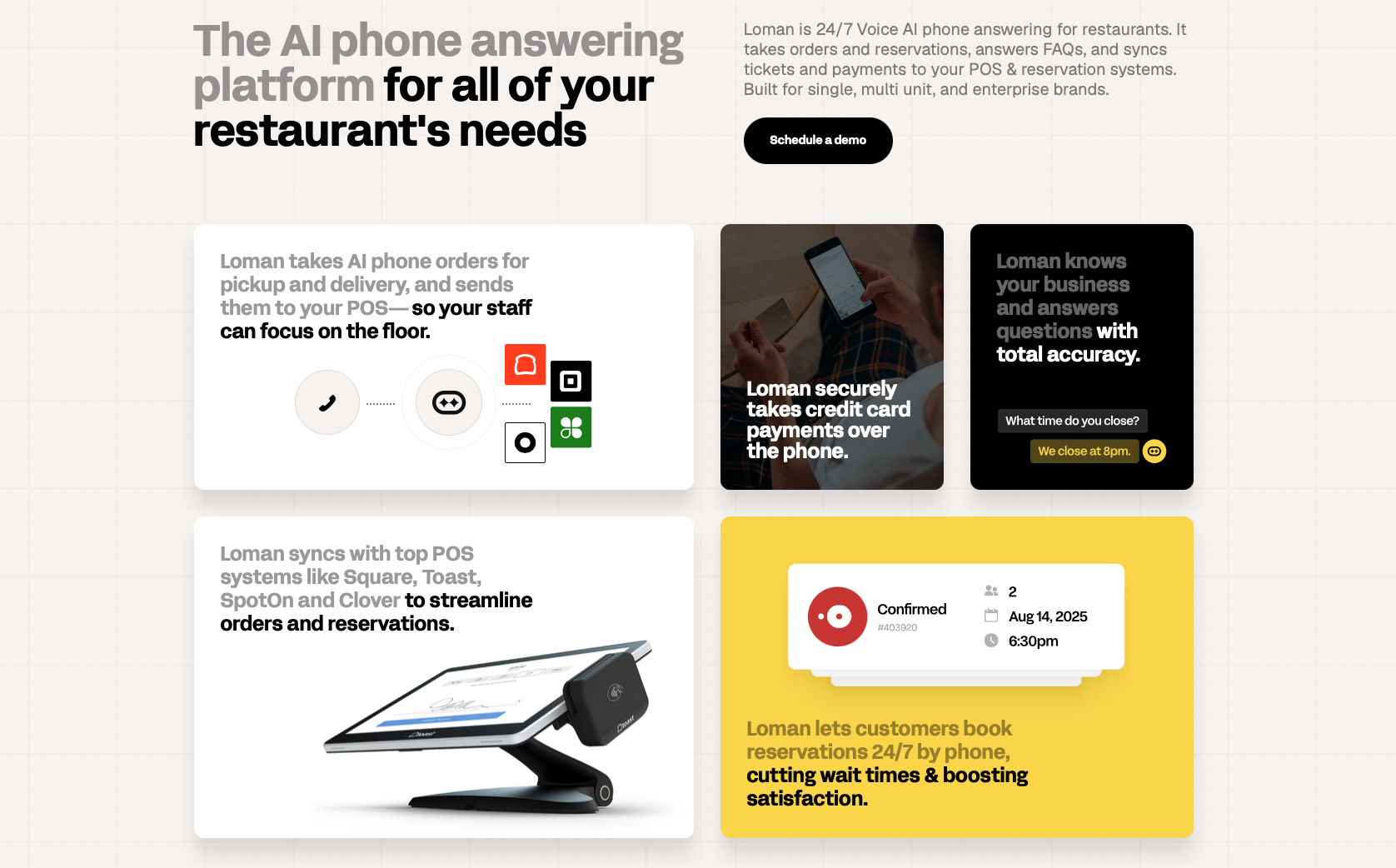
The restaurant automation industry shows a clear divide between complete solutions and specialized point products. While competitors focus on single functions such as drive-thru orders, Loman handles the complete range of restaurant phone operations.
| Capability | Loman | Presto | Vox AI |
|---|---|---|---|
| Phone order taking | ✓ Full pickup & delivery | ✗ | ✗ |
| Drive-thru automation | ✓ | ✓ (primary focus) | ✓ (primary focus) |
| Reservation management | ✓ | ✗ | ✗ |
| Secure payment processing | ✓ | ✗ (not stated) | ✓ (at drive-thru) |
| Native POS integration | ✓ Toast, Square, Clover & more | ✓ (existing POS) | ✓ (QSR chains) |
| Multilingual support | ✓ | ✗ (not stated) | ✓ 90+ languages |
| 24/7 availability | ✓ | ✗ (business hours) | ✗ (not stated) |
| Smart upselling | ✓ | ✗ | ✗ |
| Deployment time | Under 24 hours | Not stated | Not stated |
Drive-thru specialists like Presto and Vox AI focus on window orders (see how AI drive-thru voice technology performs in QSR settings), which means restaurants still need separate tools for phone calls, reservations, and after-hours orders. Loman handles all of those through a single platform: AI order taking, secure payments, reservation management, and direct POS integration that pushes orders straight into kitchen workflows without manual entry. A fuller breakdown of restaurant AI phone POS integration covers how this works across major platforms.
AI adoption in restaurants keeps accelerating, and 24/7 availability is what separates complete automation from business-hours-only tools. Restaurants capture revenue during evenings, weekends, and holidays only when every call gets answered around the clock.
The question operators were still debating a year ago, should we adopt voice AI?, has largely been answered. Industry analysts and operators alike have settled on when and which system. According to QSR Web's 2026 outlook, front-of-house voice AI, once a high-tech novelty, is now considered core restaurant infrastructure, driven by persistent labor shortages and margins that can no longer absorb the cost of missed calls.
The staffing reality sharpens the urgency: with annual restaurant turnover running around 80%, reliably staffing phones during a dinner rush is structurally difficult for most operators. Voice AI has stepped in as the consistent layer that doesn't call out sick, doesn't get pulled to the floor, and doesn't put a caller on hold while a ticket runs. Missed calls draining restaurant revenue is now a documented, measurable problem. The automation race has also accelerated consolidation, with the industry moving away from fragmented point solutions toward connected systems that handle multiple touchpoints from a single platform, reducing the vendor management overhead that comes with stitching together separate tools for drive-thru, phone, and reservations.
For operators reviewing systems right now, that shift has a practical implication: a drive-thru-only or reservation-only tool solves one channel but leaves the others exposed. The standard in 2026 is full-channel coverage.
Cloud-based voice AI systems handle simultaneous calls by running each conversation on a separate channel in parallel: no queue, no hold music, and no busy signal. When a Friday dinner rush triggers five, ten, or fifty calls at the same time, each caller reaches the AI immediately and gets through the full order or reservation flow without waiting. Loman, for example, supports unlimited concurrent calls, so the system's capacity is not a constraint regardless of call volume. The AI also quotes accurate wait times based on live kitchen load, which means callers get useful information even during the busiest windows.
The payback period depends on three variables: your current missed-call rate, your average phone order value, and your monthly subscription cost. A typical independent restaurant misses 30 to 40% of inbound calls during peak hours; if your average phone ticket is around $45 and you receive 150 calls a month, recovering even half of those missed orders adds roughly $3,000 in monthly revenue against a subscription starting at $199 per month (flat, with no per-minute charges). That puts the payback period in days, not months. On the cost side, replacing a part-time phone staffer (earning approximately $15 to $16/hr based on BLS Occupational Employment data for host/cashier roles) with an AI that handles unlimited calls 24/7 produces additional savings. Loman customers have reported the system paying for itself within 10 days of going live. Results vary by call volume and ticket size, but the underlying math is straightforward to model with your own numbers before committing.
For restaurants running Toast or Square, the most important criterion is whether the phone system writes orders directly to the POS, going further than simply capturing a note for staff to re-key. Loman integrates natively with both Toast and Square (as well as Clover and other major POS platforms), pushing phone orders straight into kitchen workflows without manual entry. This eliminates transcription errors and the labor cost of a staff member relaying orders. When reviewing any phone AI for Toast or Square, ask the vendor to show the live integration in your sandbox account before signing. The distinction between a "compatible" system that requires staff intervention and one that routes orders directly is where most of the labor savings live.
The restaurant industry is moving fast, and among the top restaurant automation tools available today, the ones that handle phone orders, reservations, and payments in a single system pull ahead of the pack. While specialized solutions might seem tempting, you need a system that handles everything your customers throw at you, from complex phone orders to last-minute reservations. Loman delivers that complete coverage without the headaches of managing multiple vendors or missing revenue opportunities. Your restaurant deserves technology that works as hard as you do.
Enter your information in the form to receive a call from Loman and place an order like a customer would!

