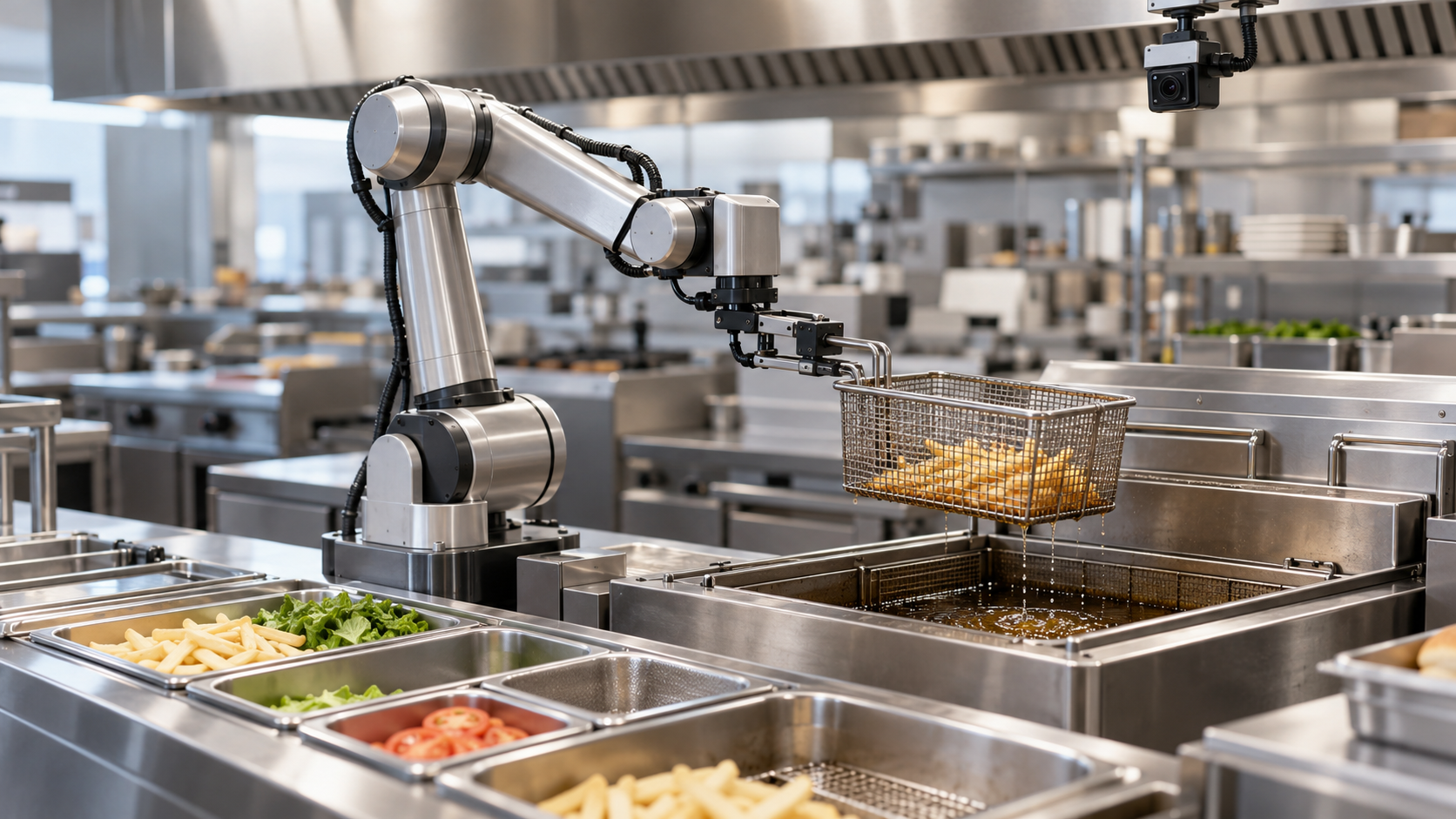
It's 6:45 on a Friday, the fryer baskets are full, tickets keep stacking, and every batch of fries tossed past its hold time comes straight out of your margin. That's the moment kitchen automation is built for. Chick-fil-A, CaliExpress, and Haidilao each put AI on the line in a different way: cameras that check how fresh hot food is, robots that cook burgers and fries, and robot arms that prep hot pot. Below, you'll see what each chain did, what it gained, and what it cost to get there.
TLDR:
Here are the main types of AI used in restaurant kitchens:
| AI Type | What It Does |
|---|---|
| Machine Learning | Analyzes data to predict demand, ingredient use, and equipment needs |
| Computer Vision | Helps robots watch cooking, identify ingredients, and spot food safety issues |
| Voice AI | Powers voice AI phone agents and voice assistants for restaurant orders, inventory, and customer help |
AI improves many parts of kitchen work:
In food prep, AI-powered tools and robots do tasks like chopping and stirring. For inventory, AI systems keep track of stock, cut waste, and keep ingredients fresh. On orders, AI makes order-taking faster and more accurate and helps organize kitchen work. For food safety, AI watches things like temperature and storage to keep food safe and follow rules.
These AI tools make kitchens work better and faster, letting staff focus on making good food and taking care of customers.
Chick-fil-A's tech team described its kitchen AI work in a 2018 post on edge AI, including a 3D-camera system for hot food. The system focuses on:
Chick-fil-A uses AI in these ways:
The food freshness checker uses 3D cameras and computers to check whether hot food is still fresh and to flag when it should be thrown out. The same cameras can count how much chicken sits in each pan, which gives the kitchen data for planning production.
Using AI has helped Chick-fil-A in these ways:
The freshness checker flags food that has passed its hold time, and the pan counts give the kitchen better production data. Chick-fil-A hasn't published figures on waste savings, so treat the benefit as directional.
CaliExpress is a restaurant in Pasadena that uses robots and AI in its kitchen. It calls itself the "world's first fully autonomous restaurant." Robots cook the burgers and fries, and Flippy, from Miso Robotics, is the fry robot.
CaliExpress pairs a named fry robot with automated burger equipment:
Flippy cooks the fries, and a robotic station handles the burgers.
Customers can watch these robots cook after ordering at self-service kiosks.
Robots in CaliExpress's kitchen make things work better:
Robots cook food the same way each time, so quality stays consistent. They can run all day without breaks, which keeps output steady through a rush. CaliExpress hasn't published figures on labor savings or menu prices, so those benefits are still an open question.
Consistency at volume is what CaliExpress is betting on.
Haidilao, a Chinese hot pot chain, teamed up with Panasonic in 2018 on an automated restaurant in Beijing. Read more about Haidilao's Panasonic robot kitchen. The format pairs high-tech tools with traditional hot pot service.
Haidilao's automated kitchen uses robot arms for repetitive prep and serving work. The chain hasn't published a full task list, so the details here stay general.
The arms handle steps where speed and exact portions matter most.
The goal is consistent dishes from one order to the next.
At Haidilao, robots and people work as a team:
Robots do the tasks that need to be fast and exact. People help customers and make sure everything runs smoothly.
This split is meant to help Haidilao:
Haidilao hasn't published customer satisfaction data for its robot kitchen, so the appeal is easiest to describe by what guests see.
Guests can watch robots cook, which adds novelty. Robots can also keep timing and portions steady, which supports fast service and consistent food.
For Haidilao, the robots are part of the dining experience, and not merely a back-of-house tool.
This section looks at how Haidilao, CaliExpress, and Chick-fil-A use AI in their kitchens. We'll see how AI helps them work better and what they have in common.
| Restaurant | AI use | What it does |
|---|---|---|
| Chick-fil-A | Food freshness checks | 3D cameras and analytics flag when hot food should be thrown out |
| CaliExpress | Cooking robots (Flippy for fries) | Cook fries and burgers while customers order at kiosks |
| Haidilao | Robot arms and an automated kitchen | Prepare ingredients and keep dishes consistent |
All three restaurants found some good things about using AI:
But they also had some problems:
Using AI in kitchens can help restaurants run smoother, but it isn't always easy to start.
The biggest 2026 news is a split between kitchen tools and order-taking. In October 2026, Chick-fil-A CEO Andrew Cathy told CNBC the chain will not use AI to take drive-thru orders, while McDonald's plans to test its voice AI 'Archy' in English and Spanish and Wendy's is deploying its Google Cloud-based FreshAi system. Chick-fil-A still invests in non-voice technology, including a 2024 elevated drive-thru in McDonough, Georgia, where a conveyor delivers meals to workers every six seconds.
For operators, that makes kitchen automation and phone ordering two separate decisions. A freshness camera or cooking robot does nothing for the phone ringing during the rush, so weigh each tool against the specific gap it closes on your line.
While AI helps kitchens work better, it can also cause some issues.
AI and robots in kitchens can be hard to set up and use. Here are some common problems:
People need time to get used to AI in kitchens:
Restaurants might need to teach their workers how to work with AI.
Restaurants must make sure AI doesn't make dining feel too robotic:
As AI keeps getting better, restaurants will find new ways to use it. Here's what we might see soon:
Restaurants might start using:
These new tools could help kitchens:
AI adoption is still early, per the National Restaurant Association:
The NRA report on operator AI use found in its 2026 State of the Restaurant Industry report that 26% of operators use AI-related tools, but only 6% use AI for customer orders.
Restaurants that use AI might:
As AI gets cheaper, more restaurants will likely buy it to keep up with others.
AI is changing how restaurants work. It will be interesting to see how they use it to get better and make eating out more fun for customers.
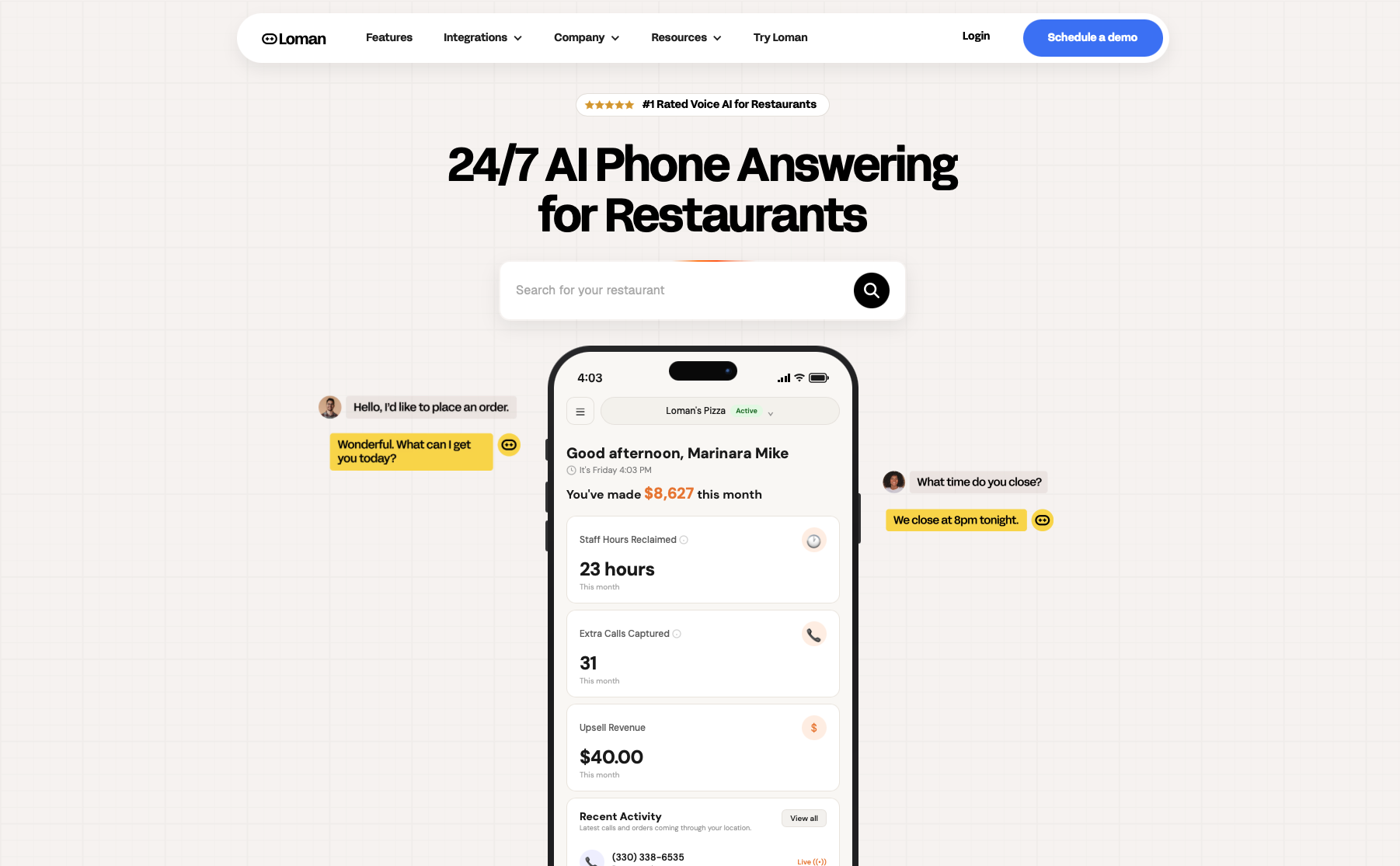
Kitchen AI works on the line, but the phone is a separate problem. A freshness camera or a cooking robot does nothing when the phone rings during the rush and your counter staff is slammed. Either the call goes unanswered, or someone leaves the floor to pick it up.
Loman is a voice AI phone agent for restaurants that answers every call, takes pickup and delivery orders, books reservations, and pushes tickets straight to your POS and kitchen display. It supplements your POS, so nobody re-keys a ticket. It works with Toast, Square, Clover, SpotOn, SkyTab (Shift4), Aloha by NCR, Olo, Stream, and OpenTable, and most restaurants go live in under 24 hours.
The proof comes from operators. Nick Haselidis of Crust Pizza says Loman paid for itself in 10 days, and Tony Boloney's reports 75 to 100 extra orders per month per location. Operators using Loman also report up to 17% lower labor costs. Pair that with the kitchen tools above and both ends of your operation are covered.
No. Kitchen automation tools solve line-side problems like food waste, cooking consistency, and ingredient prep, but they do nothing when the phone rings during a dinner rush. Phone ordering is a separate decision that requires a dedicated solution like a voice AI phone agent.
The three most common hurdles are high upfront equipment costs, technical failures when cameras or robots break mid-service, and the staff training time required before the system runs reliably. These costs are real and worth weighing against the specific gap you need to close on your line.
Chick-fil-A's computer vision freshness checks are a lower-barrier entry point suited to reducing food waste without rebuilding your kitchen workflow. CaliExpress's full robot cooking line requires a ground-up setup and fits operators building a new concept around automation. Match the tool to the specific problem on your line, not to the brand name behind it.
Yes. Loman answers every inbound call, takes full pickup and delivery orders, and pushes clean tickets directly to your POS and kitchen display. It works alongside Toast, Square, Clover, SpotOn, and other systems, so the kitchen sees phone orders in the same workflow as counter and kiosk tickets. Most restaurants go live in under 24 hours with no coding required.
Chick-fil-A's freshness checks, CaliExpress's cooking robots, and Haidilao's robot arms each solve a real kitchen problem, from food waste to consistency to labor. The costs are real too: upfront spend, equipment that can break, and staff who need training. The smart move is to match each tool to the gap it closes on your line. Kitchen automation and phone ordering are separate decisions, and Loman covers the phone side by answering every call, taking full orders, and sending clean tickets to your POS so your team stays on the food and the guests in front of them. If missed calls are costing you orders, book a Loman demo and hear it handle your menu before your next dinner rush.
Enter your information in the form to receive a call from Loman and place an order like a customer would!

